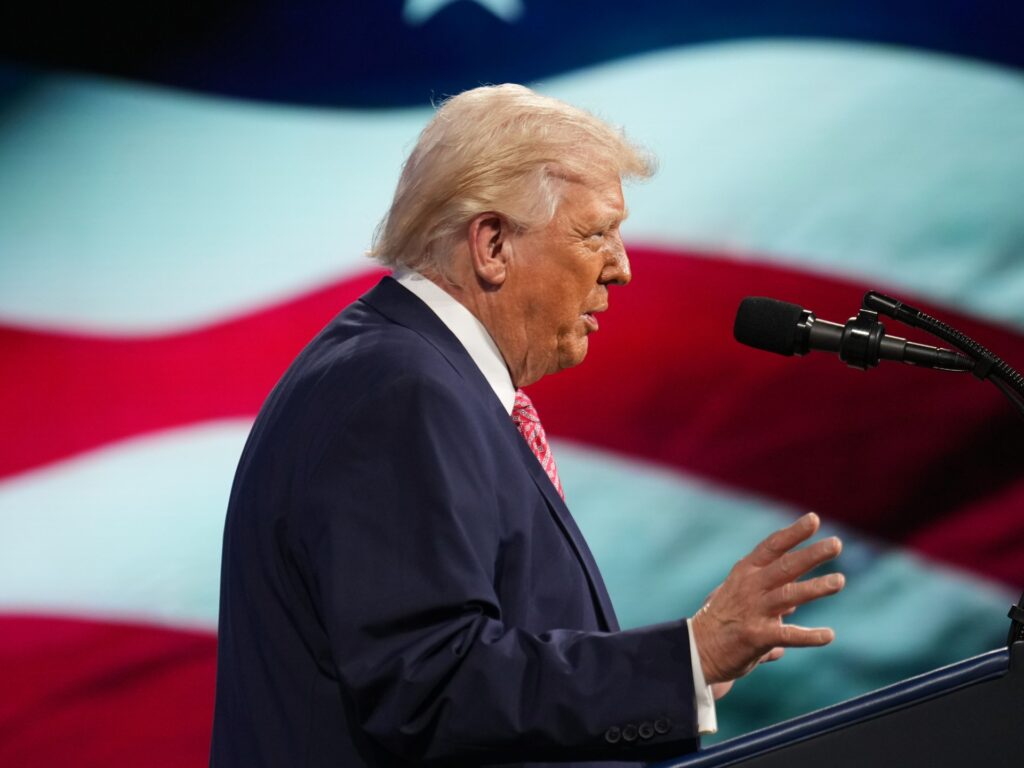
Former President Donald Trump made significant remarks at a recent Saudi investment conference, where he declared that a US-Israeli confrontation with Iran is underway and poised to reshape the Middle East. Trump emphasized that this evolving conflict would soon free the region from Iranian “nuclear blackmail,” signaling a potential geopolitical shift in the area.
During his speech, Trump expressed confidence in the success of the United States and Israel’s efforts, suggesting that the strategic partnership between these nations is central to countering Iran’s nuclear ambitions. He indicated that Iran’s influence, especially through its nuclear program, has long posed a threat not only to the region but to global security.
Trump’s comments come at a time when tensions in the Middle East remain high, with ongoing disputes involving Iran’s nuclear activity and its role in regional dynamics. The US has consistently opposed Iran’s nuclear program, which it views as a destabilizing force, and has pursued various diplomatic and military strategies to curb Iran’s capabilities.
The former president’s message was targeted at investors and policymakers, underscoring his viewpoint that diminishing Iran’s power will create new opportunities for stability and growth in the Middle East. By labeling Iran’s nuclear capabilities as “blackmail,” Trump highlighted his perspective that the Iranian regime uses its atomic ambitions as leverage over neighboring countries and the international community.
Critics of Trump’s stance caution that the prospect of war could further destabilize the already volatile region. They argue that military conflict may exacerbate humanitarian crises and deepen divisions among Middle Eastern nations.
Supporters, however, believe that a strong position against Iran is necessary to ensure long-term peace and security. They point to the historic enmity between Iran and Israel and the broader Sunni-Shia sectarian divides that permeate Middle Eastern politics.
The conversation about Iran’s nuclear program and its role in the Middle East has been ongoing for decades, involving multiple international negotiations and agreements. The Joint Comprehensive Plan of Action (JCPOA), commonly known as the Iran nuclear deal, was a landmark effort aimed at limiting Iran’s nuclear activities but has faced significant challenges and opposition, especially from the US under previous administrations.
Trump’s latest comments add to the complex dialogue about the future of the Middle East, reflecting enduring concerns about nuclear proliferation, regional security, and the consequences of foreign intervention.
In conclusion, Trump’s statement at the Saudi investment conference lays bare a vision of a Middle East transformed through conflict and strategic maneuvering. Whether this vision will materialize or lead to greater instability remains to be seen, but it undeniably reignites discussions about America’s role in reshaping the geopolitical landscape of the region.