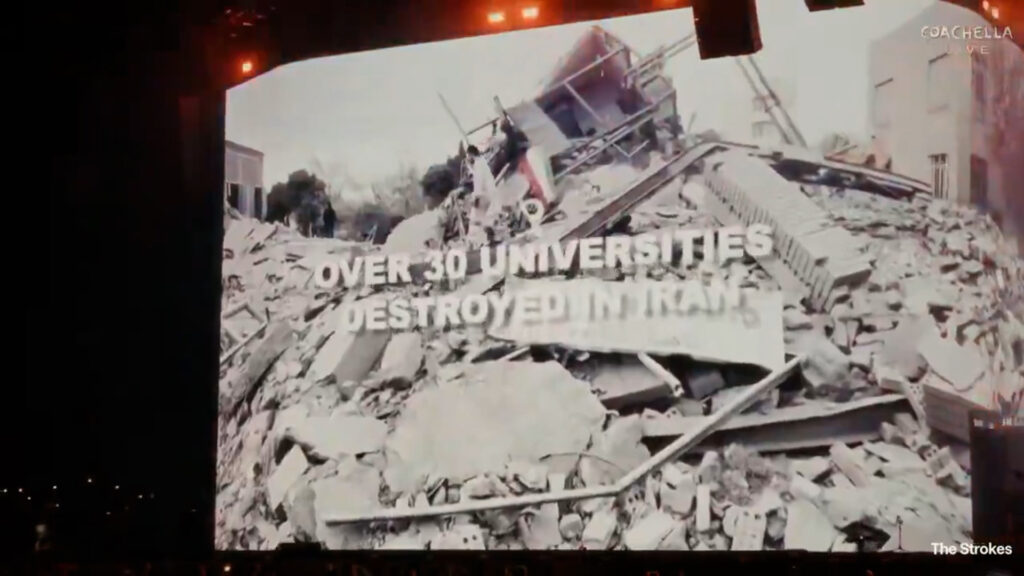
At the recent Coachella music festival, the acclaimed US band The Strokes took an unexpected but powerful political stance by highlighting the devastation of educational institutions in Gaza and Iran. Their performance became more than just a musical act; it served as a platform to bring global attention to the destruction wrought by US and Israeli actions on universities in these regions.
During their set, visual elements underscored the magnitude of damage endured by these centers of learning. Images and footage were projected, portraying bombed-out campuses and shattered classrooms, painting a stark picture of the ongoing conflict’s toll on education.
The Strokes’ move is a rare instance where mainstream artists have used one of the world’s most popular music festivals to comment directly on international conflict and its devastating impact on civilian infrastructure. This act resonated deeply with many festival-goers and online viewers, sparking conversations about the cost of conflict not just in terms of lives lost but also the cultural and educational destruction that affects future generations.
Universities in Gaza and Iran have historically been critical hubs for intellectual growth and cultural development. Their destruction has disrupted countless students’ education and shattered the hopes for rebuilding communities through knowledge and innovation.
By choosing Coachella, a global stage with vast media coverage, The Strokes have amplified the voices of those suffering in these conflict zones. Their performance is a reminder of the broader humanitarian crises that often get overshadowed by political narratives.
Critics and supporters alike have weighed in, some praising the band for their bold statement and willingness to use their influence for advocacy, while others argue that music festivals are inappropriate venues for political messaging.
Regardless of the debate, The Strokes have undeniably succeeded in drawing attention to a critical issue: the destruction of universities as a byproduct of geopolitical strife. This act pushes for a larger conversation on the protection of educational institutions during conflicts and the need for international policies that safeguard the right to education.
As the world watches, The Strokes’ Coachella performance stands as a poignant intersection of art, politics, and activism — demonstrating how cultural platforms can be harnessed to highlight pressing global issues and inspire dialogue among diverse audiences.