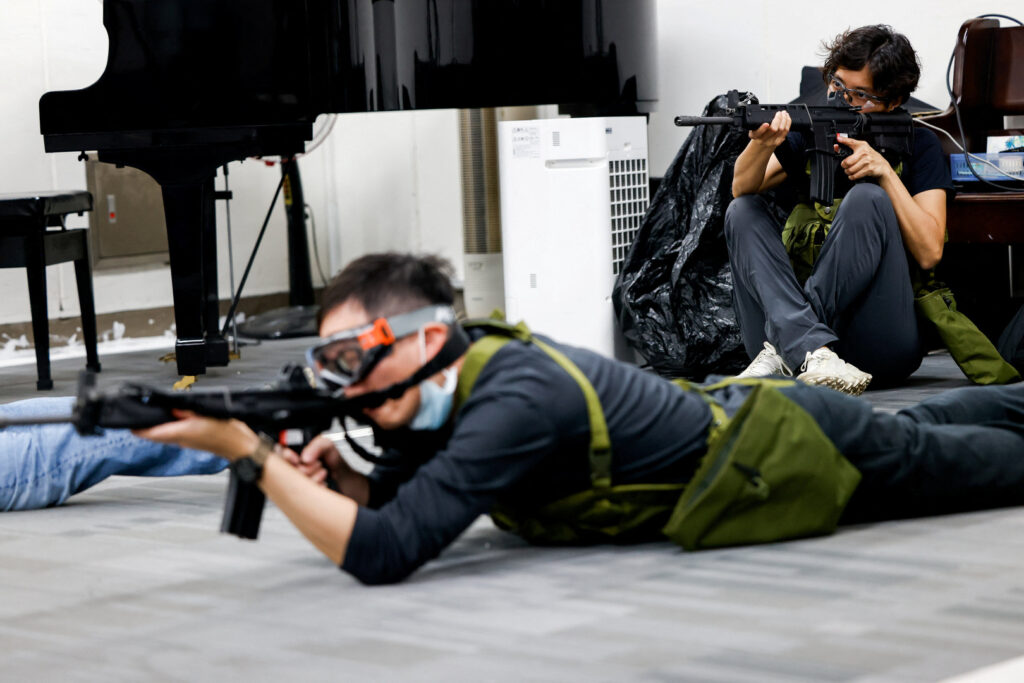
Civilians take part in an airsoft rifle training exercise in Taipei, Taiwan, March 24, 2026. REUTERS/Ann Wang
As the much-anticipated Trump-Xi summit approaches, Taiwanese civilians are increasingly turning to self-defence training in response to rising concerns of a potential Chinese military threat. With tensions mounting between Taiwan and China, many island residents are taking proactive steps to equip themselves with basic defence skills, hoping to bolster their ability to protect their families and communities in the event of conflict.
The Taiwanese government has long maintained a cautious stance in the face of China’s assertive claims over the island, emphasizing the importance of readiness and resilience among its population. Against this backdrop, self-defence classes have seen a significant surge in enrollment, reflecting a collective anxiety about the possibility of Chinese forces attempting to seize control of Taiwan by force.
Local instructors have noted a dramatic increase in demand for courses ranging from martial arts to emergency response training, highlighting a widespread desire among civilians to develop practical skills that could prove vital during a crisis. These programs not only teach physical defence techniques but also focus on situational awareness, first aid, and crisis management.
Community centers, gyms, and even schools across Taiwan have adapted quickly to accommodate the growing interest. Many residents express a sense of empowerment and solidarity as they train together, reinforcing the idea that civilian preparedness is a crucial part of the island’s broader defence strategy.
Experts on cross-strait relations caution that the upcoming summit between US President Donald Trump and Chinese President Xi Jinping may have significant implications for Taiwan’s security environment. While the summit could pave the way for diplomatic advances, it also raises hopes and fears simultaneously—hopes for peaceful resolution, fears of escalating tensions.
Taiwan’s strategic position and democratic values are viewed as pivotal in the Indo-Pacific region, making the island a focal point in global geopolitics. The civilian self-defence movement is seen not only as a reflection of local sentiment but also as an indication of the complex challenges Taiwan faces amid great-power competition.
The widespread participation in self-defence initiatives illustrates a grassroots commitment to sovereignty and safety, underscoring the community’s determination to stand firm in the face of uncertainty. As the world watches the Trump-Xi dialogue unfold, Taiwan’s civilians are quietly preparing, embodying resilience and vigilance at a critical moment in their history.