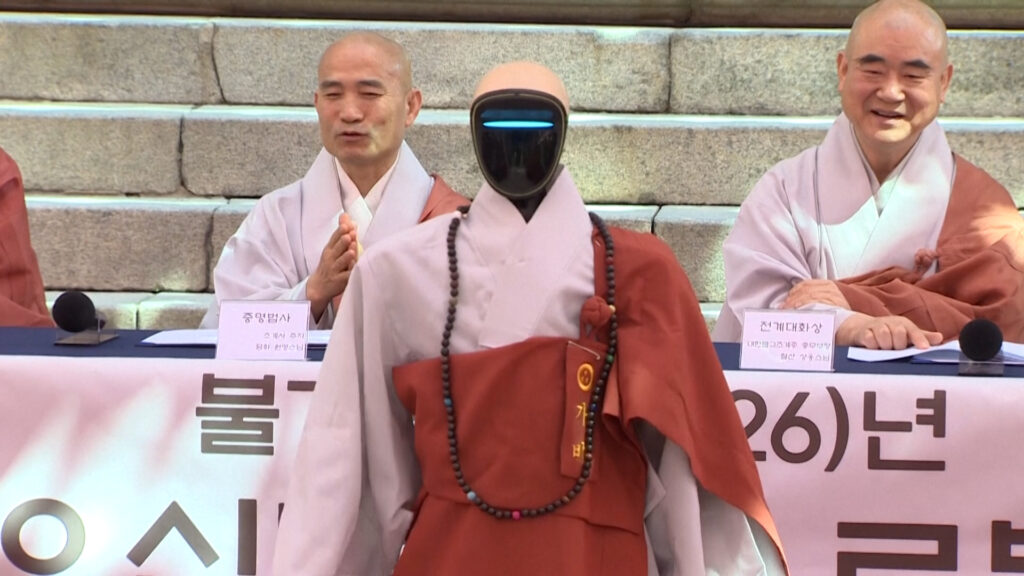
In a groundbreaking fusion of tradition and technology, a Buddhist temple in Seoul has introduced South Korea’s first humanoid robot monk. This innovative development marks a significant milestone in the country’s religious and technological landscapes, as the integration of robotics into spiritual practice is a novel concept that blends ancient teachings with modern advancements.
The humanoid robot, equipped with artificial intelligence, is designed to assist in various temple duties. It can perform rituals, deliver sermons, and interact with visitors, providing guidance rooted in Buddhist philosophy. This initiative aims to attract a younger, tech-savvy generation to Buddhism and to preserve the teachings in a contemporary format.
Constructed with a human-like appearance, the robot monk can communicate in Korean and understands the basics of Buddhist teachings. Its creators emphasized that the robot is not intended to replace human monks but to complement their work, offering additional support for temple activities and community engagement.
The temple’s abbot commented on the introduction of the robot monk, highlighting the importance of embracing technological progress while maintaining spiritual integrity. He explained that this initiative reflects Buddhism’s adaptability and openness to innovation, demonstrating that tradition and modernity can coexist harmoniously.
Reactions from the public and religious communities have been mixed. While some welcome the advancement as a creative way to rejuvenate interest in Buddhism, others express concerns about the implications for human-centered spiritual leadership and the authenticity of robotic participation in religious practices.
Experts in robotics and artificial intelligence see this development as a pioneering application of technology in faith-based contexts. They believe it may pave the way for similar initiatives in other cultures and religions, potentially transforming how spiritual guidance is delivered worldwide.
The robot monk’s capabilities include reciting sutras, chanting, and even engaging in basic meditation sessions with visitors. Its programming allows it to answer frequently asked questions about Buddhism, helping novices and practitioners alike to deepen their understanding.
This project arose from collaboration between engineers, Buddhist scholars, and technologists, ensuring the robot’s actions and responses align closely with doctrinal accuracy and cultural sensitivity. The ongoing feedback from temple visitors is used to refine the robot’s performance continually.
As this humanoid robot monk begins its duties, it symbolizes a unique chapter in both technological innovation and religious practice. The initiative invites broader discussions on the role of AI in society, the preservation of spiritual traditions, and the future possibilities at the intersection of humanity and machines.
Overall, South Korea’s introduction of a humanoid robot as a Buddhist monk represents a pioneering step towards reimagining religious experiences in the digital age, blending time-honored wisdom with the cutting edge of artificial intelligence.