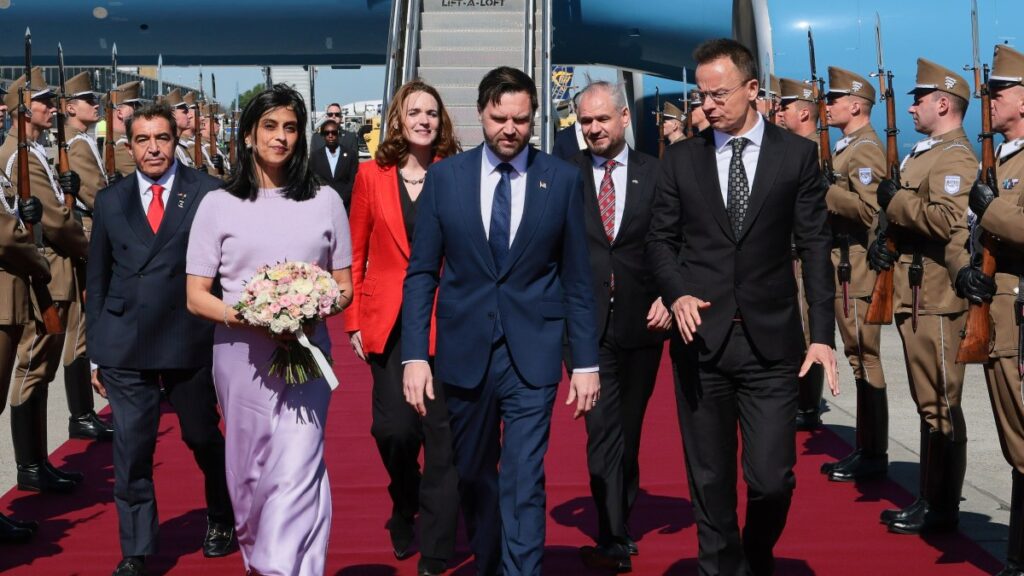
In a significant diplomatic move ahead of the critical Sunday elections in Hungary, U.S. Vice President Vance has arrived in Budapest to bolster support for Prime Minister Viktor Orbán. This visit underscores the deepening ties between the United States and Hungary, particularly highlighting the alignment between U.S. interests and Hungary’s far-right government under Orbán.
Prime Minister Orbán faces his toughest electoral challenge yet, with opposition forces galvanized and public sentiment showing signs of shifting. The presence of the U.S. Vice President is seen as a strategic effort to reinforce Orbán’s position on the international stage and convey a message of strong transatlantic support.
Vance’s visit comes at a time when Hungary’s political climate is intensely competitive. Orbán’s Fidesz party has long been criticized for its nationalist and conservative policies, which have drawn both domestic and international scrutiny. Despite this, Orbán has maintained significant popular support, largely due to his economic policies and firm stance on immigration.
The U.S.-Hungary relationship under Orbán has been notably complex, with cooperation on security and economic interests intersecting with concerns over democratic backsliding. Vance’s engagement in Budapest is therefore also a reflection of broader geopolitical dynamics, wherein the U.S. aims to strengthen alliances in Central Europe amid rising global tensions.
During his visit, Vice President Vance is expected to meet with Orbán to discuss bilateral relations, regional security, and economic cooperation. The visit is also anticipated to send a clear signal to voters and political actors within Hungary that the U.S. remains a committed partner.
Analysts suggest that this diplomatic gesture may impact the election by reinforcing Orbán’s narrative of Hungary’s sovereignty and strategic importance. The timing of the visit, just days before the vote, indicates an effort to influence the electoral outcome positively for the incumbent government.
Opposition parties have criticized the visit, arguing that U.S. intervention undermines Hungary’s democratic processes. However, supporters of Orbán welcome the show of international backing as a validation of his leadership and Hungary’s current political direction.
The Sunday vote will be closely watched by the global community, as its results will not only determine Hungary’s future political landscape but also reflect the regional balance of power in Central Europe.
In conclusion, U.S. Vice President Vance’s visit to Hungary highlights the strategic priority the U.S. places on maintaining strong relations with Orbán’s government despite challenges. As the election approaches, this engagement underscores the intersection of domestic politics and international diplomacy, with significant implications for Hungary and beyond.