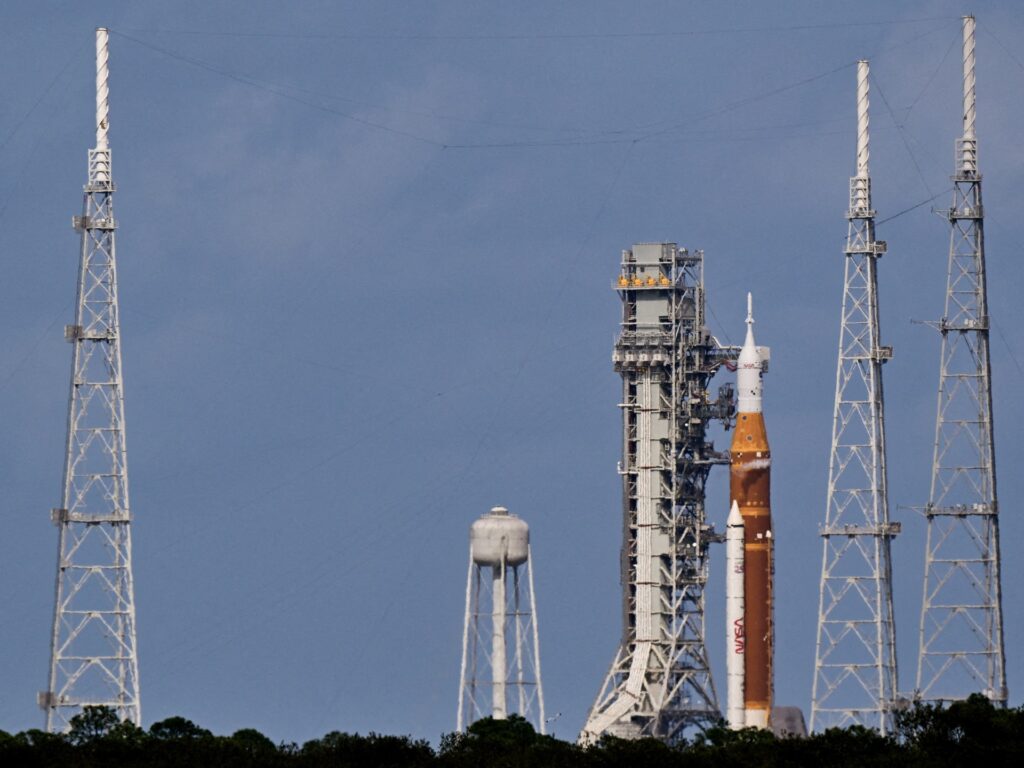
NASA’s Artemis II mission has successfully lifted off, marking a pivotal moment in the agency’s ambitious plan to return humans to the Moon and lay the groundwork for future manned missions to Mars. As the second mission in the Artemis program, Artemis II is a crewed spaceflight that follows the uncrewed Artemis I mission, signifying NASA’s renewed commitment to lunar exploration and beyond.
The Artemis program aims to establish a sustainable human presence on the Moon, which serves as a critical stepping stone for exploration of the Martian surface. Artemis II is designed to carry astronauts on a journey around the Moon, testing vital spacecraft systems and human performance in deep space environments.
Lift-off ceremonies were conducted with worldwide anticipation, showcasing cutting-edge technology and the collaboration of international partners. The Space Launch System (SLS), NASA’s most powerful rocket ever built, propelled the crewed Orion spacecraft into space, demonstrating unprecedented capabilities in launch vehicle technology.
This mission carries four astronauts, including highly trained specialists who will monitor the spacecraft’s systems, conduct scientific experiments, and prepare for future longer duration lunar missions. Unlike Artemis I, which only orbited the Moon uncrewed, Artemis II will feature live communications, human navigation, and operational testing.
The journey includes a lunar flyby that will bring the crew within close proximity to the Moon’s surface before returning to Earth after approximately ten days. This trajectory allows NASA to validate Orion’s life-support systems, navigation, and communication technology, crucial for longer interplanetary voyages.
NASA’s Artemis II also emphasizes diversity and inclusion, with crew members representing various backgrounds and disciplines, highlighting the agency’s commitment to inspiring a new generation of explorers.
The successful launch of Artemis II is not only a scientific and technological achievement but also a symbolic milestone of humanity’s enduring drive to explore frontiers beyond our home planet.
As Artemis II charts this new path, attention now turns toward Artemis III, which aims to land astronauts on the lunar surface for the first time since 1972. The insights and experience gained from Artemis II will be instrumental in ensuring the safety and success of this epoch-making lunar landing.
In addition to lunar goals, NASA’s ultimate vision is to use the Moon as a testing ground for technologies and operations essential for Mars exploration. Artemis II advances this goal by enabling critical research on living and working in space over extended periods.
International partnerships continue to be a cornerstone of the Artemis program, with agencies from Europe, Canada, and Japan contributing technologies and expertise. This collaborative approach underlines the global nature of space exploration in the 21st century.
Public engagement initiatives are in full swing to share the excitement of Artemis II with people around the world, fostering enthusiasm and support for space exploration.
In conclusion, the successful lift-off of NASA’s Artemis II mission invigorates efforts to expand human presence beyond Earth, setting the stage for future discoveries on the Moon and Mars. The journey to new worlds has truly begun.