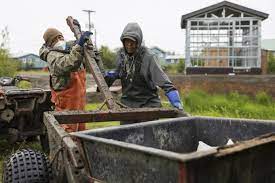
Sanitation workers Thomas Noatak and Joseph Moses start every workday riding a four-wheeler along the muddy roads of this small Yup’ik village on southwestern Alaska’s vast Kuskokwim River, looking for human waste.
They’re checking honey bucket bins — large steel containers where residents dump their waste at neighborhood collection points. When they find a bin full enough to warrant a trip to the dump site just outside town, they load it up and haul it nearly a mile over deeply potholed and rutted streets, hoping to do it without splashing.
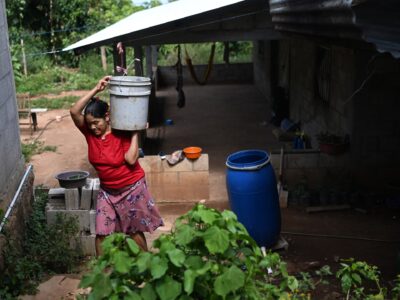
Many Alaska villages don’t have running water and flushing toilets. Instead of using a bathroom, people retire to a room in a house, pull a curtain and use a honey bucket — typically a 5-gallon bucket with a toilet seat on top and a plastic bag inside. Instead of showers, they rely on steam baths or sponge baths. Water for drinking and washing has to be hauled in.
All that’s changing in Akiachak, where most of the village’s nearly 700 people began getting modern plumbing for the first time this spring and summer — and finding their lives transformed.
“I was so happy, I kept doing my dishes,” said Katherine Wassilie. But for her and many other tribal members, it was saying goodbye to the honey bucket that had the biggest impact: “I’m really happy I got that throne.”
More than 3,000 homes in Alaska, concentrated mostly in 32 villages, lack running water. The people who live in them are among more than 2 million Americans who don’t have basic indoor plumbing, according to the U.S. Department of Health and Human Services.
It’s not just an inconvenience. It’s a health issue, with higher rates of respiratory illnesses and skin infections like impetigo and boils where plumbing doesn’t exist.
Native infants in the Yukon-Kuskokwim Delta are hospitalized at five times the national rate for respiratory syncytial virus, or RSV, according to the Yukon-Kuskokim Health Corp., which provides services for this region about 400 miles (644 kilometers) west of Anchorage. The hospitalization rate for pneumonia is 11 times higher for Alaska Native children from villages without plumbed water.
Sewer and water hookups change that, said Dr. Ellen Hodges, the corporation’s chief medical officer.
“We think most of the benefit from piped water comes from that access to fresh, regular running water, being able to wash your hands, clean down surfaces in your home,” Hodges said. “It is sort of astonishing to me that in this day and age and all the technological advances that we don’t have this in more of our villages.”
In Akiachak, west side residents have had the hookups for nearly two decades. But work on the east side — where most of the town’s people live — was slowed for years until village officials met certain conditions to unlock $28 million in federal and state funding.
Before getting running water, those residents had to haul water from the river or laundry to their home or collect rainwater.
Installing the hookups required connecting and burying water and sewer mains, building two additional lift stations, and providing interior plumbing in every home — kitchen and bathroom sinks, a toilet, a shower and ventilation.
Having most everyone on the water and sewer system appears to be paying benefits already, said Fritz George, president and chairman of the Akiachak Native Community, or the village’s tribal government.
“It seems like we have a healthier community, healthier children,” he said.
“Not even half a year, and people don’t want to go back to the honey bucket,” said Carl Ekamrak, the elder-in-charge of the Akiachak Moravian Church, with a chuckle.
Honey buckets aren’t gone entirely. Living in Alaska is expensive — a pound of black pepper costs $34 and a can of corned beef hash is $11, for example — so some residents are unwilling or unable to pay the $100 monthly cost for the water service.
But most are, including Ray Nose, a maintenance worker at the school who said he was “gladly” paying.
“It’s changed us for the better,” Nose said. “I used to haul water all the time, dumped honey buckets. Now it’s a breeze.”
Mary Lou Beaver grew up in Akiachak, packing water from the river as a girl, collecting rainwater and using an outhouse. Now retired from teaching and living in Anchorage, Beaver — who was visiting her old village to help relatives after a death — is glad that those memories will become relics of the past.
She said Americans should be equal, with access to running water for all.
“Why did it take so long?” she asked.
The entire project is important not only to this generation but also to the ones that follow because brushing teeth, taking baths and doing dishes will become normalized, leading to healthier communities, said Robert Sitton, a superintendent on the construction project for the Alaska Native Tribal Health Consortium.
Ronald Nose, who worked on the original west side project when it began in 1998 and is now helping complete the east side’s system, remembers as a child packing wood and water from the Kuskokwim River to a village steam house so people could take steam baths to get clean.
He’s proud of the part he’s played bringing clean water into people’s homes.
”It’s a lot easier, a lot cleaner,” he said. ”You wash your own clothes in your own home, shower, wash dishes, way easier without packing water. Life changing.”
It took no time at all for Mary Frederick to get used to indoor plumbing when she got it nearly two decades ago — and she hated it when the stilts supporting her elevated home collapsed and forced her to revert back to the honey bucket system for a while. Her house has since been repaired, prompting Frederick to proclaim “Hallelujah!” that she can once again simply flush a toilet.
“I’m glad I don’t have to smell the honey bucket no more,” she said.
The Associated Press receives support from the Walton Family Foundation for coverage of water and environmental policy. The AP is solely responsible for all content. For all of AP’s environmental coverage, visit https://apnews.com/hub/climate-and-environment