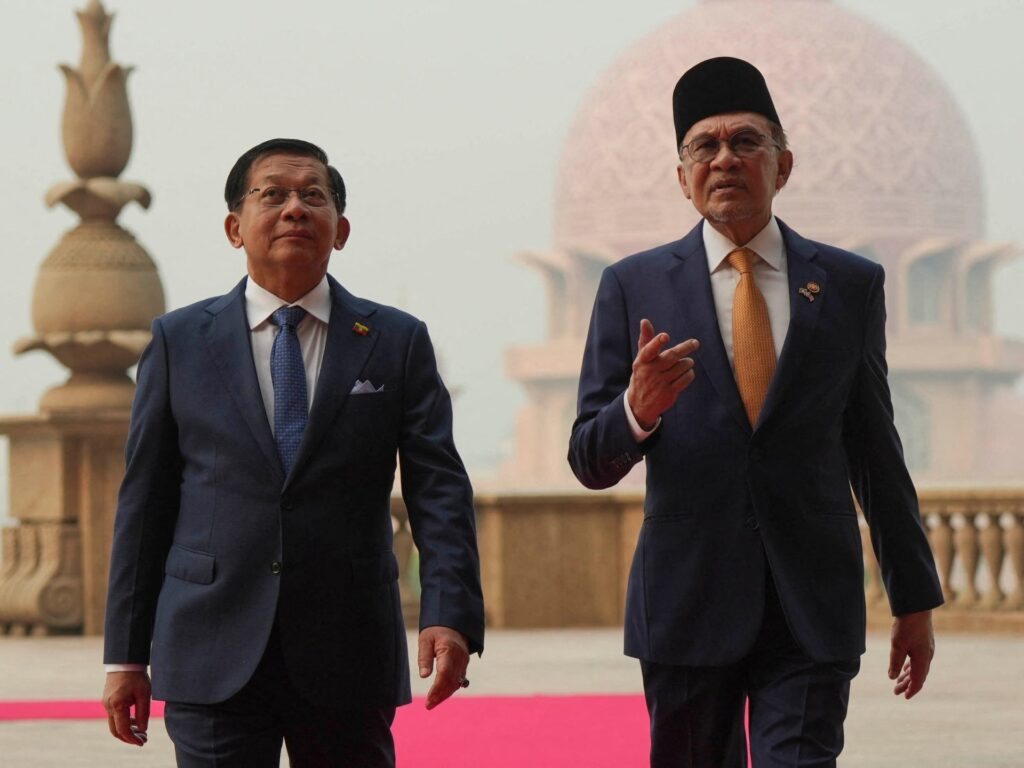
Myanmar’s coup leader-turned-president, Min Aung Hlaing, is regaining acceptance among neighboring countries despite the continued internal conflict and military actions against civilians. Since seizing power in a 2021 coup, Min Aung Hlaing has faced widespread international condemnation due to the violent crackdown on protesters and ongoing clashes in the country. Yet, ASEAN, the Association of Southeast Asian Nations, has recently taken steps to engage with him diplomatically.
This shift towards engagement contrasts with the isolation Myanmar faced immediately following the coup. ASEAN leaders, motivated by a desire to maintain regional stability and keep dialogue open, have welcomed Min Aung Hlaing into meetings and discussions once more. This acceptance is seen as a pragmatic move by ASEAN to influence Myanmar’s direction internally through dialogue rather than exclusion.
However, critics warn that this regional embrace risks emboldening a military regime that continues to bomb civilian populations and suppress democratic movements. Human rights organizations highlight that despite ASEAN’s engagement, Myanmar’s military remains responsible for grave abuses and violence against ethnic groups and peaceful protesters.
The complex situation underscores the tension between regional diplomacy and human rights concerns. ASEAN’s approach prioritizes regional unity and conflict resolution, intending to prevent further destabilization in Southeast Asia. Meanwhile, the international community remains divided on the best path forward for Myanmar, with some advocating for continued sanctions and isolation and others supporting renewed engagement.
Min Aung Hlaing’s regained acceptance by neighbors has complicated the geopolitical landscape. Neighboring countries like Thailand, Malaysia, and Indonesia emphasize dialogue but also express concerns over prolonged instability and humanitarian crises. ASEAN’s Five-Point Consensus, aimed at resolving the Myanmar crisis, continues to face challenges in implementation.
As ASEAN leaders extend this diplomatic hand, the military government in Naypyidaw uses the platform to legitimize its rule, claiming progress in restoring peace and dialogue within Myanmar. Meanwhile, on the ground, armed resistance groups and civilian protesters persist in opposing military rule.
In conclusion, while Min Aung Hlaing has won back his regional neighbors’ cooperation and inclusion in ASEAN processes, the ongoing conflict and atrocities committed against civilians remain pressing issues. The international community must balance support for dialogue and peace with a firm stance on human rights and accountability as Myanmar navigates a turbulent future.