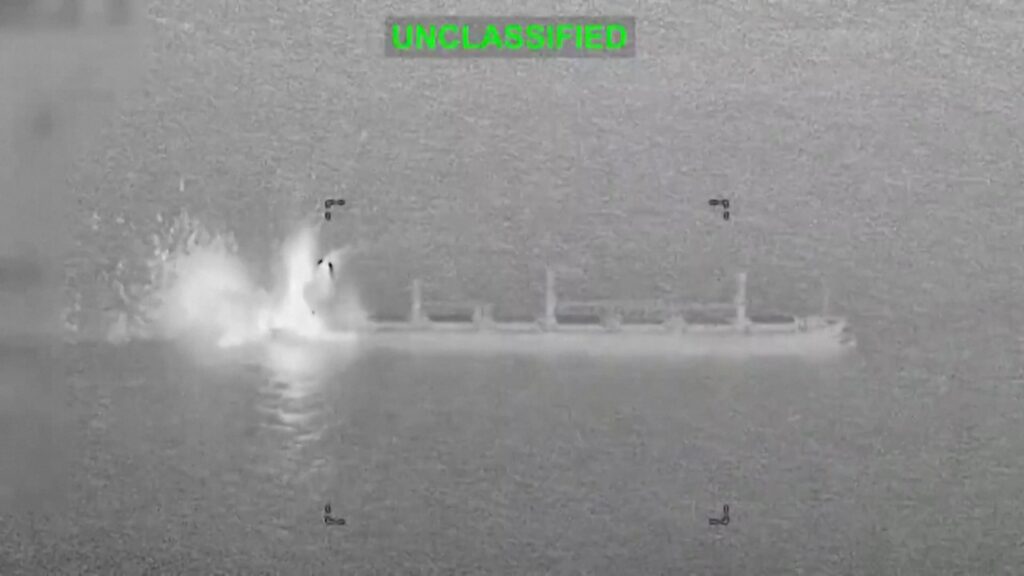
In a significant military action, a US fighter jet bombed a commercial cargo ship in the Gulf of Oman, according to the United States Central Command (CENTCOM). This incident marks a dramatic moment in ongoing tensions surrounding the enforcement of a naval blockade on Iran.
The cargo vessel was reportedly attempting to breach the blockade established by the US-led coalition. The Gulf of Oman, a strategically crucial waterway connecting the Arabian Sea to the Strait of Hormuz, has seen increased military activity due to geopolitical conflicts involving Iran and its regional neighbors.
CENTCOM confirmed the strike, emphasizing that the cargo ship was deliberately trying to evade the blockade. The move aligns with broader US efforts to exert pressure on Iran’s maritime routes as part of a strategy to curb Iran’s influence and nuclear ambitions.
Details on the ship, including its origin, owner, and cargo, have not been fully disclosed. However, sources suggest the vessel was engaged in commercial shipping, raising concerns over potential impacts on international trade in one of the world’s busiest maritime corridors.
The US has maintained a naval blockade around Iran, aiming to stop shipments that the US alleges could support Iran’s military or nuclear programs. This blockade has been a source of international controversy, with Iran condemning the action as an act of aggression and violation of international law.
The bombing incident escalates existing tensions in the region, risking further diplomatic and military confrontations. The US states that the action was necessary to maintain the integrity of the blockade and maritime security.
International reactions are awaited as the global community watches closely. Allies of the US may support the move as part of broader sanctions and containment strategies against Iran, while others may call for restraint and dialogue to avoid escalation.
The Gulf of Oman continues to be a hotspot for naval and geopolitical maneuvers, with the US and its allies closely monitoring Iranian activities and attempting to disrupt supplies they believe enhance Tehran’s contested military capabilities.
This latest episode underscores the fragile security situation in the Middle East, where commercial interests and military objectives often intersect, impacting regional stability and global energy supplies.
As investigations continue, further information about the incident and its consequences for US-Iran relations and international maritime law will be crucial. The incident highlights the risks faced by commercial shipping in conflict-prone regions and the complex dynamics of enforcing maritime blockades amid ongoing diplomatic tensions.