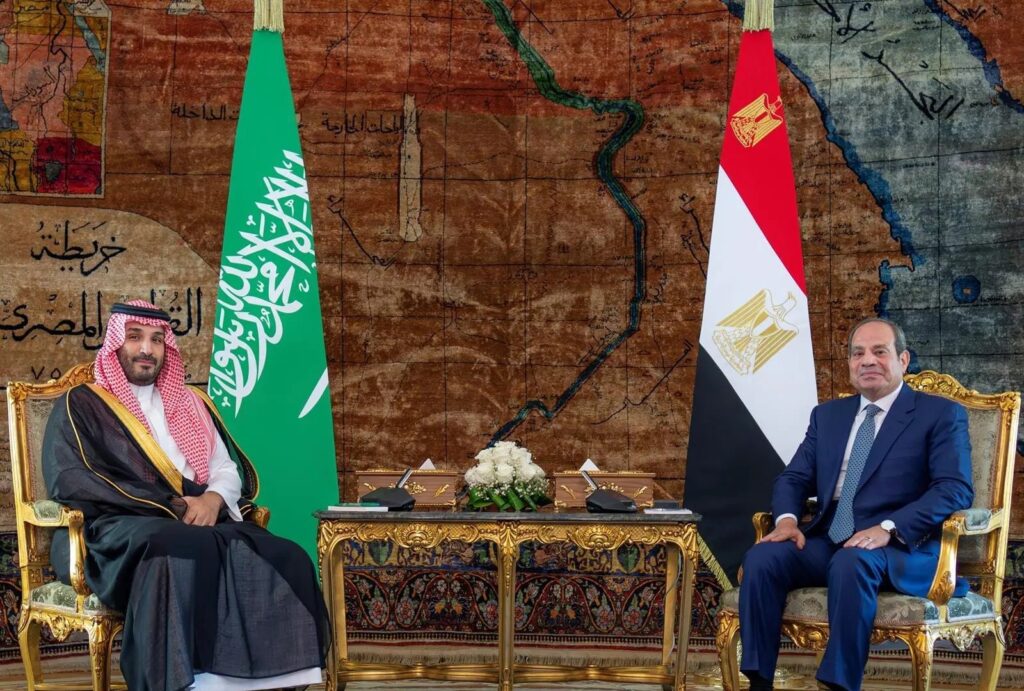
In a significant diplomatic engagement, Egyptian President Abdel Fattah el-Sisi met with Saudi Crown Prince Mohammed bin Salman (MBS) to discuss pressing regional issues, with a particular focus on ensuring secure navigation through the Red Sea. This meeting highlights the strategic importance both nations place on the Red Sea, a vital maritime corridor for global trade and regional stability.
The Red Sea, serving as a critical link between the Mediterranean Sea via the Suez Canal and the Indian Ocean, has witnessed disruptions that have had far-reaching economic consequences, notably for Egypt. Over the past two years, these disruptions have contributed to a steep decline in revenues from the Suez Canal, Egypt’s key economic lifeline, which reportedly fell by $7 billion.
President el-Sisi’s support for the Saudi call to secure navigation routes in the Red Sea underscores a shared regional imperative. Ensuring safe maritime passage is not only crucial for safeguarding economic interests but also for maintaining geopolitical stability in a region often challenged by security threats and conflicts.
The Suez Canal is one of the world’s busiest waterways, facilitating roughly 12% of global trade. Revenue generated from the canal forms a substantial part of Egypt’s economy, funding numerous development projects and government budgets. The reported $7 billion drop in revenues over two years due to Red Sea disruptions reflects the critical vulnerability of this economic artery to regional instability.
The meeting between el-Sisi and MBS included discussions on enhancing maritime security measures, joint naval exercises, and collaborative intelligence sharing focused on the Red Sea. Both leaders recognize that coordinated efforts are vital to counter threats such as piracy, terrorism, and the influence of hostile non-state actors in the maritime domain.
Additionally, they addressed the broader context of regional cooperation, emphasizing the Red Sea’s role as a shared resource that requires collective stewardship. Saudi Arabia’s proactive call for securing navigation is seen as a move to bolster regional alliances and reassure global trading partners of the stability of this strategic waterway.
Egypt’s backing of Saudi efforts also reflects a diplomatic alignment reinforcing their leadership roles within the Arab world and the Gulf Cooperation Council framework. This partnership aims to project strength and unity while addressing the economic and security challenges that could undermine their regional influence.
The economic implications of securing the Red Sea are far-reaching. For Egypt, restoring and boosting Suez Canal revenues is crucial to national economic recovery and growth. For Saudi Arabia, safe maritime routes ensure the smooth export of oil and other goods, vital for the kingdom’s economic diversification plans under Vision 2030.
Both countries also recognize that the Red Sea serves as a gateway for emerging trade routes, particularly connecting markets in Africa, Asia, and Europe. Strengthening security along these routes will enhance trade efficiency and promote investments in port infrastructure and logistics.
This meeting is expected to pave the way for enhanced bilateral and regional cooperation frameworks targeting Red Sea security. Observers note that it could lead to the establishment of joint task forces or a coalition aimed at safeguarding maritime traffic against increasing threats.
In conclusion, the el-Sisi-MBS meeting marks a critical step in reinforcing regional solidarity over maritime security in the Red Sea. Their commitment to this goal represents a strategic response to economic challenges and security risks that could disrupt one of the world’s most important trade corridors.
The stabilization of the Red Sea shipping lanes is not only vital for Egypt’s economic interests but also for maintaining global trade flows. The cooperation between Egypt and Saudi Arabia is a positive development, signaling determination to overcome regional challenges through partnership and shared responsibility.