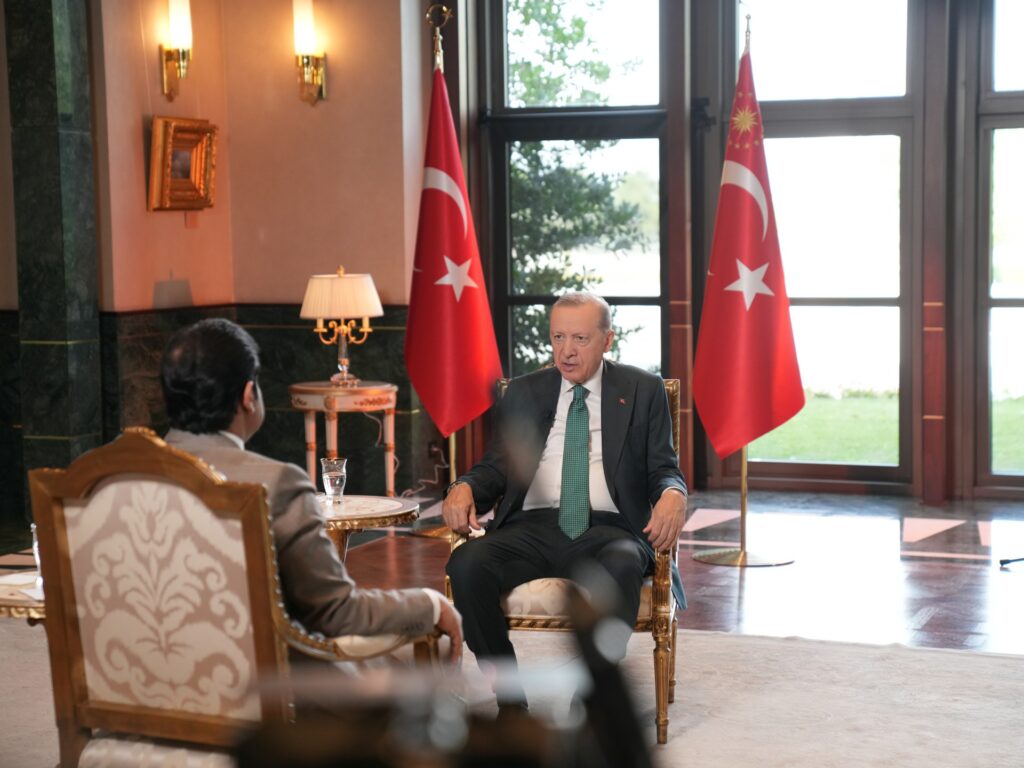
In a significant development in Middle Eastern and South Asian geopolitics, Turkish President Recep Tayyip Erdogan has announced the possibility of Egypt joining a newly formed defence pact between Turkiye, Saudi Arabia, and Pakistan. Speaking to Al Jazeera, Erdogan expressed openness to expanding the pact by including additional members, signaling a potentially broader regional alliance.
The defence pact, recently signed by the three nations, aims to enhance military cooperation, strategic coordination, and collective security among its members in a region often marked by complex political tensions and security challenges. President Erdogan underscored that while the agreement currently binds Turkiye, Saudi Arabia, and Pakistan, it remains inclusive and flexible to incorporate other countries sharing similar security goals.
Erdogan’s remarks came during an interview where he also pledged ongoing support and commitment from Turkiye towards the successful implementation of the pact. This alliance follows a period of heightened diplomatic engagement among the member countries, each of which holds significant influence regionally and internationally.
Egypt’s potential inclusion is particularly noteworthy given its strategic position and military capabilities in North Africa and the Arab world. As a key player in Middle Eastern geopolitics, Egypt joining the pact could deepen the alliance’s impact and operational scope.
The pact represents a shift towards greater military collaboration among these Islamic-majority nations amid evolving global power dynamics. With Turkiye’s growing assertiveness in regional affairs, Saudi Arabia’s leadership role in the Arab world, and Pakistan’s strategic position in South Asia, the alliance could serve as a counterbalance to other regional and global power blocks.
Erdogan highlighted that the defence pact is not merely a military alliance but a platform for mutual understanding, trust-building, and a unified stance against common threats. This perspective aims to foster stability and security cooperation beyond conventional military engagements.
Observers believe that Egypt’s inclusion would mark a significant enhancement of the pact’s political weight and operational capacity. It would also reflect a warming of relations between Egypt and Turkiye, which have experienced oscillating ties in recent years due to differing regional policies.
The announcement also coincides with renewed diplomatic efforts among Middle Eastern countries to manage conflicts, promote economic cooperation, and address security concerns collectively. Analysts suggest that this defence pact might pave the way for more comprehensive regional security architectures.
Critics, however, caution that expanding military alliances in a volatile region could escalate tensions with other regional powers and complicate diplomatic relations.
Nevertheless, Erdogan’s commitment to the pact and the openness to new members underline an evolving strategy by Turkiye to assert greater influence in regional security matters and build coalitions based on shared interests and common challenges.
As the defence pact begins its implementation phase, all eyes will be on how it navigates the complex geopolitical landscape, manages internal dynamics among member states, and potentially incorporates new partners like Egypt into its fold.
This development reaffirms Turkiye’s role as a pivotal player in shaping the strategic future of the Middle East and adjacent regions, with implications for global diplomacy and security frameworks.