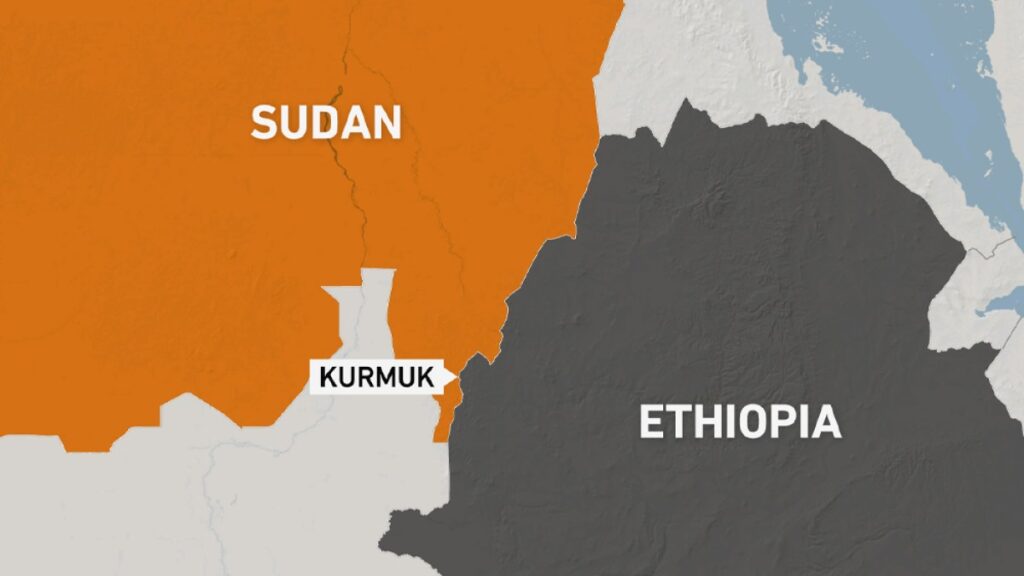
The Sudanese military has reported a significant advance by the paramilitary Rapid Support Forces (RSF) and their allies into the town of Kurmuk, located in Blue Nile state near the Ethiopian border. According to official military and government sources, this move marks a critical development in the ongoing conflict dynamics in the region.
Kurmuk is a key strategic town due to its position on Sudan’s eastern frontier with Ethiopia, serving as an important transit and logistical hub. Control over Kurmuk has long been contested because it offers significant military and economic advantages by linking cross-border trade routes and serving as a gateway for movement between Sudan and Ethiopia.
The RSF, a powerful paramilitary group previously integrated under Sudan’s armed forces but now acting more independently, has increasingly extended its influence in various parts of Sudan. Their latest push into Kurmuk signals an escalation of tensions and has raised concerns about the potential for further conflict along the volatile Sudan-Ethiopia border region.
Government military representatives confirmed the incursion, indicating that the RSF’s advance has resulted in intense confrontations around the town. Details about casualties or the extent of territorial control remain limited, as the situation on the ground continues to evolve rapidly.
The Blue Nile state, historically affected by conflict due to ethnic and political complexities, has been a hotbed of unrest for years. Its proximity to Ethiopia, which has recently experienced its own internal conflicts, further complicates the security landscape. The advance into Kurmuk could have wider implications for regional stability.
International observers have expressed concern about the growing hostilities in this border area. If unchecked, the fighting risks destabilizing humanitarian conditions for local populations and may trigger broader regional conflicts involving refugee flows and cross-border militancy.
The Sudanese government has called for calm and emphasized the importance of restoring order and maintaining Sudan’s territorial integrity. Meanwhile, the RSF’s increasing militarization and territorial ambitions challenge the authority of the central government, threatening Sudan’s fragile political transition.
Efforts by international actors to mediate between conflicting parties in Sudan have so far yielded limited success. The renewed fighting in Kurmuk underscores the fragility of peace efforts and the urgent need for comprehensive dialogue that includes all stakeholders in the conflict.
As the situation develops, monitoring the RSF’s movements and government responses will be crucial in understanding the trajectory of security in Blue Nile state and the broader Sudanese-Ethiopian border region.
The conflict in Sudan remains complex, with ethnic, political, and economic dimensions intersecting. The recent RSF advance into Kurmuk highlights the volatility that continues to challenge peace and stability in this conflict-prone area.