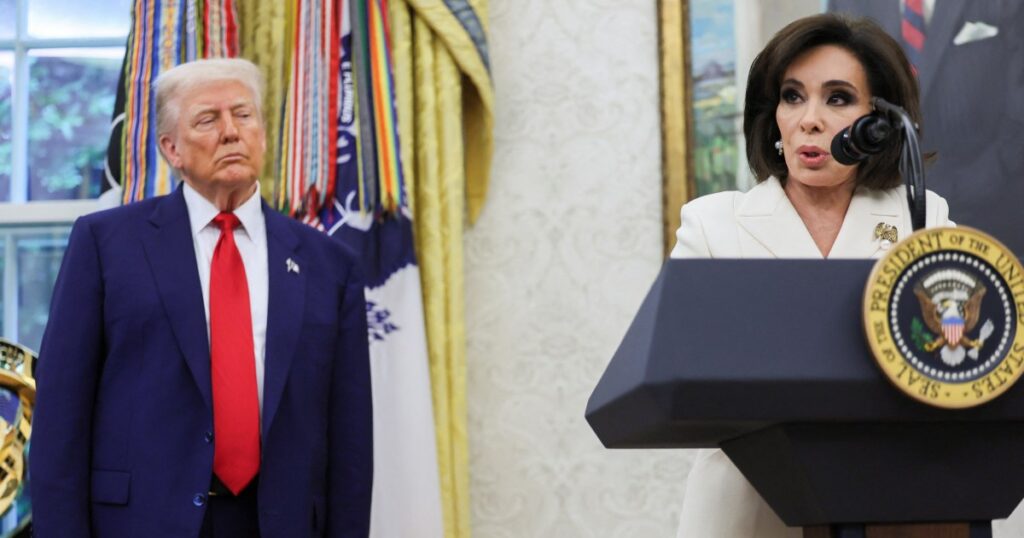
Former President Donald Trump recently launched a sharp criticism against Jeanine Pirro, his hand-picked attorney for Washington, DC, over her handling of a vandalism case involving the US Reflecting Pool. The incident has sparked controversy amid accusations of mismanagement and political interference.
The Reflecting Pool, a famed landmark situated between the Lincoln Memorial and the Washington Monument, was vandalized, drawing significant public and media attention. Initial charges were filed against an individual believed to be responsible for the damage. However, Jeanine Pirro, acting as the US Attorney for DC, decided to drop the charges, a move that raised eyebrows across political and legal circles.
Trump’s reaction to Pirro’s decision was swift and public. He accused her of failing to uphold justice and suggested that she had mishandled the case to the detriment of the landmark’s sanctity and the rule of law. The former president’s attack highlights ongoing tensions within his appointed legal team and questions over the administration of justice in politically sensitive cases.
Legal experts point out that cases involving national monuments often require careful handling due to their historical and symbolic significance. The decision to drop charges may have been influenced by prosecutorial discretion, evidence challenges, or other legal considerations that have not been fully disclosed.
Critics argue that the incident underscores potential political motivations influencing the justice system in Washington, DC, particularly when high-profile individuals and controversial actions are involved. Supporters of Pirro assert that the decision is within legal norms and reflects a prudent approach to prosecution.
The dispute between Trump and Pirro exemplifies the complexities of prosecutorial responsibilities amid politically charged atmospheres. Observers note that this episode could have broader implications for how similar cases are managed and the perception of fairness in the US legal system.
As debates continue, the vandalism of the Reflecting Pool remains a sensitive issue, intertwining questions of preservation, justice, and political loyalty. Stakeholders from various sectors are calling for transparency and a clearer explanation of the reasons behind the decision to drop charges.
This controversy adds to the ongoing discourse about the role of legal officials appointed by political figures and the balance they must strike between following the law and managing political expectations. The outcome of this episode could influence future appointments and policies related to landmark protection and law enforcement in the capital.
In conclusion, Trump’s attack on Jeanine Pirro over the vandalism case reveals deep divisions within his circle and raises important questions about accountability, justice, and the stewardship of America’s historic sites. The situation continues to evolve, with both political and legal ramifications yet to be fully determined.