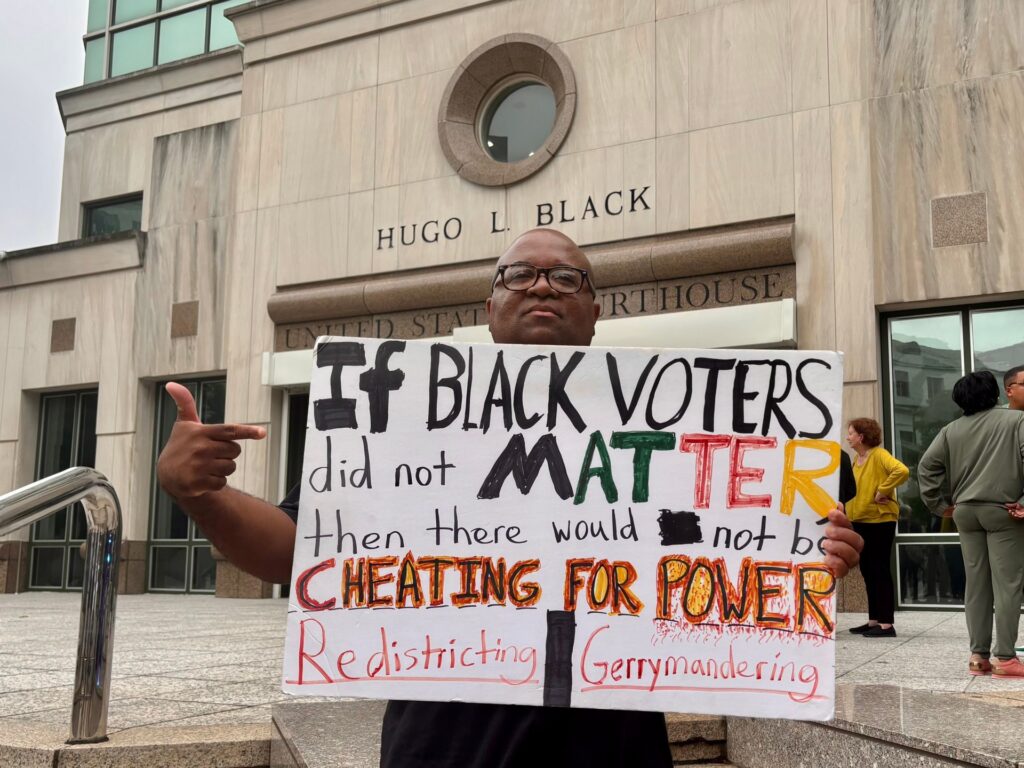
The state of Alabama has renewed efforts to gain approval from the U.S. Supreme Court for a congressional map that was previously rejected in 2023 due to concerns over racial discrimination. This move by Republican lawmakers signals a significant push ahead of the upcoming midterm elections, intensifying the ongoing debate over voting rights and redistricting practices.
In 2023, a federal court found the proposed map to be racially discriminatory, ruling that it diluted the voting power of Black residents in the state. The court’s decision was grounded in the violation of the Voting Rights Act, emphasizing the importance of fair representation for minority communities. Following the rejection, Alabama had been operating under court-drawn maps to ensure compliance with federal law.
Republican officials argue that the contested map reflects legitimate political boundaries and contends that it complies with legal standards. They claim that the current court-imposed map is confusing and disrupts the state’s political landscape, prompting the desire to restore the GOP-drawn map.
The Supreme Court’s involvement introduces a higher level of scrutiny and has the potential to set a precedent for similar cases nationwide. Alabama’s appeal highlights the balance courts must strike between state legislative authority and federal protections against discriminatory practices.
Critics of the proposed map worry that reinstating it could undermine minority voting strength, potentially marginalizing Black voters and impacting the composition of Alabama’s delegation to the U.S. Congress. Civil rights groups have voiced strong opposition, emphasizing the historical struggle for equal representation.
The timing of the Supreme Court appeal is critical with the midterm elections approaching, as congressional districts dictate electoral competitiveness and the political future of the state. The decision could affect voter engagement and perceptions of electoral fairness.
This case is part of a broader national conversation on redistricting, gerrymandering, and their effects on democracy. Across the country, states are grappling with how to draw maps that are fair, reflect demographic changes, and protect minority voting rights.
Legal experts note that the Supreme Court’s ruling will be closely watched, as it will provide guidance for future redistricting battles and the enforcement of the Voting Rights Act. The outcome may either bolster states’ autonomy in redrawing districts or reinforce federal oversight to prevent racial discrimination.
Alabama’s renewed push underscores the continuing tensions between political parties, racial justice advocates, and the judicial system over the integrity of electoral processes. Whether the Supreme Court approves the map or upholds the lower court’s ruling, the ramifications will be felt far beyond Alabama’s borders.
As the case progresses, stakeholders from all sides are mobilizing, aware that the final decision will influence not only the shape of Alabama’s congressional districts but also the broader discourse on voting rights and representation in America.