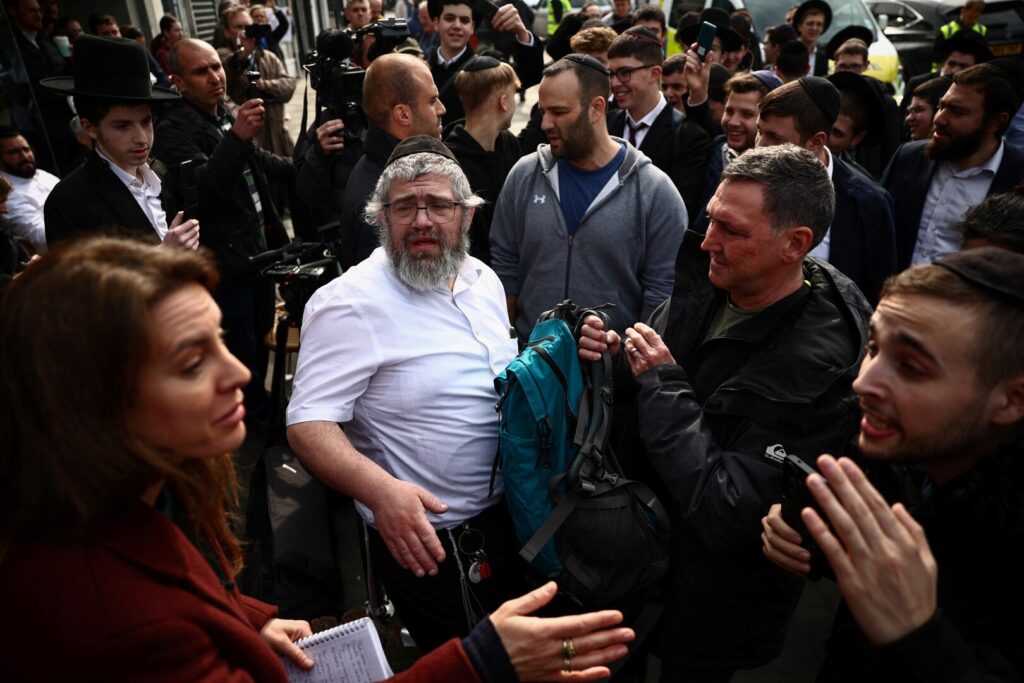
Members of the local community ask journalists (front L and 2nd R) working for news organisation Al Jazeera to leave the area, in the Golders Green neighbourhood of north London on March 23, 2026, after volunteer ambulances run by a Jewish organisation were set on fire overnight. Britain's Prime Minister Keir Starmer on March 23 condemned "a deeply shocking antisemitic arson attack" on volunteer ambulances run by a Jewish organisation in London. (Photo by Henry Nicholls / AFP)
An incident involving an off-duty Metropolitan Police officer has recently drawn significant public attention. The officer was filmed intimidating a group of Al Jazeera journalists during an encounter in London. This event has sparked discussions around police conduct, journalistic freedom, and the responsibilities of law enforcement officers, even while off duty.
The footage clearly shows the off-duty officer among a group that approached the journalists in a seemingly confrontational manner. The exact circumstances that led to the confrontation remain under investigation, but the video has raised concerns about the officer’s behavior and intentions.
Al Jazeera has condemned the incident, stating that their journalists were carrying out legitimate reporting activities and should not be subjected to intimidation or harassment. The network emphasized the importance of protecting journalists so that they can work without fear of interference or aggression.
The Metropolitan Police Department has acknowledged the incident and confirmed that they are conducting an internal inquiry to determine if the officer’s conduct breached any professional codes or policies. While officers are expected to uphold a standard of behavior both on and off duty, the line between personal and professional actions can sometimes be subject to scrutiny, especially when public trust is at stake.
Critics argue that off-duty officers can still exercise considerable influence and authority, which can intimidate members of the public or the media. This case has reignited debates about the scope of police powers and accountability outside of official duties.
Supporters of the police stress the challenges faced by officers, who might encounter stressful and unpredictable situations even when off duty. They argue that isolated incidents should be carefully investigated before drawing broad conclusions about police conduct.
The incident also underscores broader issues related to press freedom in the UK and worldwide. Journalists covering sensitive topics may face harassment or intimidation from various sources, including law enforcement. Advocacy groups continue to call for strong protections and clear guidelines to ensure journalists can report safely and without undue pressure.
As the investigation proceeds, the case is likely to be closely watched by the media, civil rights organizations, and the public. It highlights the delicate balance between law enforcement responsibilities and the rights of journalists to operate freely.
In conclusion, the confrontation between an off-duty Metropolitan Police officer and Al Jazeera journalists has sparked a wider conversation about police conduct, journalistic safety, and the boundaries of authority. The ongoing inquiry will be critical in addressing these issues and reinforcing standards for all members of the police force, regardless of duty status.