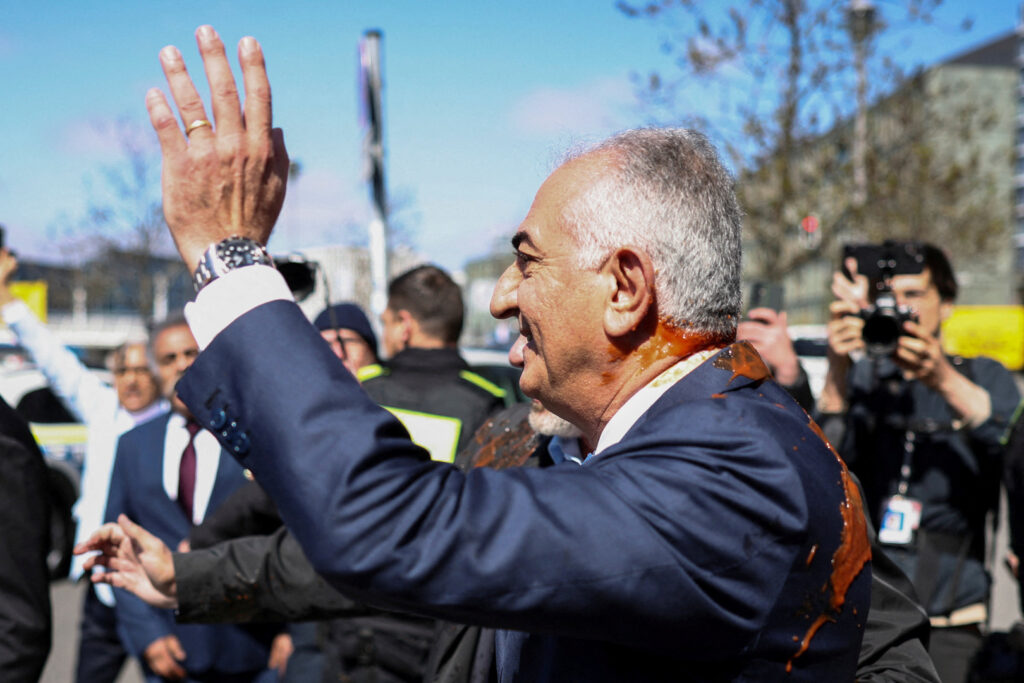
Reza Pahlavi, the exiled son of Iran's last shah and an Iranian opposition figure, stained with red substance, leaves after a press conference at the House of the Bundespressekonferenz in Berlin, Germany, April 23, 2026. REUTERS/Liesa Johannssen TPX IMAGES OF THE DAY
During his recent visit to Berlin, Reza Pahlavi, the exiled former crown prince of Iran, was unexpectedly targeted when a protester hurled red fluid at him. The incident occurred amidst his public appearance in the German capital, attracting significant attention from security personnel and media alike.
Reza Pahlavi, who has long been an outspoken critic of the current Iranian regime, continues to play a prominent role in advocating for democracy and human rights in Iran. His visit to Germany was planned to engage with diaspora communities and European officials, highlighting ongoing issues within Iran and rallying international support.
The activist’s dramatic act of confrontation appears to be a symbolic gesture, possibly intended to convey dissent against Pahlavi’s positions or historical associations. Red fluid, often symbolizing blood or violence, underscored the intensity of the protester’s message. Despite the suddenness of the event, Pahlavi was unharmed and quickly escorted to safety by security forces present at the scene.
Observers note that such incidents reflect the deep divisions and passionate emotions surrounding Iran’s political landscape, even beyond its borders. Reza Pahlavi, although in exile for decades, remains a polarizing figure whose legacy is viewed differently by various factions within Iran and the international community.
The protest highlights the volatile nature of political activism related to Iran among expatriate groups and activists. It also raises concerns regarding security measures for prominent figures at public events worldwide. German authorities have stated they are investigating the incident thoroughly to identify the protester and understand the motive behind the attack.
Pahlavi’s visit to Europe continues despite the incident, as he intends to hold meetings with policymakers and Iranian expatriates. His agenda focuses on uniting opposition groups and promoting efforts to restore democratic governance in Iran.
Critics of Pahlavi argue that his claims to leadership are outdated and question his effectiveness as a unifying symbol for change. Supporters, however, applaud his unwavering stance and continuous activism against authoritarianism in Iran.
This episode in Berlin underscores the challenges faced by political exiles who draw intense reactions that can sometimes manifest violently. It also reflects ongoing tensions between pro- and anti-regime factions within diaspora communities.
In conclusion, the red fluid incident is more than a mere protest; it symbolizes the enduring conflict surrounding Iran’s future and the complex legacy of figures like Reza Pahlavi. The event serves as a reminder of the sensitive political environment that persists among Iranians in exile and abroad. Security experts urge heightened vigilance at similar events to prevent such disruptions.
As Reza Pahlavi continues his diplomatic and advocacy efforts, the international community watches closely how these dynamics unfold, hoping for peaceful progress and respectful discourse. The incident in Berlin, while unsettling, does not appear to have deterred the former crown prince’s determination to champion democratic ideals for Iran.