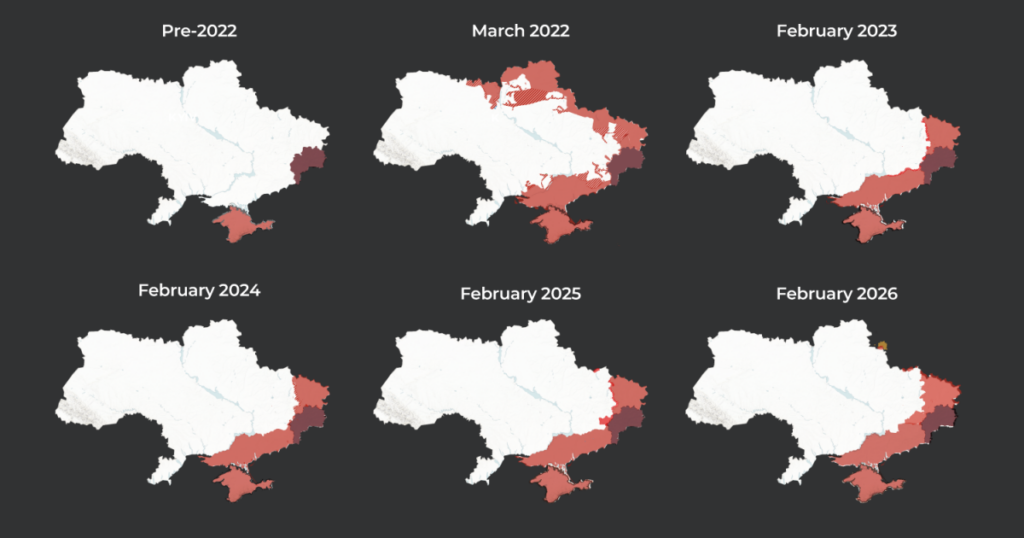
As the war in Ukraine marks its fourth anniversary, the landscape of conflict remains turbulent and complex. Russia currently occupies approximately 20 percent of Ukraine’s territory, a significant portion that underscores the ongoing intensity of this prolonged conflict. Despite this, the front lines have shifted only marginally, highlighting a war characterized by slow, grinding advancements rather than rapid breakthroughs.
The territorial occupation by Russia spans key regions that are strategically important for both military and economic reasons. These areas include parts of the Donetsk and Luhansk regions, which have been contentious since the conflict began. Control over these territories allows Russia to hold a foothold inside Ukraine, complicating any peace negotiations and maintaining leverage.
Mapping these attacks reveals a pattern of persistent artillery bombardments, sporadic ground offensives, and the use of fortified positions. Both Ukrainian and Russian forces have fortified their lines extensively, turning much of the frontline into a entrenched battleground reminiscent of past historical conflicts.
The slow movement of the front line can be attributed to several factors. Ukraine’s steadfast defense and the effective use of modern military technology have been crucial in preventing larger territorial losses. On the other hand, Russia’s military strategy has involved securing and consolidating captured areas rather than aggressive attempts to rapidly expand their control.
Humanitarian impacts in the occupied territories have been devastating. Civilians face ongoing threats from military operations, including shelling and air strikes, disruption of essential services, and challenges in accessing humanitarian aid. The conflict has displaced millions and left infrastructure in ruins.
Internationally, the situation remains a focal point of diplomatic efforts. Sanctions against Russia continue, aiming to pressure Moscow into ceasing hostilities, while significant military aid supports Ukraine’s defense. However, a clear resolution remains elusive as the front line holds steady.
In conclusion, the war in Ukraine, now four years on, shows a grim tableau of sustained conflict with Russia controlling a fifth of Ukraine’s territory. The battle lines shift slowly, reflecting both the resilience of Ukrainian forces and the entrenched military strategies on both sides. The human cost remains high, and the international community closely watches, hoping for a peaceful end to the enduring strife.