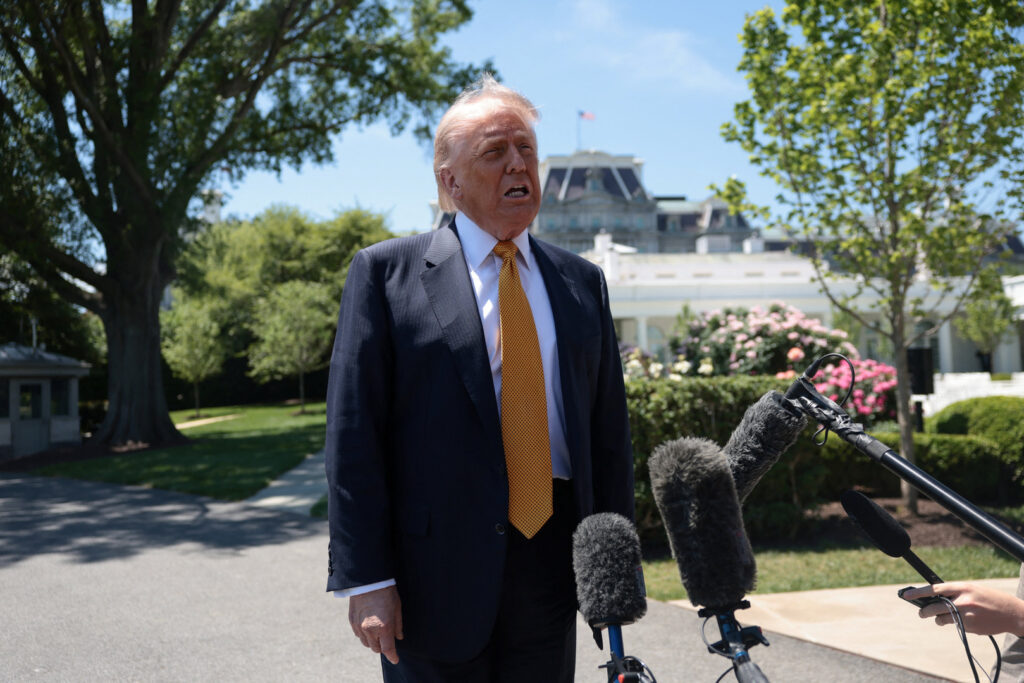
U.S. President Donald Trump speaks to the press, ahead of departing the White House for Joint Base Andrews en route to Beijing, China, in Washington, D.C., U.S., May 12, 2026. REUTERS/Evelyn Hockstein
In a recent interaction with reporters, former President Donald Trump carefully sidestepped a direct question regarding whether he has established any ‘red lines’ that would prompt an end to a ceasefire with Iran. When asked about the specific conditions that might terminate the ceasefire, Trump did not offer a concrete answer, leaving observers to speculate on his stance.
This exchange highlights the complexities surrounding US-Iran relations, particularly in the context of ongoing efforts to maintain a fragile ceasefire. The term ‘red line’ typically refers to a point or condition that, if crossed or unmet, would trigger a significant response—in this case, an end to peace or ceasefire agreements.
Trump’s reluctance to clarify his position may stem from a strategic decision to keep diplomatic options open or to avoid escalating tensions in an already volatile region. The absence of a clearly defined threshold raises questions about US policy and how future actions by Iran might be perceived or responded to.
Experts note that the ambiguity could serve multiple purposes: it might deter Iran from making provocative moves by maintaining uncertainty, or it could reflect ongoing deliberations within US leadership about the precise measures considered unacceptable.
The geopolitical landscape with Iran is marked by longstanding disputes involving nuclear programs, regional influence, and sanctions. Ceasefires and negotiations often revolve around managing these issues while preventing direct conflict.
Trump’s approach contrasts with prior administrations that have occasionally set public ‘red lines’ or benchmarks as part of their diplomatic rhetoric. The current situation underscores the delicate balance in managing international relations where explicit statements can have far-reaching consequences.
As tensions persist, the international community continues to watch closely for any signal that might indicate a shift in policy or escalation. The lack of a defined red line leaves space for multiple interpretations and underscores the uncertainty that characterizes current US-Iran dynamics.
In summary, Trump’s avoidance of specifying any ‘red line’ related to the Iranian ceasefire reflects the intricate and cautious nature of diplomatic engagement with Iran. Whether this ambiguity will contribute to sustained peace or provoke further instability remains to be seen as developments unfold on the global stage.