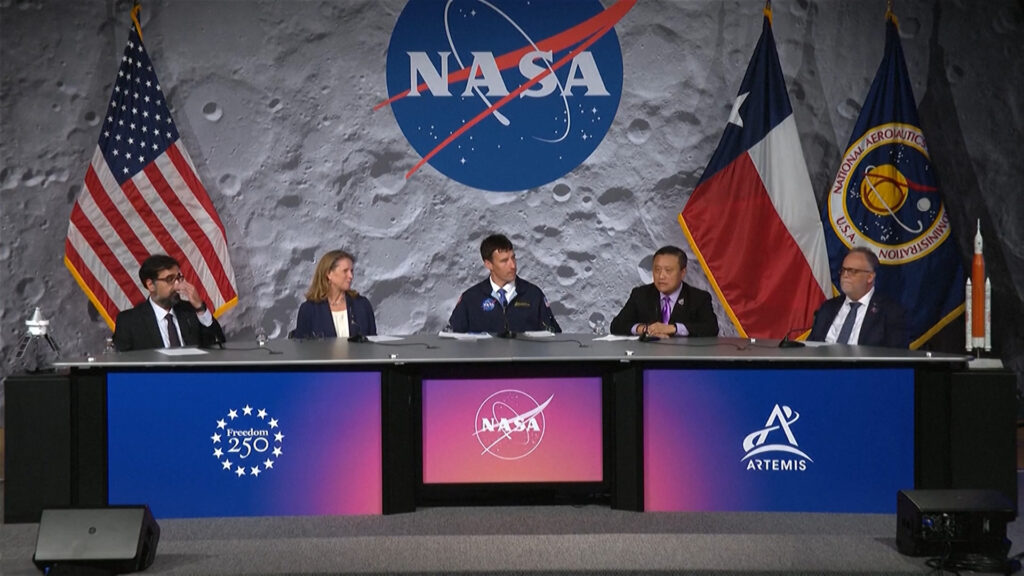
NASA has proudly announced the success of its Artemis II mission, marking a significant milestone in space exploration. The mission, which involved sending astronauts around the moon, has been described by NASA scientists as a “fantastic feat” demonstrating the power of advanced technology and human ingenuity. The Artemis II mission aimed to pave the way for future lunar exploration, particularly targeting the establishment of a sustainable human presence on the moon. The spacecraft successfully completed its journey around the moon, testing critical systems and gathering invaluable data that will inform future missions.
The mission’s success not only reinvigorates NASA’s commitment to deep space exploration but also strengthens international cooperation in space endeavors. By sending astronauts on such a perilous journey, NASA showcased its capability to execute complex aerospace projects safely and efficiently. NASA officials emphasized that while Artemis II is a landmark achievement, the agency has much work ahead to develop the infrastructure and technologies necessary for long-duration lunar habitation.
One of the key objectives beyond Artemis II is to land astronauts on the moon’s surface as part of Artemis III, aiming for a more extended and sustainable mission. This includes advancements in lunar habitat construction, resources utilization, and life support systems. Moreover, Artemis II has helped validate the Space Launch System (SLS) and the Orion spacecraft, both vital components of NASA’s Artemis program. These technologies will form the backbone of further human exploration, potentially extending to Mars and beyond.
The mission has also provided rich scientific opportunities, including studying the moon’s environment and testing radiation protection for astronauts. NASA’s success has energized the global space community and inspired future generations of scientists, engineers, and explorers. Despite this achievement, NASA remains aware of the complexities and risks associated with space travel. Continued innovation, testing, and international collaboration will be crucial in overcoming these challenges.
In summary, the Artemis II mission represents a triumphant step forward in NASA’s lunar exploration goals. Celebrated as a “fantastic feat,” it underscores the agency’s dedication to pushing the boundaries of human spaceflight. Yet, the journey is far from over, as NASA intensifies efforts to realize a permanent human presence on the moon and eventually on Mars, heralding a new era in space exploration.