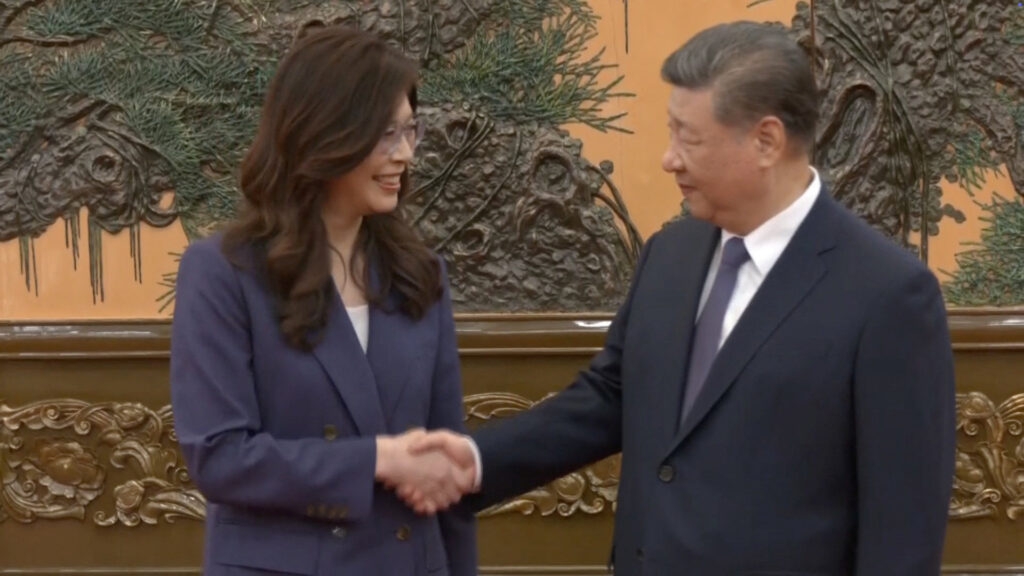
Cheng Li-wun, chairperson of the Kuomintang (KMT), Taiwan's largest opposition party, shakes hands with Chinese President Xi Jinping at the Great Hall of the People in Beijing, China April 10, 2026, in this screengrab from a video provided by CTI. CTI via REUTERS TV ATTENTION EDITORS - THIS IMAGE WAS PROVIDED BY A THIRD PARTY. TAIWAN OUT. NO RESALES. NO ARCHIVES. MANDATORY CREDIT.
In a significant development in cross-strait relations, Cheng Li-wun, the leader of Taiwan’s main opposition party, the Kuomintang (KMT), has called for a path of reconciliation after her recent meeting with Chinese President Xi Jinping. This meeting marks an important gesture amid ongoing tensions between Taiwan and mainland China.
Cheng Li-wun emphasized the importance of their shared cultural heritage as a foundation for dialogue and peace. She suggested that acknowledging these common roots could help ease the complex political and social issues that have long defined the relationship between Taiwan and China.
During the meeting, Cheng indicated a willingness to slow Taiwan’s military build-up, a move that could potentially de-escalate military tensions in the region. This suggestion aligns with the KMT’s traditionally more China-friendly stance compared to Taiwan’s ruling Democratic Progressive Party (DPP), which has pursued stronger defenses amid fears of potential aggression from Beijing.
The call for reconciliation comes at a time when cross-strait relations have been strained due to various political, military, and diplomatic challenges. Taiwan’s strategic position in the Indo-Pacific and its vibrant democracy have been points of contention in China’s foreign policy. Beijing sees Taiwan as a breakaway province that should eventually be reunified with the mainland, by force if necessary, while Taiwan continues to assert its sovereignty.
Cheng Li-wun’s stance is notable because it offers an alternative approach to the often confrontational dynamics observed recently. By suggesting a slowdown in the military escalation, the KMT leader is opening the door for renewed dialogue and potentially more cooperative engagements between the two sides.
However, this proposal has received mixed reactions within Taiwan’s political landscape. Supporters argue that it could reduce the risk of conflict and foster stability, while critics warn that it might undermine Taiwan’s security and its democratic values.
The meeting between Cheng Li-wun and Xi Jinping, therefore, is more than just a diplomatic formality; it reflects deep-seated political strategies and visions for the future of Taiwan-China relations. The emphasis on reconciliation and shared culture highlights a softer diplomatic approach that contrasts with the rhetoric of military readiness and sovereignty assertion.
International observers are watching closely to see how these developments influence the broader geopolitical landscape, especially considering Taiwan’s critical role in global technology supply chains and regional security.
In conclusion, Cheng Li-wun’s advocacy for reconciliation and a tempered military stance post-meeting with Xi Jinping suggests a potential shift in Taiwan’s opposition party’s approach toward mainland China. Whether this approach gains traction and leads to substantive dialogue or policy changes remains to be seen, but it undeniably introduces a new dimension to the complex relations across the Taiwan Strait.