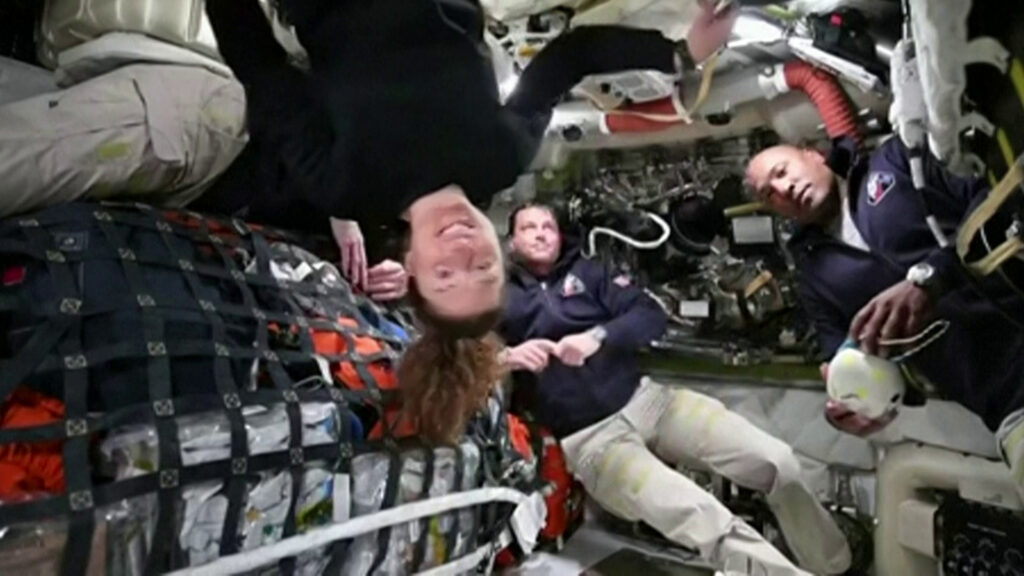
The Artemis II mission has taken a monumental step forward as the Orion capsule successfully fired its engines to propel itself out of Earth’s orbit on its highly anticipated journey to the moon. This critical milestone marks a significant advancement in NASA’s ambitious Artemis program, aimed at returning humans to the lunar surface and eventually establishing sustainable exploration beyond.
The Orion capsule’s engine ignition is the next essential phase following the spacecraft’s launch. This maneuver, known as the trans-lunar injection, is designed to break free from Earth’s gravitational pull and set the spacecraft on a precise trajectory toward the moon. Successfully completing this burn is necessary to ensure the crewed mission can reach lunar orbit safely and continue with the planned activities in lunar vicinity.
Artemis II is NASA’s first crewed mission in the Artemis program, and it aims to pave the way for future moon landings. Unlike the uncrewed Artemis I, this mission involves astronauts aboard Orion, marking the first time since the Apollo era that humans have ventured beyond low Earth orbit. The mission will not land on the moon but will orbit it, allowing for critical testing of spacecraft systems and human performance in deep space.
This milestone confirms the Orion capsule’s robust design and the efficacy of its propulsion system. Engineers and mission controllers at NASA’s Johnson Space Center have been closely monitoring the spacecraft’s systems to ensure every component functions as expected. The engine burn was executed flawlessly, demonstrating the crew module’s readiness for the next stages of the mission.
The Artemis II crew comprises veteran astronauts who have undergone rigorous training for operating the Orion capsule and managing mission objectives in a deep space environment. Their role is vital for validating the spacecraft’s capabilities and preparing for the Artemis III mission, which intends to land the first woman and the next man on the lunar south pole.
This successful burn boosts the momentum for the Artemis program, which embodies humanity’s renewed commitment to lunar exploration and beyond. It also highlights international and commercial partnerships working alongside NASA to develop technologies and strategies for sustained human presence on the moon.
As the Orion capsule travels out of Earth’s orbit, audiences around the globe are watching this historic moment that reignites human space exploration. The mission symbolizes not only the technical achievements of space engineering but also the enduring spirit of discovery pushing the boundaries of what is possible.
Looking ahead, Artemis II will conduct a series of maneuvers as it approaches lunar orbit, followed by extensive scientific and technical experiments aimed at testing life support systems, communications, and navigation far from Earth. These tests are crucial for ensuring the safety and success of upcoming missions that will venture deeper into space.
The Artemis program represents a new era of exploration, cooperation, and innovation. The success of this engine burn demonstrates the program’s steady progress and brings humanity closer to re-establishing a permanent presence on the moon, setting the stage for future expeditions to Mars and beyond.