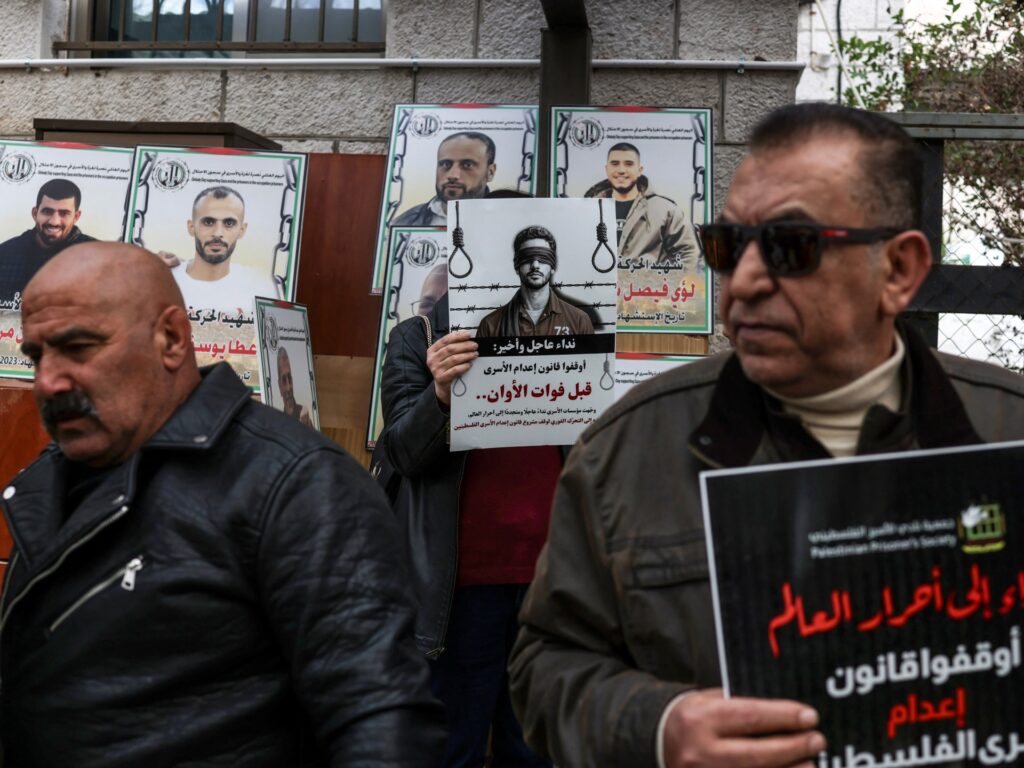
Hundreds of Palestinians and supporters gathered in the West Bank to protest against the Israeli government’s recent decision to impose the death penalty on Palestinian prisoners. This measure marks a significant escalation in the Israeli judicial landscape, where capital punishment has been largely dormant.
The rally brought together civil society groups, human rights activists, and local citizens, all united in their opposition to what they describe as a harsh and unjust law specifically targeting Palestinians. Demonstrators held banners and chanted slogans denouncing the death penalty, highlighting concerns over human rights violations and the potential for increased violence and unrest in the region.
Organizers of the protest emphasized the law’s impact on Palestinian communities, arguing that it deepens the already fraught relations between Israelis and Palestinians. They warned that implementing such a measure could lead to further international condemnation and exacerbate tensions.
Civil society organizations across the West Bank have actively joined the protests, mobilizing communities and raising awareness about the legal and ethical ramifications of the law. These groups contend that the death penalty undermines the prospects for peace and justice, calling instead for dialogue and reconciliation.
The European Union has issued a formal statement expressing ‘great concern’ regarding Israel’s decision. The EU’s representatives underscored the importance of upholding human rights standards and urged Israeli authorities to reconsider this legislation. They highlighted that the use of capital punishment could damage efforts towards achieving a sustainable resolution to the Israeli-Palestinian conflict.
International human rights organizations have also condemned the death penalty law, reiterating long-standing objections to capital punishment in all contexts. They advocate for global abolition and promote alternative judicial approaches that respect the dignity and rights of all individuals.
The Israeli government, however, maintains that the law is a necessary measure to deter violence and strengthen national security. Officials argue that it targets those convicted of serious crimes, including terrorism-related offenses, and is being applied in accordance with legal protocols.
Analysts suggest that the new legislation may further polarize the already divided communities, potentially sparking more protests and unrest not only in the West Bank but across the broader region. The move has drawn criticism from various factions questioning the impact on peace negotiations and the wider geopolitical landscape.
As the situation unfolds, human rights advocates continue to monitor the implementation of the death penalty law closely, calling for international oversight and support for Palestinian detainees. They emphasize the need for transparency, accountability, and adherence to international legal norms.
The recent protests reflect a growing movement within Palestinian society and among international allies demanding justice and the protection of fundamental rights. The outcome of this contentious issue remains to be seen, but the widespread opposition signals strong resistance to the death penalty’s introduction in this volatile context.