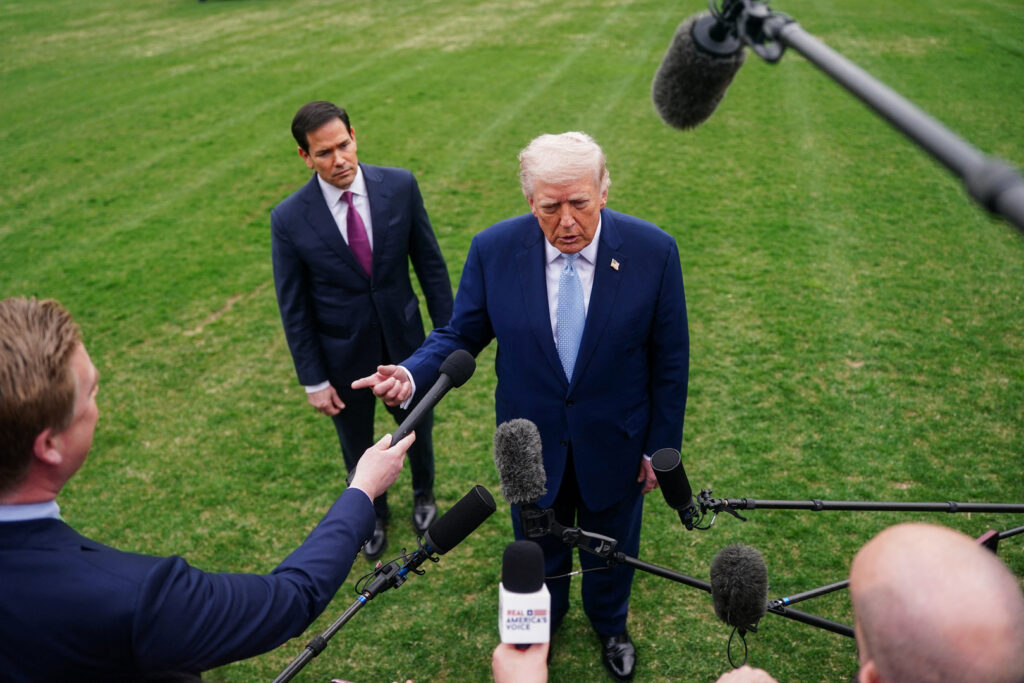
U.S. President Donald Trump speaks to the media, flanked by U.S. Secretary of State Marco Rubio, as he departs the White House for Florida, in Washington, D.C., U.S., March 20, 2026. REUTERS/Nathan Howard
Senator Marco Rubio has expressed strong disappointment after NATO allies, including Spain, refused to allow the United States to use their military bases for operations targeting Iran. Rubio characterized this refusal as a significant setback in the US’s strategic military efforts, emphasizing that NATO’s collective approach must be revisited to ensure greater alignment and support for shared security interests.
The US had sought permission to utilize NATO bases in Spain to support its military objectives related to Iran, amidst escalating tensions in the region. However, Spain’s decision to block this request has raised broader questions about the unity and operational cohesion within the NATO alliance.
Rubio criticized the move, stating that such obstacles undermine the effectiveness of NATO as a collective defense organization. He stressed that allies need to reaffirm their commitments and ensure that strategic support is not hindered by political differences. According to Rubio, this moment presents an opportunity to thoroughly re-examine NATO’s roles, responsibilities, and mechanisms to adapt to emerging global security challenges.
The senator’s comments come amid ongoing debates in international forums about the role of NATO in modern geopolitical conflicts, especially involving Iran’s increasing influence in the Middle East. His remarks highlight concerns that without robust cooperation and consensus among allies, NATO’s capacity to respond decisively and swiftly to threats may be compromised.
Spain’s decision also reflects larger dynamics within the alliance where national interests occasionally diverge, potentially impacting joint military strategies. The incident sparked discussion on diplomatic channels and the importance of consensus-building in multinational defense agreements.
Experts note that this development could trigger a reassessment of NATO’s strategic objectives and its ability to serve as a unified front against adversarial actions. Rubio’s call for re-examination suggests that political leaders may seek ways to streamline decision-making processes and reinforce collective defense principles to prevent similar issues in the future.
In conclusion, Marco Rubio’s reaction to Spain’s refusal underscores the need for NATO to revisit its framework to maintain relevance and effectiveness in the face of evolving global threats. As the alliance navigates internal disagreements, the emphasis remains on fostering stronger unity to support international security partnerships and uphold strategic alliances against common threats like Iran.