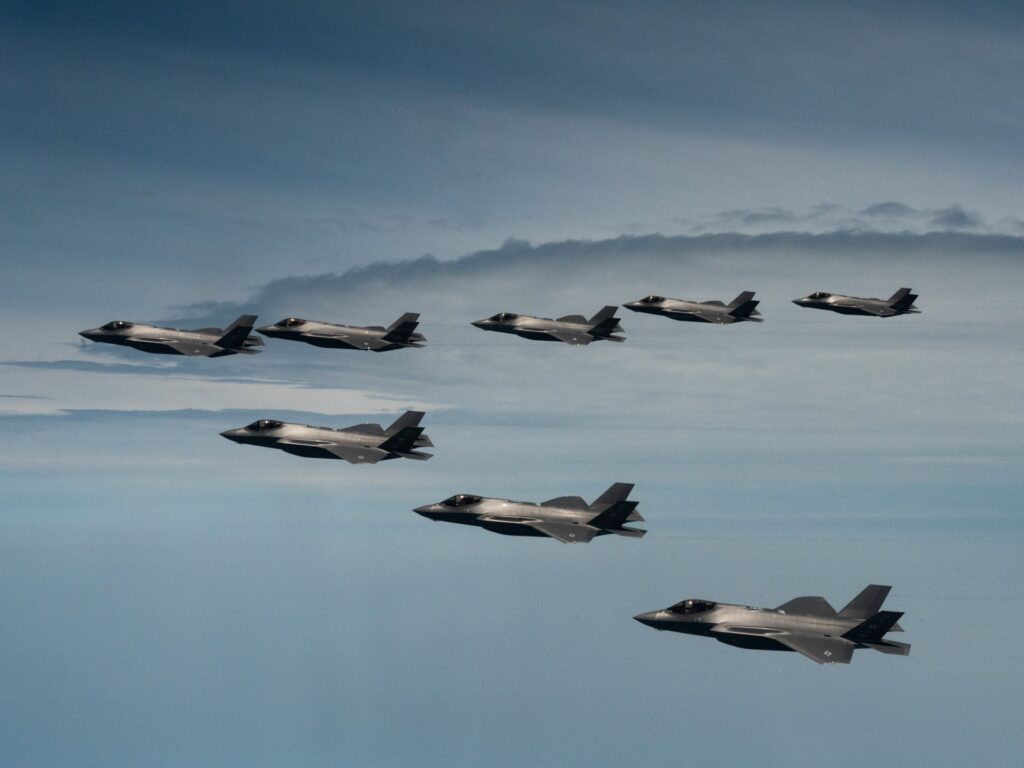
Recently, Iran claimed to have brought down a US F-35 fighter jet, an aircraft often described as ‘unkillable’ due to its advanced stealth technology and supersonic capabilities. The F-35 Lightning II is designed to evade radar detection and various advanced tracking systems, making it one of the most sophisticated military jets in the world.
The Iranian Revolutionary Guard Corps (IRGC) stated that they used an Iranian-made missile defense system to successfully target and destroy the F-35. According to Iranian sources, the jet was operating near Iranian airspace, and the successful strike underlines their growing military capabilities amidst increasing tensions in the region.
The F-35 is a fifth-generation multirole fighter jet that employs stealth technology, advanced sensors, and networking systems to maintain air superiority and conduct precision strikes. Its design minimizes radar cross-section and incorporates electronic countermeasures, which historically have made it difficult to detect and engage in combat.
However, Iran’s claim has been met with skepticism from defense analysts and US military officials. The US Department of Defense has not confirmed the loss of any F-35 jets to enemy fire. Additionally, independent verification of the incident is lacking, leading some experts to consider the claim part of a strategic narrative by Iran to showcase its defense prowess.
This event highlights the ongoing cat-and-mouse game in modern aerial warfare where advancements in stealth technology are continuously challenged by improvements in missile defense systems and radar tracking.
If true, the downing of an F-35 would signify a substantial shift in military balance, showcasing how emerging technologies and tactics are evolving. It would also suggest vulnerabilities in the US stealth technology that might prompt revisions in operational protocols and aircraft design.
Iran’s announcement comes at a time of strained US-Iran relations, with both sides ramping up military posturing and rhetoric. The incident adds a new layer of complexity to the geopolitical landscape of the Middle East and the role that advanced military hardware plays in regional security dynamics.
Regardless of the incident’s authenticity, it underscores the rapidly changing nature of military technology and demonstrates how even supposedly ‘unkillable’ assets face credible threats in modern combat scenarios. Militaries worldwide are investing heavily in counter-stealth technologies and integrated air defense systems to adapt to these evolving challenges.
In conclusion, Iran’s claim to have shot down an ‘unkillable’ F-35 is significant whether or not independently verified. It signals a bold declaration of military capability and serves as a reminder that no technology is impervious to countermeasures in the ever-advancing arena of global military engagements.