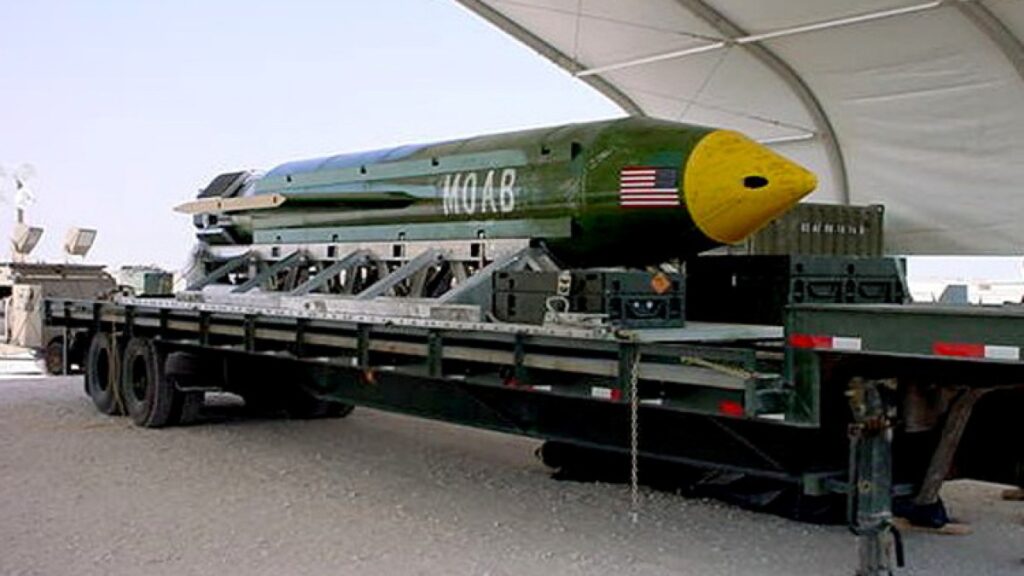
The GBU-43/B Massive Ordnance Air Blast Bomb, often referred to by its nickname the “Mother of All Bombs” (MOAB), is one of the most powerful non-nuclear bombs developed and used by the United States military. Recent US media reports suggest that the military is considering plans to deploy this massive bomb in potential actions involving Iran, raising significant international attention and concern.
The MOAB was developed by the U.S. Air Force in the early 2000s and first tested in 2003. It is designed to create a large blast effect over a wide area, using a powerful explosive force rather than nuclear energy. Weighing approximately 21,600 pounds (about 9,800 kilograms), it is the largest conventional bomb in the US arsenal.
Known for its devastating impact, the MOAB produces a massive shock wave that can destroy surface targets and underground bunkers, making it useful against heavily fortified enemy positions or tunnels. Despite its immense power, it is guided by GPS and dropped from a cargo plane, typically a C-130 Hercules, which releases it over the target area from high altitude.
The nickname “Mother of All Bombs” highlights the bomb’s significant destructive capability, derived from the phrase “Mother of All Bombs.” It gained public recognition when it was used for the first time in combat in April 2017 against ISIS militants in Afghanistan’s Nangarhar province, aiming to destroy enemy cave complexes.
If the US military were to employ the MOAB in Iran, it would mark a serious escalation given Iran’s geographic, political, and strategic significance. The decision would likely be influenced by the bomb’s effectiveness against hardened military targets and underground facilities, which are reportedly part of Iran’s strategic infrastructure.
However, the bomb’s use in such scenarios is fraught with risks. The blast radius and shockwave could cause significant collateral damage, potentially harming civilians and escalating regional tensions. International reactions would likely be swift and critical, with possible repercussions for global diplomacy and security.
Furthermore, deploying the MOAB signifies a move that might be aimed at demonstrating overwhelming military capability to deter adversaries or to achieve specific military objectives quickly. But this approach also raises questions about the humanitarian impact and the long-term consequences of such a decision.
In sum, the GBU-43/B MOAB represents a formidable conventional weapon that the US military might consider leveraging in sensitive geopolitical situations like the one with Iran. Its potential use underscores the ongoing complexity and volatility of international relations and military strategy in the region.