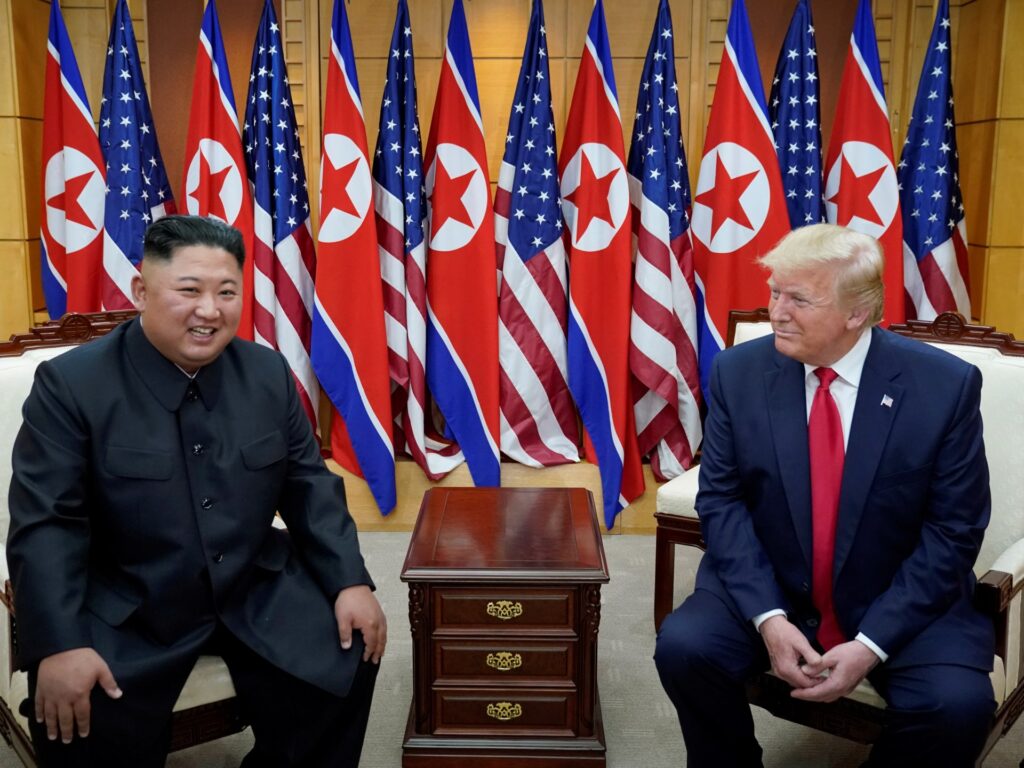
Former US President Donald Trump has revealed that North Korean leader Kim Jong Un has responded positively to his request for a conversation, marking a potentially significant development in the relationship between the two nations. Trump described the communications with Kim Jong Un as being at a ‘positive’ stage, suggesting a thaw in the often fraught interactions between the US and North Korea.
The announcement comes amid a complex geopolitical climate, with North Korea’s diplomatic moves attracting widespread attention. Trump’s comment implies that there could be a forthcoming dialogue aimed at easing tensions or addressing mutual concerns.
In a separate, contentious statement, Trump also criticized South Korea for refusing to join any potential war efforts against Iran. He expressed frustration with Seoul’s stance, implying that the South Korean government is not aligning itself with the interests of the US in the volatile Middle Eastern region.
Trump’s remarks reflect ongoing global tensions, where alliances and diplomatic strategies are constantly being re-evaluated. His criticism of South Korea highlights the differing approaches between the US and its Asian ally concerning the Iranian conflict, which has been escalating in recent times.
The prospect of a conversation with Kim Jong Un offers a glimmer of hope for diplomatic progress that could impact regional security and international relations positively. However, the situation remains fluid, with many experts cautioning that substantive outcomes from such interactions are often unpredictable.
Trump’s public statements are likely aimed at shaping the narrative around US foreign policy and reinforcing his own diplomatic credentials. The evolving situation underscores the importance of dialogue in international affairs, especially with nations like North Korea, where traditional channels of communication have often been limited or hostile.
Analysts suggest that if talks between Trump and Kim materialize, they could address key issues such as denuclearization, sanctions, and regional stability, though past negotiations have faced significant challenges.
Meanwhile, the critique of South Korea could influence diplomatic relations on the Korean Peninsula, potentially affecting cooperation on security matters and regional alliances.
This development is part of a broader pattern of shifting alliances and strategic maneuvering in global politics, where leaders use public statements as tools to pressure adversaries, reassure allies, and advance national interests.
As events unfold, the international community remains watchful of the interactions between the US, North Korea, and South Korea, understanding that these dialogues bear significant implications for peace and stability in East Asia and beyond. The coming weeks may reveal more about the sincerity and substance of the engagement initiated by Trump’s outreach to Kim Jong Un.