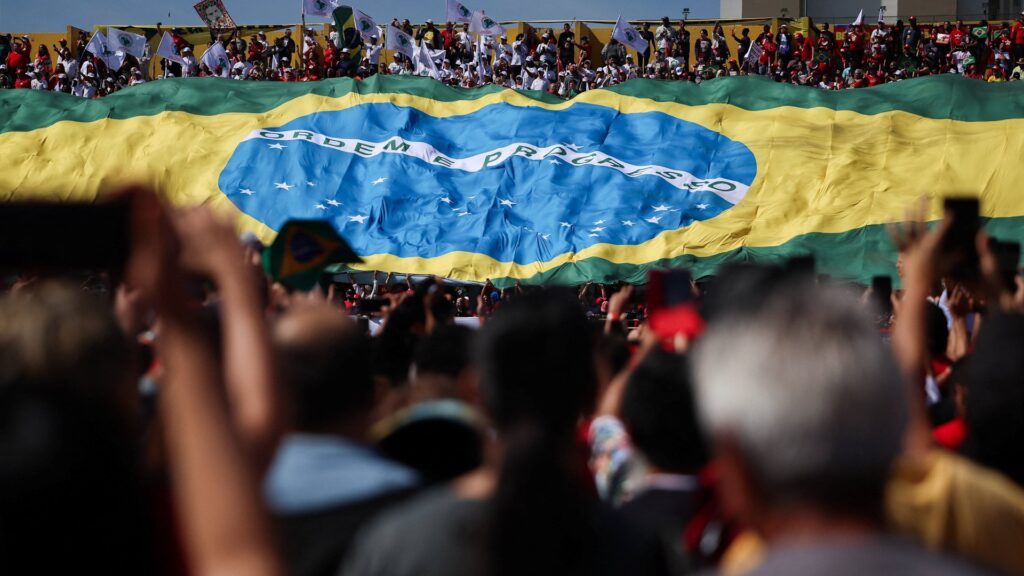
Brazil’s presidential race is officially underway with two prominent candidates launching their bids for the presidency. Luiz Inácio Lula da Silva, commonly known as Lula, and Eduardo Bolsonaro, the son of former President Jair Bolsonaro, have emerged as leading contenders. This election marks one of the most polarized and closely watched political events in Brazil’s recent history.
Lula, representing the leftist Workers’ Party (PT), is a former president who previously led Brazil between 2003 and 2010. Known for his social policies that significantly reduced poverty and expanded social welfare programs, Lula has a strong base of supporters who view him as a champion of the working class and progressive reforms. His tenure, however, has also been marked by controversies and corruption allegations, some of which led to his imprisonment before being released.
Eduardo Bolsonaro, a congressman and the third son of Jair Bolsonaro, is positioning himself as the continuity candidate representing the right-wing political legacy of his father. Jair Bolsonaro was president from 2019 to 2022 and is known for his conservative policies, populist rhetoric, and polarizing style of governance. Eduardo’s campaign emphasizes law and order, conservative values, and economic liberalization.
The presidential race between Lula and Bolsonaro’s son plays out against a backdrop of economic challenges, social inequality, and political divisions in Brazil. The country faces issues such as inflation, unemployment, environmental concerns particularly related to the Amazon rainforest, and public security.
Both candidates have been actively campaigning across the country’s diverse regions, addressing supporters and outlining their visions for Brazil’s future. Lula pledges to reinvigorate social programs and address inequalities, while Eduardo Bolsonaro promises to uphold conservative principles and implement pro-business policies.
The election is not just a contest between two individuals but a wider referendum on Brazil’s political direction. It reflects the deep ideological divide that has characterized Brazilian politics in recent years, with significant portions of the electorate supporting either a return to the leftist governance model or continuation of a conservative agenda.
Brazil’s elections are scheduled to take place later this year, with the potential for a runoff if no candidate achieves a majority in the first round. Observers domestically and internationally are closely watching the developments, as the outcome will have far-reaching implications for Brazil’s future stability, policy direction, and role on the global stage.
The political scenario in Brazil continues to be dynamic, with other candidates and parties also participating in the race. However, Lula and Eduardo Bolsonaro are considered the frontrunners due to their political backgrounds and strong support bases.
As the campaign intensifies, both candidates will need to address critical issues such as economic recovery, social justice, environmental protection, and national unity to convince the Brazilian electorate.
The upcoming presidential race thus represents a pivotal moment for Brazil, with the choice between competing visions for governance, social policies, and economic strategies set to shape the country’s trajectory in the years to come.