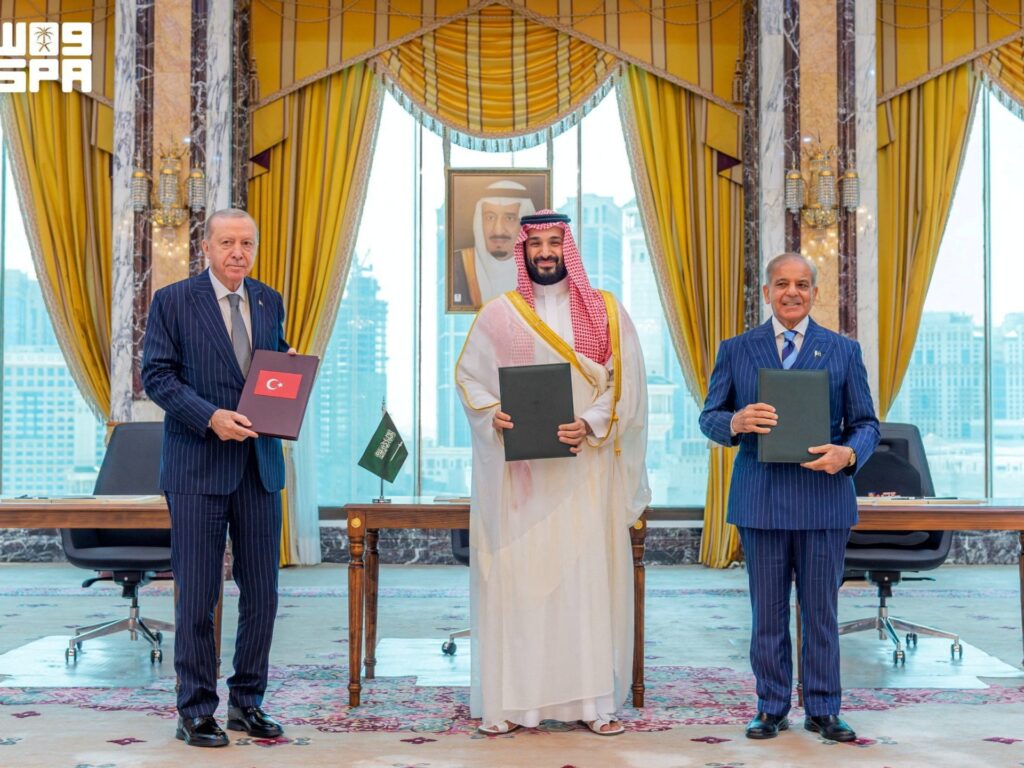
In a significant development in Middle Eastern geopolitics, Saudi Arabia, Pakistan, and Turkiye have entered into a strategic pact that has captured regional and international attention. The agreement, while not naming any specific adversary, is widely considered by analysts to be a move primarily influenced by concerns over Iran and its expansive regional network.
This trilateral pact suggests a deepening alignment among these three key Muslim-majority countries, emphasizing mutual interests and cooperation in the face of evolving security challenges. Although the pact stops short of explicitly identifying any enemy, the implicit reference to Iran reflects longstanding tensions and strategic competition in the region.
Iran has long been a dominant player in Middle Eastern affairs, with extensive alliances and proxies throughout the region. Saudi Arabia, Pakistan, and Turkiye, each with their own strategic stakes and historical complexities vis-à-vis Iran, see this alliance as a potential counterbalance to Tehran’s influence.
The three countries differ in their geopolitical orientations and internal dynamics. Saudi Arabia is a prominent Gulf power deeply involved in regional politics, economics, and security. Pakistan, with its significant military and nuclear capabilities, has traditionally maintained a delicate balance between various regional powers. Turkiye, straddling Europe and Asia, has increasingly asserted its regional ambitions, seeking greater influence in Middle Eastern and Islamic world affairs.
By forming this pact, the trio aims to consolidate collective security frameworks that enhance their defensive and diplomatic postures. This cooperation spans intelligence sharing, military coordination, counterterrorism efforts, and potentially economic partnership.
Observers point out that this pact signals a strategic recalibration. It is not merely about defense but about sending a message to Iran and other players that these nations are aligned and prepared to support each other’s interests in a volatile environment.
The agreement also has broader implications. It indicates a shift in regional alliances and a possible realignment of power dynamics that could affect the balance of influence among Gulf Cooperation Council (GCC) countries, South Asia, and the broader Middle East.
Furthermore, this trilateral cooperation might influence global powers engaged in the region. U.S., Russia, China, and the European Union will likely assess this pact within the context of their own strategic interests, especially concerning Iran’s nuclear program, energy supplies, and regional stability.
Critics of the pact argue that sidestepping direct mention of Iran might be a diplomatic strategy to maintain flexibility in engagement, avoiding overt hostility that could escalate tension. However, the strategic undertones clearly point towards a concerted effort to counterbalance Iran’s regional ambitions.
In conclusion, the Saudi-Pakistan-Turkiye pact represents more than a mere alliance; it is a strategic signal of evolving regional politics. As it unfolds, the pact will be closely watched by governments, analysts, and stakeholders invested in Middle Eastern peace and stability. Whether it becomes a robust shield or merely a symbolic gesture will depend greatly on the commitment of these countries to cooperation and the responses of Iran and the broader international community.