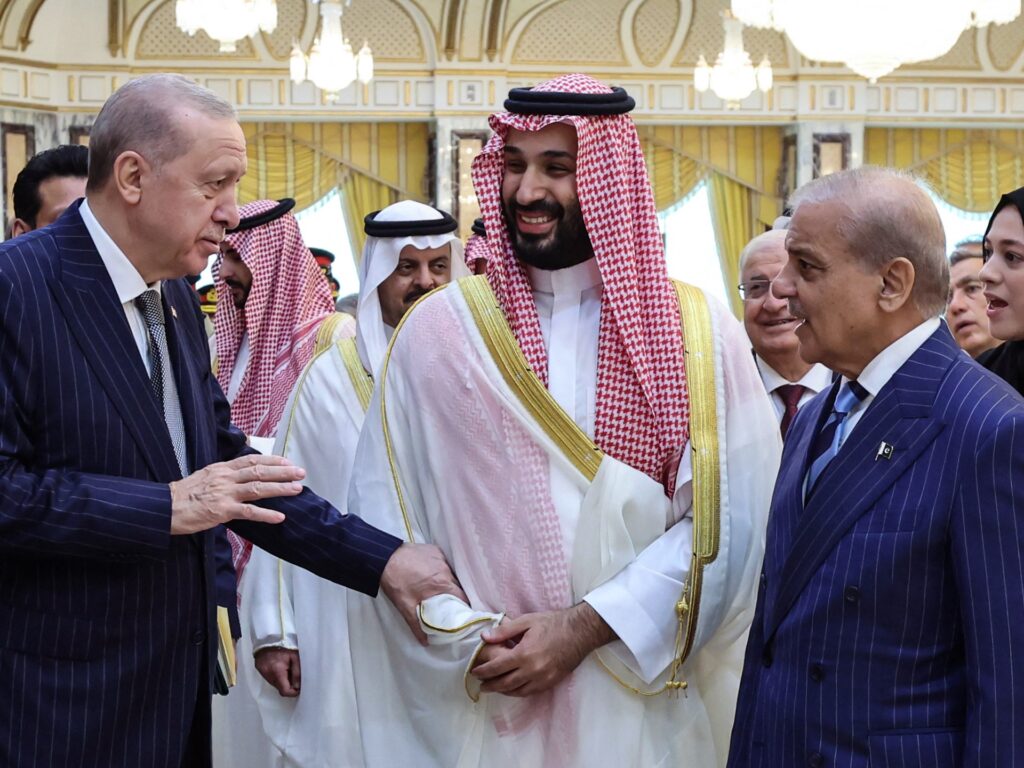
The recent Mecca Joint Defence Pact, which unites Pakistan, Saudi Arabia, and Turkey, marks a significant geopolitical development in a region historically characterized by complex alliances and rivalries. This alliance brings together three influential Muslim-majority nations strategically located between Iran and Israel, two major regional powers with longstanding contention.
The pact’s formation reflects these countries’ ambitions to create a new regional equilibrium, potentially redefining power dynamics across the Middle East and South Asia. Pakistan, with its strategic geopolitical position and military capabilities, Saudi Arabia, as a dominant Gulf state with vast economic resources and religious leadership, and Turkey, a rising regional power with expanding diplomatic and military influence, collectively represent a formidable coalition.
A key question is whether this alliance can effectively challenge or balance the influence of Iran and Israel, who have vied for dominance in the region through proxy conflicts and strategic partnerships. The Mecca Pact could serve as a counterbalance, aiming to prevent expansionism, secure borders, and promote cooperation among member states. However, its effectiveness depends on the extent of genuine cooperation, coordination in defense policies, and mutual trust.
Several factors may affect the alliance’s impact. First, the historical complexities within and between these nations, including varying political systems, economic interests, and regional ambitions, may limit cohesion. For example, Pakistan’s traditionally cautious stance toward Middle Eastern conflicts might contrast with Saudi Arabia’s assertive regional policies. Similarly, Turkey’s independent foreign policy aspirations sometimes diverge from Saudi and Pakistani approaches.
Second, the alliance must navigate the broader regional environment involving global powers such as the United States, Russia, and China, which maintain significant stakes in Middle Eastern stability and resource security.
Furthermore, the alliance’s practical military integration, intelligence sharing, and joint strategic planning will be critical indicators of its potential to foster a new regional order. If successful, the Mecca Joint Defence Pact could lead to strengthened deterrence capabilities against perceived threats and a unified front supporting regional stability.
Finally, the alliance could influence diplomatic negotiations and conflict mediation in the region, potentially offering alternative frameworks to those dominated by Western powers. However, skepticism remains about how deeply this pact can overcome historical mistrust or competing national interests.
In conclusion, the Pakistan-Saudi-Turkiye alliance through the Mecca Joint Defence Pact holds the potential to create a new regional order, but its effectiveness is contingent upon overcoming internal differences, successfully integrating defense and strategic objectives, and responding to external geopolitical pressures. Its evolution will be a critical development to watch in the continuously shifting landscape of Middle Eastern and South Asian geopolitics.