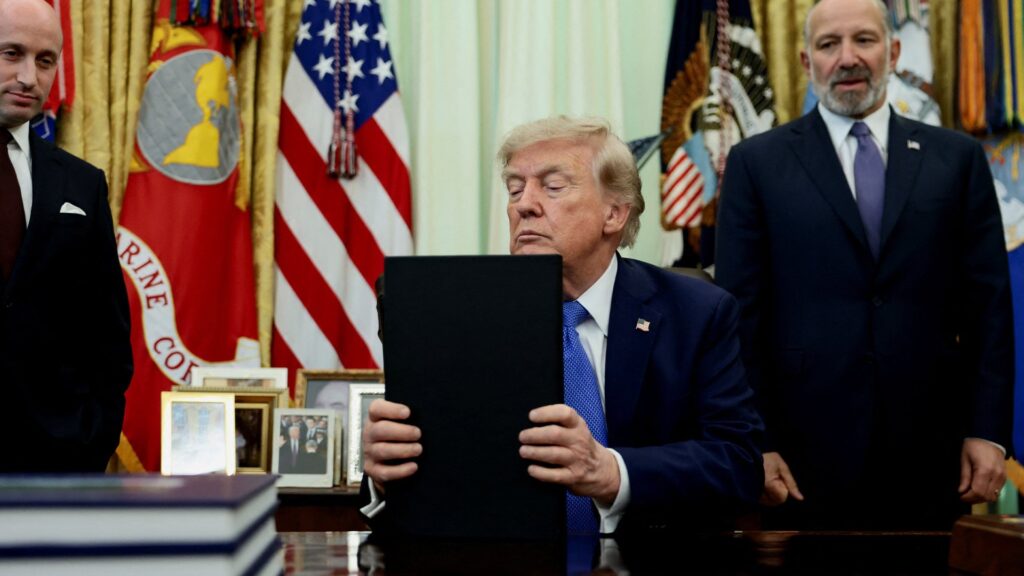
US President Donald Trump has taken a significant step to curb what is commonly referred to as ‘birth tourism’ by signing two executive orders aimed at further restricting the eligibility for birthright citizenship. Birthright citizenship, a policy under the 14th Amendment which grants automatic citizenship to anyone born on US soil, has been a contentious issue, especially among those who believe it encourages non-citizens to travel to the US solely for the purpose of giving birth and securing citizenship for their child.
The executive orders target individuals who travel to the United States specifically to give birth in order to secure US citizenship for their children. This phenomenon, often used by wealthy foreigners, has impacted immigration policies and intensified debates about the scope and limits of the 14th Amendment.
President Trump’s new directives aim to make it harder for such individuals to exploit the birthright citizenship laws. The orders instruct immigration authorities and relevant government agencies to tighten visa screening processes, enhance border security, and scrutinize cases where birth tourism might be suspected.
One of the executive orders directs the Department of State and homeland security agencies to review all visa applications suspected of being linked to birth tourism and to deny entry if the primary intent is to give birth and obtain citizenship for the child. It also calls for increased cooperation between federal and state law enforcement to detect and prevent fraudulent activities related to birth tourism.
Additionally, these orders emphasize the protection of US citizens’ rights while ensuring that immigration policies are not abused. The administration argues that the current birthright citizenship laws are being exploited without consideration for the welfare and legal status of the child or parents involved.
Critics of birth tourism point out that this practice places a strain on public resources and social services, as children born in the US automatically qualify for public benefits. There is also concern that it undermines the spirit of naturalization laws that intend citizenship to be earned through residency and integration.
Supporters of the executive orders claim they address a loophole that allows foreign nationals to benefit from US citizenship without meeting traditional residency or legal immigration standards. They argue that tightening the rules preserves the integrity of US citizenship and ensures that benefits are reserved for those with a genuine long-term connection to the country.
On the other hand, opponents criticize these measures, saying they could undermine the constitutional rights of children born in the US, regardless of their parents’ status. Legal experts warn that any attempt to limit birthright citizenship could face challenges in courts, as the 14th Amendment explicitly grants citizenship to all born on US soil.
The debate over birth tourism and birthright citizenship has intensified in recent years, crossing into broader discussions about immigration policy and national identity. President Trump’s executive orders reflect a broader agenda to tighten immigration controls and address loopholes perceived to be exploited by foreign nationals.
In practical terms, these orders could lead to more rigorous visa application processes, greater scrutiny at points of entry, and possible legal reforms in the future. Immigration authorities may also increase investigative efforts to identify and deter those participating in birth tourism.
However, the impact of these executive orders remains to be seen as legal battles and political opposition could delay or dilute their implementation. Birthright citizenship remains a foundational element of US law, and any changes could have far-reaching consequences.
In conclusion, President Trump’s signing of executive orders banning birth tourism marks a key development in the ongoing efforts to reform immigration policies. It highlights the administration’s focus on curbing practices viewed as exploiting US laws while igniting significant debate over the rights of children and the responsibilities of immigration enforcement. The coming months may reveal how these orders influence immigration administration and the complex dialogue surrounding citizenship in America.