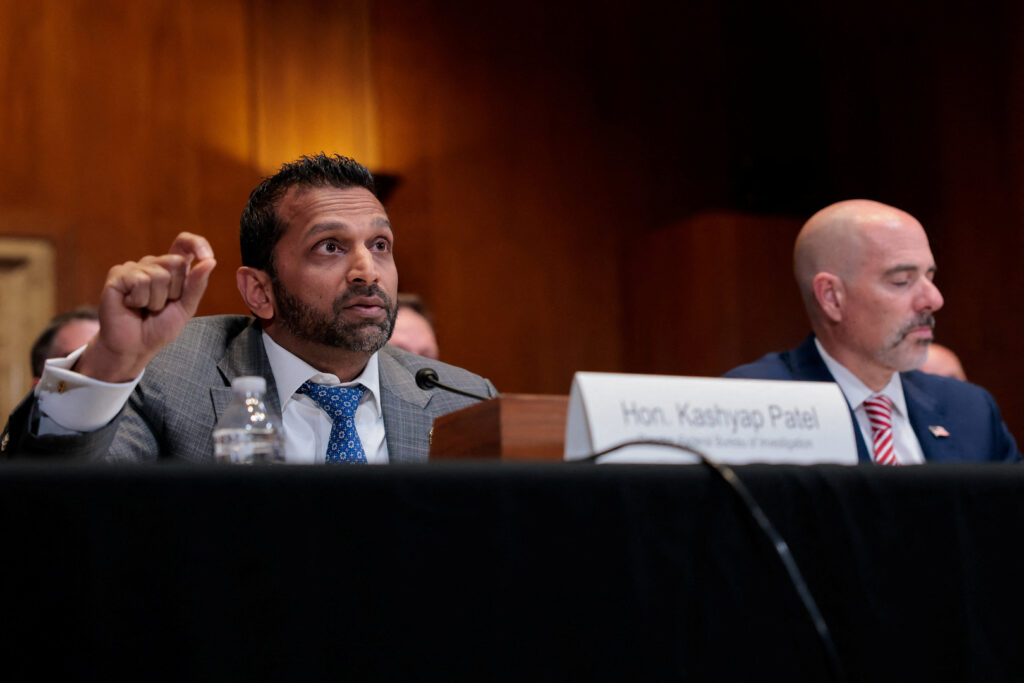
FBI Director Kash Patel, sitting next to Drug Enforcement Administration (DEA) Administrator Terrance C. Cole, testifies before a Senate Appropriations Commerce, Justice, Science, and Related Agencies Subcommittee hearing on U.S. President Donald Trump's FY2027 budget request for the Federal Bureau of Investigation (FBI), the Drug Enforcement Administration (DEA); the United States Marshals Service; and the Bureau of Alcohol, Tobacco, Firearms and Explosives (ATF), on Capitol Hill in Washington, D.C., U.S., May 12, 2026. REUTERS/Kylie Cooper
During a tense Senate budget hearing, FBI Director Kash Patel exchanged heated remarks with Senator Chris Van Hollen, a confrontation that spotlighted allegations concerning Patel’s drinking habits. The hearing, primarily focused on the FBI’s budget and operational priorities, devolved into a contentious debate when Van Hollen brought up questions about Patel’s personal conduct, specifically allegations of excessive drinking.
Patel promptly rejected the accusations, characterizing them as unfounded and politically motivated attempts to undermine his leadership. He emphasized his dedication to the FBI’s mission and highlighted his commitment to maintaining professional standards and effective agency operations.
Senator Van Hollen, known for his critical stance on law enforcement oversight, argued that such behavior would be inappropriate for someone leading a crucial national security agency. The Senator called for greater transparency about Patel’s conduct, stating that public officials must be held to the highest standards.
The exchange became a focal point of the hearing, drawing attention from both the media and the public. Despite the heated nature of their interaction, both parties ultimately agreed on the importance of securing adequate funding for the FBI to address pressing security challenges.
This incident underscores the often contentious relationship between Congressional oversight committees and executive branch officials. While budgetary hearings typically concentrate on financial and operational details, personal allegations introduced into the dialogue can complicate proceedings.
Director Patel’s forceful response to the drinking allegations indicates his intent to maintain authority and credibility in the face of scrutiny. The FBI continues to operate under intense public and political examination, especially concerning leadership accountability.
As the budget debates continue, the hearing highlighted the delicate balance between oversight responsibilities and political maneuvering. The FBI’s future funding timelines, strategic initiatives, and leadership stability remain key issues for lawmakers watching closely.
In conclusion, the confrontation between Patel and Van Hollen represents a microcosm of larger debates regarding political accountability, personal conduct, and the challenges inherent in managing national security institutions under public scrutiny. Both figures will likely remain central in the unfolding discussions about the FBI’s role and leadership going forward.