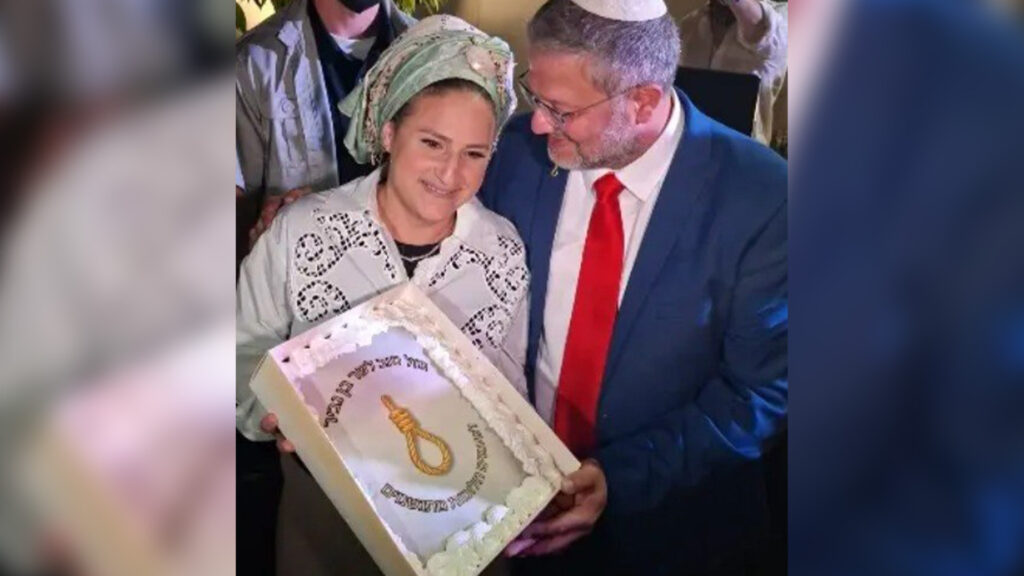
Itamar Ben-Gvir, an Israeli far-right politician, marked his 50th birthday with a highly controversial cake that featured a depiction of a death penalty noose. This symbolism directly referenced the recently enacted law permitting the death penalty for Palestinians convicted of terrorism-related offenses — a move that has sparked widespread debate both within Israel and internationally.
Ben-Gvir’s choice to incorporate this imagery into his birthday celebration has drawn sharp criticism from various quarters, including human rights organizations, political opponents, and international observers. Critics argue that the celebration trivializes the gravity of capital punishment and exacerbates tensions in an already volatile region.
The new legislation, championed by Ben-Gvir and his political allies, was introduced in response to a surge of violence and attacks. It allows for the death penalty to be imposed on Palestinian attackers, a legal stance that had previously been absent in Israeli law. Supporters claim it acts as a deterrent against terrorism, while opponents see it as a harsh and disproportionate measure that undermines prospects for peace.
Ben-Gvir’s birthday celebration cake reportedly was decorated with the image of a noose, symbolizing the death penalty, alongside messages of support for the law’s implementation. The imagery was interpreted by many as a provocative endorsement of capital punishment and a broader hardline approach toward Palestinians.
This public display comes amid escalating tensions and violence in the region, where the Israeli-Palestinian conflict continues to cause significant suffering and instability. Human rights activists have condemned the death penalty law as a violation of international law and have called on the Israeli government to reconsider its stance.
The controversy surrounding Ben-Gvir’s birthday cake has further polarized public opinion. Supporters praise his firm stance on security and justice, framing the celebration as a statement of resolve. Critics contend that such symbolism deepens divisions and could incite further violence.
In response to the backlash, some defenders of Ben-Gvir argue that the cake was a private celebration and a form of political expression. They assert that the image of the noose reflects the frustrations of many Israelis facing threats and violence.
Internationally, the death penalty law and related incidents like Ben-Gvir’s birthday cake have attracted attention from governments, media, and human rights bodies. Calls for restraint and dialogue continue to be emphasized in efforts to address the root causes of conflict.
As the Israeli-Palestinian situation remains complex and fragile, actions like Ben-Gvir’s public celebration underscore the deep divisions and the challenges of achieving peaceful coexistence. While the death penalty law represents a significant legal shift, its implications are still unfolding, especially as reactions come from various sectors of society and the international community.
Ben-Gvir’s birthday celebration thus stands as a symbol of the contentious political climate and the ongoing struggle over security, justice, and human rights in Israel and the Palestinian territories.