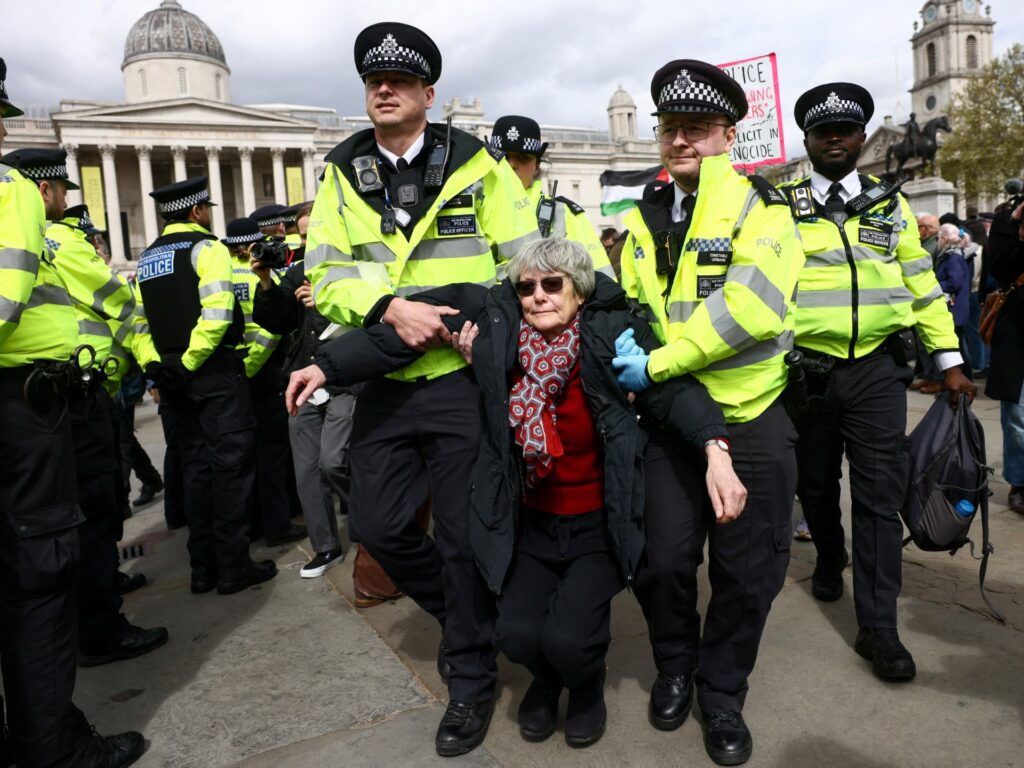
In a significant development at a protest in the United Kingdom, police have commenced arrests amidst a demonstration against the ban on Palestine Action, an activist group. The protest drew hundreds of people to Trafalgar Square, a notable public space in London, underscoring the intensity and scale of public dissent.
The gathering was marked by a diverse group of protesters, united in their opposition to the ban imposed on Palestine Action. This organization, known for its direct action tactics aimed at the Israeli arms industry, has been a subject of controversy and legal scrutiny in the UK.
During the protest, police were seen escorting an elderly woman with a cane away from the scene, an incident that highlighted the tense atmosphere and the determined participation of individuals from all walks of life.
Authorities have stated that the arrests are part of their effort to maintain public order and enforce the ban. However, protesters argue that their right to demonstrate and express their views is fundamental and must be respected.
The event has sparked a broad public debate on the balance between security measures and civil liberties, particularly concerning the right to protest peacefully. Supporters of Palestine Action claim that the ban suppresses legitimate activism and stifles important political discourse regarding the Israeli-Palestinian conflict.
This protest and the subsequent police response reflect wider tensions in the UK and beyond concerning activism, state authority, and the political sensitivity of the Palestine issue. As the situation develops, further demonstrations and legal challenges may be anticipated.
The ban on Palestine Action and the police action at the protest are likely to remain focal points in discussions about political activism, freedom of expression, and the role of law enforcement in managing dissent in democratic societies. The incident at Trafalgar Square serves as a potent reminder of the complex interplay between protest movements and government policies in contemporary Britain.