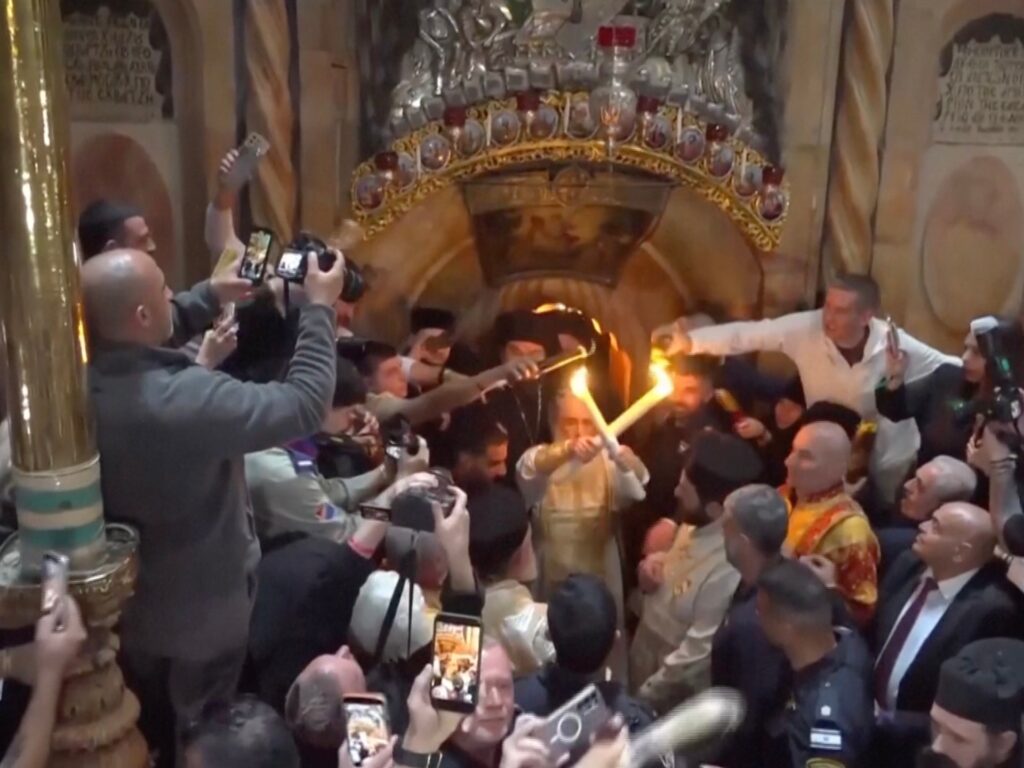
As Israel eases COVID-19 restrictions, Orthodox Christians have returned to celebrate the Easter Holy Fire ceremony at Jerusalem’s Holy Sepulchre, marking a significant moment for faith and tradition. The Holy Sepulchre, revered as the site of Jesus Christ’s crucifixion, burial, and resurrection, holds profound significance for Christians worldwide. For the first time in two years, worshippers gathered inside the church, adorned with renewed hope and devotion.
The Holy Fire ceremony, an ancient ritual symbolizing the resurrection of Christ, draws thousands of pilgrims annually. Typically held on Holy Saturday, the event features the lighting of the Holy Fire within the tomb of Jesus, which is then shared among the faithful to carry into their homes and communities.
This year’s celebration was particularly poignant as it marked a return to near-normalcy after pandemic-induced restrictions limited participation and attendance. Israeli authorities implemented safety measures to ensure the ceremony proceeded smoothly and safely, reflecting a balance between public health and religious observance.
Clergy from several Christian denominations, including Greek Orthodox, Armenian Apostolic, and Roman Catholic churches, come together in a rare and powerful display of unity. This ecumenical cooperation is a testament to the shared reverence for the Holy Sepulchre despite denominational differences.
The easing of restrictions in Jerusalem has also allowed local businesses near the Old City to welcome visitors again, boosting the local economy and restoring a sense of normal life. Pilgrimages and religious tourism, vital to Jerusalem’s economy, have started to recover, bringing joy to vendors, guides, and residents alike.
Local Orthodox Christian leaders expressed gratitude for the return of the faithful and emphasized the spiritual significance of the Holy Fire ceremony as a beacon of hope and renewal in challenging times.
The Holy Sepulchre continues to be a focal point for Christian pilgrimage, spirituality, and cultural heritage. Its reopening to large crowds symbolizes a milestone in the global efforts to resume religious traditions disrupted by the pandemic.
As Jerusalem continues to navigate the post-pandemic landscape, the return of the Easter Holy Fire ceremony stands as a luminous reminder of faith, resilience, and community continuity.