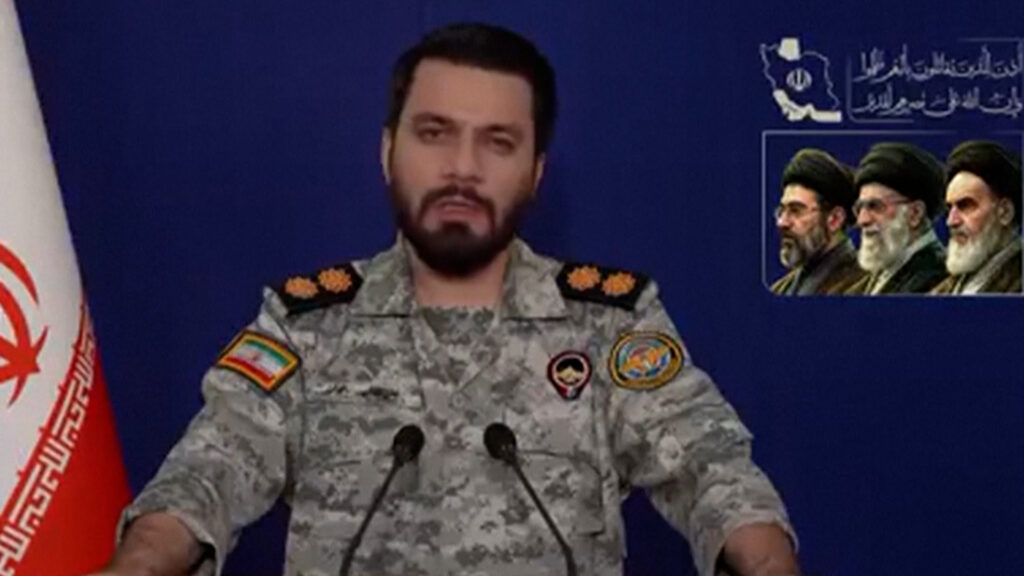
Ebrahim Zolfaghari, the spokesperson for Iran’s Islamic Revolutionary Guard Corps (IRGC), has publicly addressed recent threats of US ground operations, dismissing them as ineffectual and misguided. In a statement reflecting the IRGC’s stance, Zolfaghari emphasized that former US President Donald Trump ‘only understands the language of force,’ indicating a belief that diplomatic or peaceful efforts are unlikely with his administration or those adopting similar approaches.
Zolfaghari’s remarks come amid rising tensions between the United States and Iran, where military posturing and political rhetoric have escalated concerns about potential conflict in the region. The IRGC, a powerful branch of Iran’s armed forces, plays a critical role in national security and is often vocal about the country’s defense policies and responses to perceived external threats.
The spokesperson’s dismissal of US threats suggests that Iran is currently adopting a firm stance against what it perceives as US aggression. By stating that Trump only understands force, Zolfaghari underlines a narrative that Iran’s adversaries rely on military intimidation rather than negotiation or compromise.
This dialogue between the IRGC and the US highlights the ongoing complexity of US-Iran relations, which have historically fluctuated between efforts at diplomacy and episodes of intense hostility. The US has previously warned Iran against various military and nuclear developments, often with the implicit or explicit threat of ground operations.
However, the IRGC’s reaction points to a strategic confidence within Iranian ranks, reinforcing their readiness to resist any military intervention. Zolfaghari’s comments serve to boost morale internally and signal to external observers that Iran sees itself prepared to confront any escalation.
Analysts suggest that such statements are part of a broader information campaign designed to project strength and deter adversaries. Iran’s messaging often aims to frame the US as an aggressor, thereby justifying Iran’s defensive measures and regional activities.
In the wake of these declarations, international diplomatic circles are likely to advocate for de-escalation and caution against rhetoric that could lead to misunderstanding or conflict. Experts emphasize the need for dialogue and restraint from all parties to maintain regional stability.
The IRGC spokesperson’s remarks also reflect broader geopolitical undercurrents, including the interplay between US foreign policy changes and Iranian strategic calculations. Even though Trump is no longer in office, his administration’s policies continue to influence perceptions and actions on both sides.
In conclusion, Ebrahim Zolfaghari’s statement underscores the persistent volatility in US-Iran relations and the challenges that arise when diplomacy is sidelined in favor of forceful rhetoric. The global community remains watchful as both nations navigate this tense period, with hopes pinned on diplomatic engagement to avoid military confrontation.