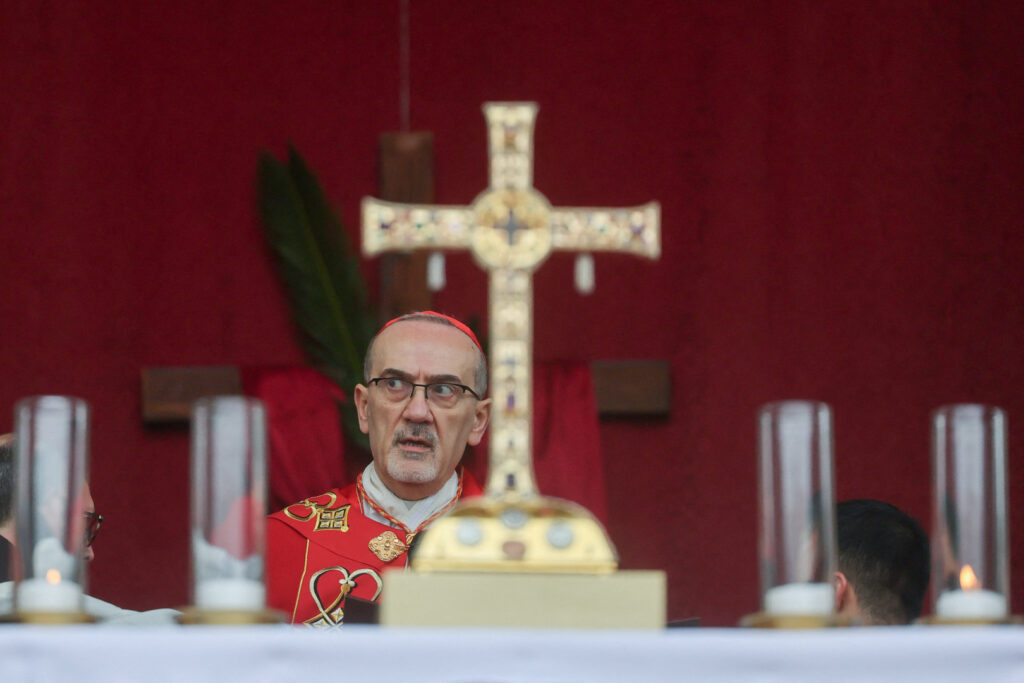
Cardinal Pierbattista Pizzaballa, the Latin Patriarch of Jerusalem, holds a prayer service to mark Palm Sunday, following the cancellation of the traditional Palm Sunday procession from the Mount of Olives, amid restrictions on gathering in large groups and the U.S.-Israeli conflict with Iran, in Jerusalem, March 29, 2026. REUTERS/Ammar Awad/Pool
On Palm Sunday, a significant day in the Christian Holy Week, tensions were heightened in Jerusalem as Israeli police barred a priest, specifically the Latin Patriarch, from entering the Church of the Holy Sepulchre. This unprecedented move came amidst ongoing wartime restrictions in the city, affecting the traditional celebrations of Christians during this sacred period.
The Church of the Holy Sepulchre, located in Jerusalem’s Old City, is a site of immense religious importance, believed to be the location of Jesus Christ’s crucifixion, burial, and resurrection. The Latin Patriarch, an important figure for the Christian community, was prevented from entering this holy site, causing concern among believers and religious leaders.
This action by the Israeli police is part of broader security measures imposed in Jerusalem due to the volatile security situation. These measures have impacted religious rituals and pilgrimages, creating an atmosphere of tension and uncertainty for those observing Holy Week.
Christians around the world, especially in Jerusalem, celebrate Palm Sunday with processions and prayers commemorating Jesus’s triumphant entry into Jerusalem. This year, however, the celebrations have been overshadowed by political and security challenges.
The barring of the Latin Patriarch highlights the complex intersection of religion, politics, and security in Jerusalem. Christian leaders have expressed disappointment and concern over the restrictions, emphasizing the importance of freedom of worship and access to sacred sites.
Local Christian communities have been striving to maintain their religious practices despite these difficulties, often facing limitations in their movements and gatherings. The tension underscores the fragile coexistence in Jerusalem, a city sacred to multiple faiths.
International religious and political bodies have called for a reconsideration of these restrictions to ensure that worshippers can freely participate in Holy Week ceremonies without fear or impediment.
The situation reflects the broader challenges of maintaining religious harmony and security in a city that is a focal point for Judaism, Christianity, and Islam. As the Holy Week progresses, the international community watches closely, hoping for peaceful resolutions that respect religious traditions and security concerns alike.
In summary, the barring of the Latin Patriarch from the Holy Sepulchre on Palm Sunday by Israeli police marks a significant moment amidst wartime restrictions in Jerusalem. It serves as a reminder of the ongoing struggles faced by religious communities in regions of conflict and the urgent need for dialogue and cooperation to protect religious freedoms and promote peace.