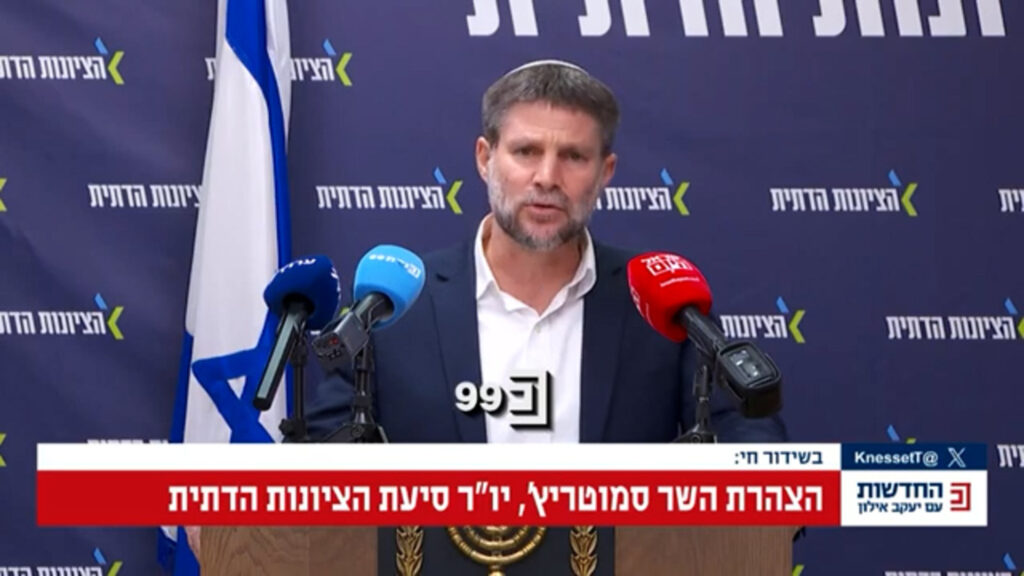
Israel’s Finance Minister Bezalel Smotrich has recently made a significant and controversial statement calling for the establishment of a ‘new border’ and the effective annexation of southern Lebanon. This announcement signals a potential shift in Israel’s approach to its northern neighbor, a region that has long been a flashpoint of tension and conflict.
Smotrich’s call for a new border implies a move beyond the long-standing United Nations-established delineation between Israel and Lebanon, known as the Blue Line. By advocating for the occupation of southern Lebanon, Smotrich aims to assert stronger Israeli control over this strategically sensitive area. Historically, southern Lebanon has been a contested region, with past conflicts involving Hezbollah, an influential militant group backed by Iran.
The implications of such a move are profound. Implementing a new border through occupation could heighten tensions not only between Israel and Lebanon but also across the broader Middle East. It risks igniting new conflict cycles, complicating peace efforts, and destabilizing an already volatile region. Moreover, this proposal is likely to draw international scrutiny, as Lebanon’s sovereignty and territorial integrity are key concerns for many global actors, including the United Nations, the United States, and European countries.
Smotrich, known for his right-wing views and strong nationalist stance, has often advocated policies that emphasize Israeli security and territorial claims. His recent statements are consistent with his track record but represent a sharp escalation from previous Israeli policies that largely respected the Blue Line as the de facto border.
The call for annexation comes amid ongoing security concerns for Israel, including cross-border attacks and rocket fire originating from southern Lebanon. While Israel justifies stricter measures to ensure national security, Lebanon faces internal political challenges and a struggling economy, complicating its ability to respond effectively.
International responses have varied, with some expressing concern over potential escalation, while others urge restraint and dialogue. The United Nations Interim Force in Lebanon (UNIFIL), tasked with monitoring the border area, has repeatedly urged all parties to maintain calm and respect existing agreements.
Experts warn that unilateral changes to borders or occupations in this sensitive area could lead to a broader conflict, undermining years of diplomatic efforts aimed at peace and stability. They emphasize the need for dialogue and negotiation involving all stakeholders, including Lebanon’s government and international mediators.
In conclusion, Finance Minister Bezalel Smotrich’s call for a new border and occupation of southern Lebanon marks a critical moment in Israeli-Lebanese relations. The proposal underscores deep-rooted regional tensions and presents a challenging scenario for peace and stability in the Middle East. As the international community watches closely, the coming weeks will be pivotal in determining whether this rhetoric will translate into concrete actions or lead to renewed conflict.