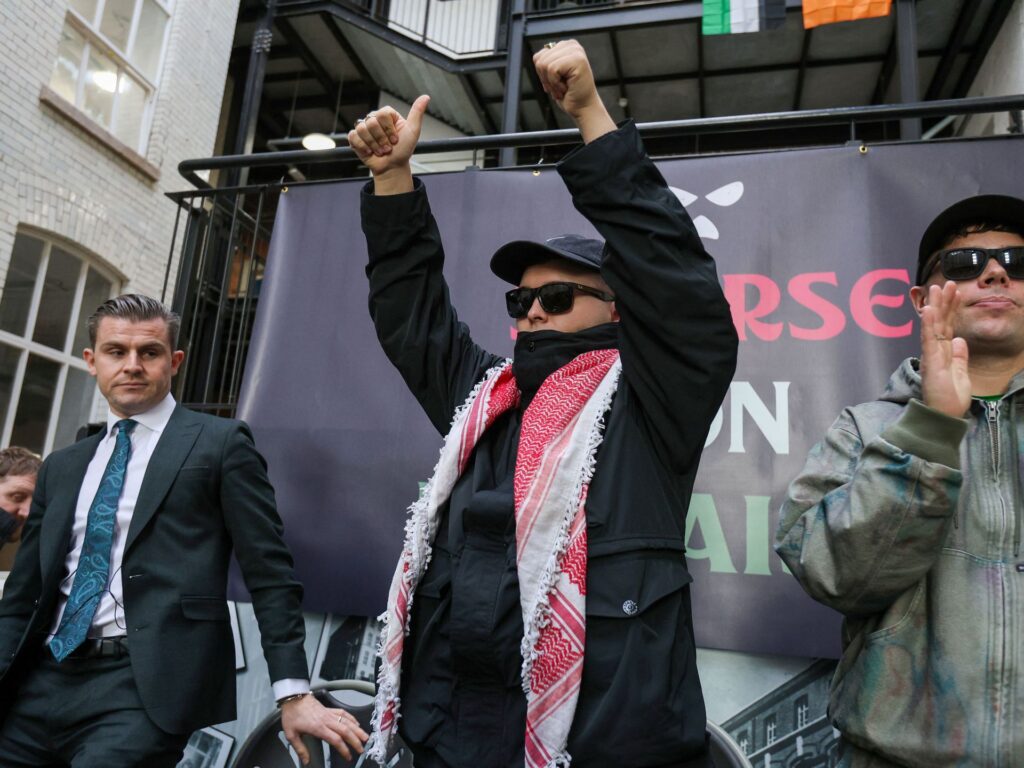
In a significant legal development, a UK court has decisively rejected an attempt to reinstate a terrorism charge against Liam O’Hanna, a rapper known by the stage name Kneecap. This ruling marks a pivotal moment in a case that has drawn considerable public and media attention due to its controversial nature and implications for artistic expression.
Liam O’Hanna, who is originally from Belfast and uses his music to express political and social issues, had been previously charged under terrorism-related provisions. However, O’Hanna has consistently maintained that the charges were unfounded and unrelated to any real threat to public safety.
The court’s rejection to revive the terrorism charge was welcomed by O’Hanna, who described the case as “never about any threat to the public, never about terrorism.” His legal team argued that the charges were an overreach and that his lyrics and artistic expression should not be misconstrued as incitement or support for terrorism.
Throughout the proceedings, advocates for O’Hanna emphasized the importance of protecting freedom of speech and artistic expression, especially in complex political contexts such as Northern Ireland, where historical tensions still influence public discourse. They have argued that criminalizing artistic content without clear evidence of intent to commit violence sets a dangerous precedent.
The case against O’Hanna had raised serious concerns among free speech activists, who feared that the terrorism charge could be used as a tool to suppress dissenting voices and minority perspectives in music and other forms of art. Critics have pointed out that the justice system must carefully differentiate between extremist content and legitimate political commentary.
This ruling is seen as a victory for advocates of civil liberties and artistic freedom, reaffirming that allegations must be substantiated with concrete evidence before leading to severe legal consequences like terrorism charges. Legal experts suggest that this case could influence how similar cases are handled in the future, potentially leading to more cautious approaches when dealing with artists accused of controversial statements.
Liam O’Hanna’s supporters view this verdict as a recognition of the complex role of artists in society—individuals who challenge norms and provoke thought rather than incite violence. O’Hanna himself has vowed to continue making music that reflects his views and experiences without fear of unjust legal repercussions.
In addition to its implications for the arts, the ruling also highlights ongoing tensions in the UK regarding counterterrorism laws and their application. As governments continue to balance national security with human rights, this case serves as a reminder of the necessity for judicial systems to uphold fairness and contextual understanding.
The conclusion of this case brings relief not only to Liam O’Hanna but also to a broader community of artists, activists, and free speech proponents who see this as a triumph against the misuse of anti-terrorism legislation. Moving forward, it remains essential for legal frameworks to protect both public safety and individual freedoms without conflating them unjustly.
Overall, the UK’s judiciary decision reinforces the critical principle that charges as serious as terrorism must be based on clear and convincing evidence, thereby protecting innocent individuals from wrongful prosecution and safeguarding democratic values in society.