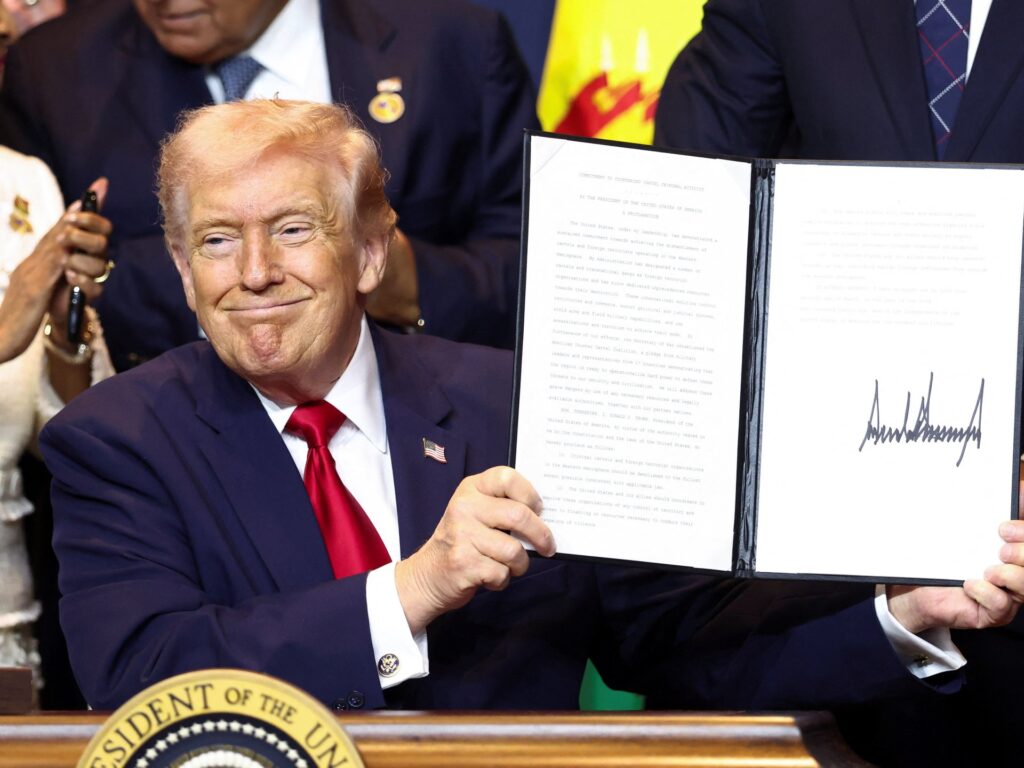
At a recent Latin American summit, President Donald Trump delivered a stark warning to criminal organizations and certain governments in the region, describing cartels as a “cancer” that must be eradicated. In a dramatic declaration, Trump suggested that the United States might consider launching missiles into Latin America as a means to combat the spread of criminal violence.
Trump’s remarks came amid heightened tensions surrounding drug trafficking and cartel violence that continue to plague parts of Latin America and spill over into the United States. He specifically singled out Cuba alongside criminal cartels, indicating a tough stance against any entities he perceives as contributing to regional instability.
During his speech, Trump emphasized the urgency of dealing decisively with these groups. “They’re a cancer that affects all our countries,” he said, underscoring the threat these criminal networks pose to public safety, economic development, and governance throughout Latin America.
The president’s threat to use military force, including missile strikes, marks a significant escalation in rhetoric compared to previous diplomatic approaches. While this statement underscores the administration’s frustration with ongoing violence and lawlessness, it also raises concerns about potential conflicts that could arise from aggressive unilateral actions.
Officials from various Latin American countries expressed mixed reactions to Trump’s comments. Some welcomed stronger cooperation and tangible action against cartels, while others criticized the aggressive language and the suggestion of foreign military intervention in their region.
The call to “eradicate” cartels aligns with ongoing efforts by the United States and regional partners to dismantle drug trafficking organizations through law enforcement collaboration, intelligence sharing, and economic measures. However, Trump’s allusion to missile deployment has introduced a new level of alarm among diplomats and analysts.
Historically, the United States has engaged with Latin America primarily through programs aimed at improving security cooperation and institutional strengthening rather than direct military engagement. The current rhetoric signals a potential shift in strategy, reflecting the administration’s hardline position on crime and governance challenges.
Critics argue that aggressive military threats risk destabilizing regions further, potentially endangering civilians and complicating diplomatic relations. Supporters contend that bold actions are necessary to decisively confront entrenched criminal enterprises that benefit from corruption and weak state institutions.
The president’s comments also touched on Cuba, accusing the government of harboring or enabling illicit activities linked to the cartels. This accusation adds another layer of complexity to diplomatic relations between the U.S. and Cuba, which have seen fluctuations in recent years.
The Latin American summit provided a platform for leaders to discuss these pressing issues, with the hope of fostering cooperative regional solutions. Trump’s forceful message has sparked debate about the most effective and ethical methods to address the intertwined problems of drug trafficking, violence, and political instability.
In conclusion, President Trump’s warnings about cartels and Cuba at the summit highlight the ongoing challenges faced by Latin America and underscore the importance of collaborative strategies. While the threat of missile strikes represents a stark and controversial proposition, it reflects the administration’s commitment to tackling criminal violence, albeit through a contentious approach that has sparked international concern.