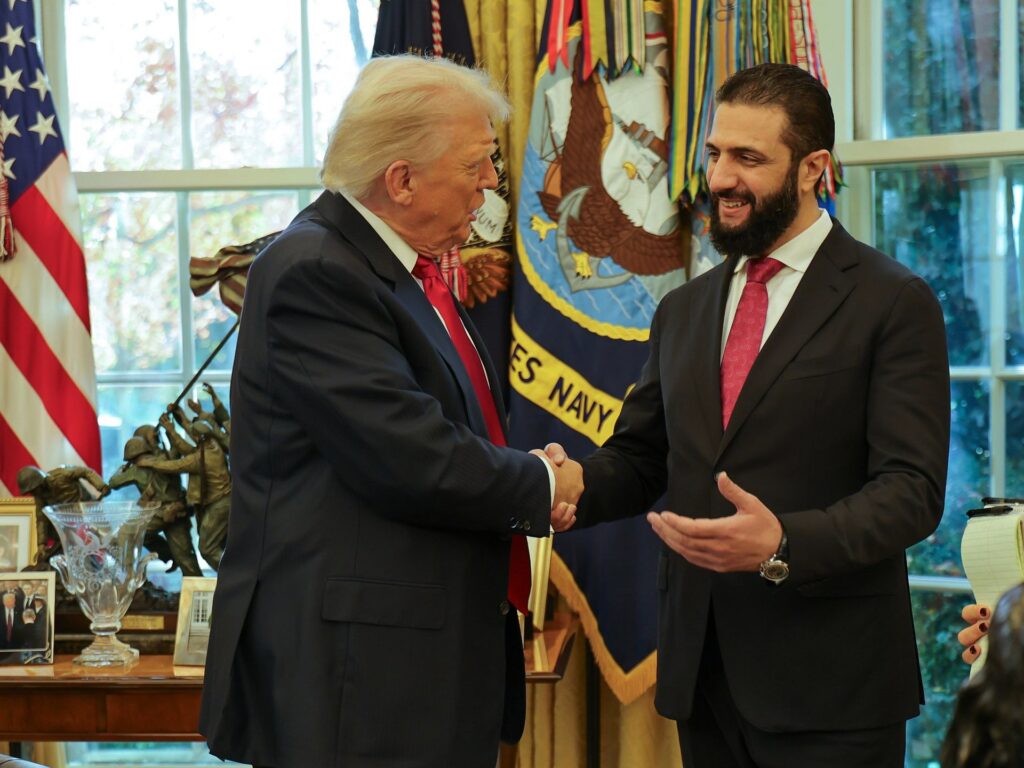
In a significant development amidst ongoing conflicts in Syria, former U.S. President Donald Trump publicly praised Syrian President al-Sharaa following a recent military offensive against the Syrian Democratic Forces (SDF). This unexpected commendation underscores the complex dynamics and shifting alliances shaping the geopolitical landscape in the region.
The Syrian President, al-Sharaa, has been a pivotal figure in the Syrian conflict, leading government efforts to reclaim territories and strengthen state control. The offensive against the SDF, a Kurdish-led militia group that has been a key player in the region, marks a critical phase in the Syrian government’s campaign to consolidate power.
The Syrian Democratic Forces, backed by international allies in the fight against terrorism, particularly the United States, have controlled significant areas in northern and eastern Syria. The offensive has raised concerns about potential escalations and the humanitarian impact on civilians in the contested zones.
President al-Sharaa’s leadership during this campaign has been characterized by strategic military maneuvers and political rhetoric aimed at reinforcing Syria’s sovereignty. His actions have drawn attention both within the region and internationally.
Adding to the intrigue, al-Sharaa is scheduled to visit Moscow on Wednesday to meet with Russian President Vladimir Putin. Russia has been a staunch ally of the Syrian government, providing military support and diplomatic backing throughout the conflict. The upcoming meeting is expected to address the ongoing offensive, future military cooperation, and broader strategic objectives in Syria.
The timing of Trump’s praise, aligned with al-Sharaa’s diplomatic engagement in Moscow, highlights the intricate interplay of global powers and regional actors. It may signal a recalibration of U.S. perspectives or a nuanced approach to the Syrian conflict backdrop.
Analysts suggest that Trump’s comments could be aimed at undermining current U.S. foreign policy or influencing domestic political narratives by highlighting successes of a regime that has traditionally been at odds with American interests.
Meanwhile, Russia’s role remains central as Moscow continues to serve as a key mediator and supporter of the Syrian regime. The al-Sharaa-Putin meeting is likely to solidify Russia’s influence and address mutual concerns regarding the SDF and broader regional stability.
The military offensive has reportedly involved intense clashes, with both sides incurring significant casualties. International humanitarian organizations have expressed alarm over the situation, urging all parties to prioritize civilian safety and adherence to international law.
The Syrian conflict, now in its second decade, continues to be a multifaceted crisis involving numerous internal and external actors. Developments such as these underscore the fluidity of alliances and the ongoing contest for power and influence in the Middle East.
As the situation unfolds, the international community watches closely, assessing the implications for peace prospects, regional security, and the lives of millions affected by the prolonged conflict. The forthcoming discussions in Moscow could have far-reaching consequences for the strategic balance in Syria and beyond.
In summary, the praise from Donald Trump toward President al-Sharaa, coinciding with the latter’s forthcoming meeting with Vladimir Putin, marks a noteworthy episode in the complex Syrian theatre, reflecting the evolving nature of international relations and conflict dynamics in the region.