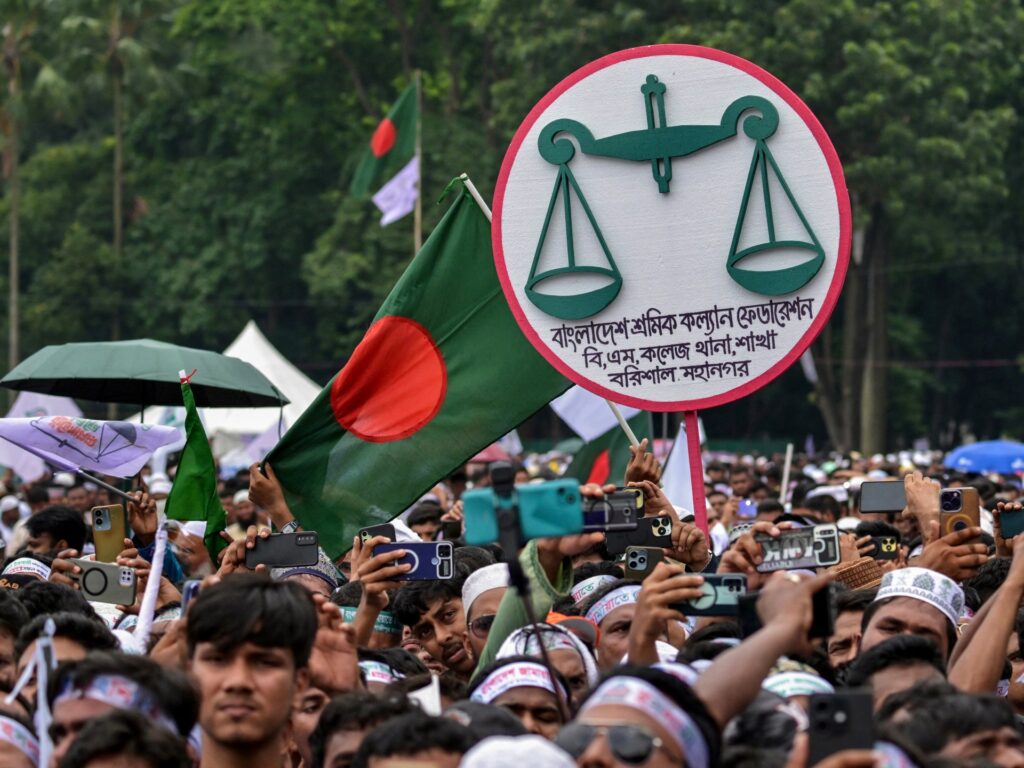
Bangladesh’s Jamaat-e-Islami, the country’s oldest Islamist political party, is poised for a historic moment. For the first time in its tumultuous and often controversial history, the party has a real chance of leading Bangladesh as the head of the ruling alliance. This development marks a significant shift in the country’s political landscape, raising questions about the party’s ideology, past, and future potential as a national leader.
Jamaat-e-Islami was founded in the mid-20th century and has long been a vocal advocate for the implementation of Islamic principles in governance. Over the decades, the party has been both influential and divisive, especially notable during Bangladesh’s independence war in 1971, when factions within Jamaat opposed the liberation movement. This history has led to widespread criticism and legal challenges against several of its leaders, including accusations of war crimes.
Despite these controversies, Jamaat-e-Islami has maintained a loyal political base, particularly among conservative and religious voters. Their platform centers around promoting Islamic values, social justice based on Islamic law, and an opposition to Western cultural influences. The party’s ability to organize grassroots support has remained strong, allowing it to sustain electoral relevance even when marginalized by mainstream political forces.
In recent years, Jamaat-e-Islami’s political strategy has evolved. It has allied with other opposition parties to increase its influence within Bangladesh’s multiparty system. The current political climate, characterized by growing disenchantment with traditional secular parties, has created an opening for Jamaat to expand its appeal. Increased public concern over economic issues, corruption, and cultural identity has driven some voters toward Islamist platforms, seeing them as a solution to systemic problems.
The possibility of Jamaat-e-Islami leading the country stems from its role in forming a ruling coalition. If the alliance wins parliamentary elections, Jamaat’s leaders could secure key ministerial positions or even the premiership. This scenario, while still uncertain, reflects the party’s improved political fortunes and strategic partnerships.
However, questions remain about how Jamaat-e-Islami would govern if given the mandate. Critics worry about the party’s past human rights record and whether it would uphold Bangladesh’s secular constitution. Supporters argue that Jamaat’s leadership could bring stability, moral governance, and economic reforms based on social justice.
International observers and regional governments are closely monitoring Bangladesh’s political developments. The prospect of an Islamist party leading a predominantly Muslim country in South Asia brings both hopes and concerns. The world watches to see if Jamaat-e-Islami can reconcile its ideology with the demands of modern governance and pluralistic democracy.
In conclusion, Bangladesh’s Jamaat-e-Islami is at a crossroads. With a historical opportunity to lead the nation, it must navigate its controversial legacy and the complexities of coalition politics. The outcome of upcoming elections could redefine Bangladesh’s future, marking a new chapter for an Islamist party that has long been at the margins of power but now stands poised to possibly shape the country’s destiny.