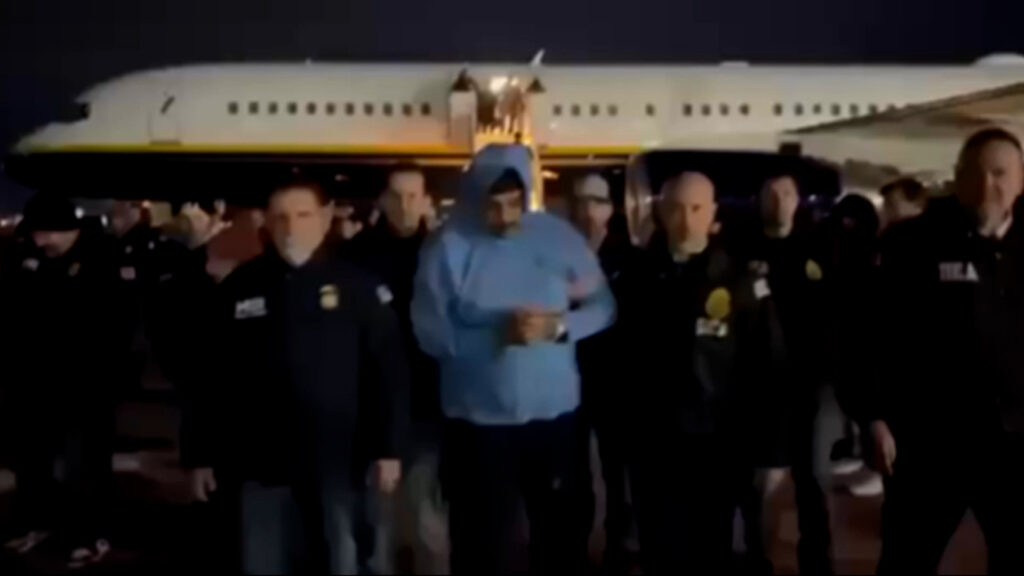
A video circulating widely across global news platforms and social media appears to show Venezuelan President Nicolas Maduro arriving at a Drug Enforcement Agency (DEA) detention center in New York, a development that, if confirmed, would send seismic shockwaves through international diplomacy and the volatile political landscape of Latin America. The grainy footage, whose authenticity is currently under intense scrutiny, depicts an individual strongly resembling the embattled Venezuelan leader being escorted by plainclothes officers into a secure facility, believed to be a high-security DEA installation.
This purported arrest comes years after the United States Department of Justice indicted Maduro and several top Venezuelan officials on charges of narcoterrorism, drug trafficking, and corruption in March 2020. At the time, the US State Department offered a reward of $15 million for information leading to Maduro’s arrest and conviction, characterizing him as the head of a “narco-terrorism partnership” with the FARC dissident group. The allegations painted a picture of a state deeply involved in moving cocaine through Venezuela to the US.
While details surrounding the circumstances of Maduro’s alleged apprehension remain shrouded in mystery, speculation is rampant. Unconfirmed reports suggest a sophisticated, covert operation, potentially involving international intelligence assets, culminating in his transfer to US soil. The suddenness of the video’s emergence, juxtaposed with the long-standing US pursuit of Maduro, fuels theories ranging from an elaborate defection to a meticulously planned capture from a third country, or even an internal coup facilitating his handover. The lack of an official statement from either Washington or Caracas only intensifies the enigma surrounding the footage.
In Caracas, state television channels maintained their regular programming, initially offering no acknowledgment of the viral video. However, sources within the capital reported an immediate tightening of security around Miraflores Palace and other key government buildings. Opposition figures, long suppressed and often exiled, have begun to cautiously react, with some expressing cautious optimism while others warn of potential instability and a power vacuum. The ruling United Socialist Party of Venezuela (PSUV) would likely decry the event as a blatant act of aggression and a violation of international law and Venezuelan sovereignty, if the reports are confirmed, potentially mobilizing supporters to protest any such development.
Internationally, the alleged capture of a sitting head of state on charges of drug trafficking is unprecedented in modern history, particularly involving a country with which the US has no formal diplomatic relations. Reactions from world capitals are anticipated to be varied. Allied nations of the United States might express support for the rule of law and the fight against drug crime, while countries like Russia, China, and Cuba, traditional allies of the Maduro regime, are expected to vehemently condemn the action as an illegal abduction and a violation of national sovereignty. The Organization of American States (OAS) and the United Nations would face immense pressure to address the legal and geopolitical ramifications.
Should the video be authenticated and Maduro formally processed through the US legal system, it would mark a watershed moment. The legal proceedings would undoubtedly be complex, drawing global attention to the inner workings of the Venezuelan state and potentially exposing a vast network of corruption and illicit activities. Politically, Venezuela would be plunged into an even deeper crisis. The question of succession, the role of the military, and the potential for civil unrest would become paramount. The path to a democratic transition, long stalled, could either be accelerated or derailed into further chaos, depending on how internal and external actors navigate this delicate juncture.
The implications extend beyond Venezuela’s borders. It could embolden international efforts against leaders accused of state-sponsored criminality, setting a powerful precedent. Conversely, it could also be seen by some as an overreach of US jurisdiction, further fueling anti-American sentiment in certain regions. The event underscores the enduring tension between national sovereignty and international justice, and the lengths to which powerful nations are willing to go to enforce their laws against perceived adversaries.
As the world awaits official confirmation and clarification, the video of President Maduro’s purported arrival at a DEA facility has already ignited a firestorm. It forces a reckoning with the complex layers of power, justice, and international relations, promising a turbulent period ahead for Venezuela and the wider international community. The authenticity of the video and the true story behind it will undoubtedly become one of the most significant geopolitical narratives of the year.