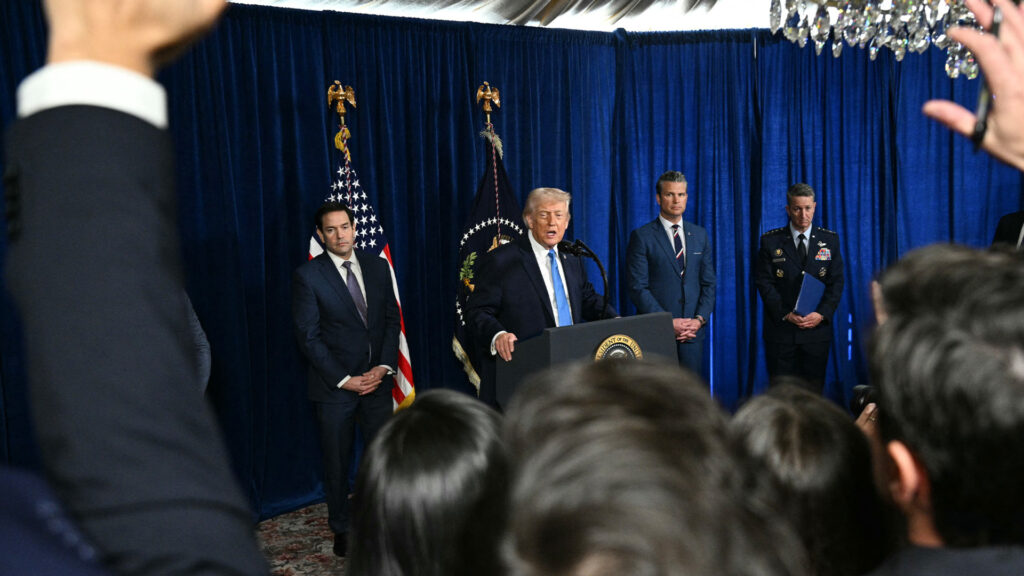
Former President Donald Trump has once again injected a highly provocative and contentious proposal into the global discourse, declaring unequivocally that the United States should “take back” Venezuela’s vast and lucrative oil reserves. This audacious assertion is predicated on his belief that these immensely valuable natural resources ought to be directly utilized to reimburse Washington for what he characterizes as past expenditures and various efforts related to the troubled South American nation. This forthright statement, delivered during a recent public appearance, emerges against a complex backdrop of persistent geopolitical tensions, severe and prolonged economic distress within Venezuela, and an ongoing, profound humanitarian crisis that has gripped the country for years.
Trump’s comments, echoing a pattern of assertive and often unconventional foreign policy rhetoric, conspicuously underscore a long-standing philosophical approach to international relations that prioritizes American interests through direct action and and at times unilateral resource control. His argument is rooted in a transactional perspective, suggesting that the U.S. has made significant investments – implicitly through diplomatic initiatives, various forms of aid, or interventions aimed at influencing Venezuelan political outcomes – and therefore possesses an inherent right to recoup these substantial expenditures directly from Venezuela’s immense oil wealth. This specific stance notably mirrors previous controversial declarations where the former president advocated for similar, direct actions concerning natural resources in other resource-rich global regions.
Venezuela, a nation endowed with the planet’s largest proven oil reserves, has paradoxically witnessed the catastrophic collapse of its once-thriving and robust oil industry. This precipitous decline is largely attributable to a confluence of factors, including years of profound governmental mismanagement, rampant corruption that has permeated state institutions, and a sustained campaign of stringent U.S. economic sanctions. The cumulative impact of these issues has plunged the country into a devastating economic crisis, manifesting in hyperinflation, widespread shortages of essential goods and services, and a mass exodus of its population, all of which have dramatically exacerbated an already dire humanitarian situation. The United States has historically maintained a staunch position against the Nicolás Maduro government, notably recognizing opposition leader Juan Guaidó as the interim president for a period, although this intricate and often shifting policy has undergone significant recalibration in recent times.
The very notion of one sovereign nation unilaterally “taking back” or appropriating the natural resources of another, independent state raises a myriad of profound and deeply troubling questions under the established framework of international law. Fundamental principles of national sovereignty unequivocally dictate that every country possesses exclusive and inalienable rights over its own natural resources, an bedrock tenet of the international system. Any unilateral actions undertaken to seize, control, or effectively expropriate another nation’s assets without explicit consent, a clear international mandate, or a resolution from a recognized global body, would be universally perceived as egregious violations of sovereignty. Such moves would almost certainly trigger widespread international condemnation, invite severe diplomatic repercussions, and initiate formidable legal challenges within international tribunals. Indeed, implementing such a policy would represent an unprecedented and highly aggressive act in contemporary international relations, particularly in the absence of an outright declaration of war or a universally sanctioned international intervention.
From an economic perspective, such a declaration, were it ever to transition from rhetoric to concrete action, would undoubtedly send unprecedented shockwaves reverberating throughout already volatile global energy markets. While the sheer logistical and practical feasibility of physically seizing Venezuela’s extensive oil infrastructure and subsequently managing its extraordinarily complex extraction, refining, and distribution operations remains highly dubious, the mere credible threat of such an action introduces an entirely new and perilous layer of geopolitical and economic uncertainty. For Venezuela, whose critically ailing economy remains almost entirely dependent on oil exports for its national revenue, any direct or indirect attempt to confiscate or undermine its primary revenue stream would inevitably deepen its already catastrophic economic crisis, potentially leading to further widespread social unrest and profound political instability.
The international community’s reactions to such a dramatic and aggressive proposal would almost certainly be swift, unified, and overwhelmingly negative, particularly from nations that steadfastly champion the principles of national sovereignty, non-intervention, and adherence to international legal norms. Major global powers such as Russia and China, both of whom have cultivated significant economic ties and wield considerable political influence within Venezuela, would undoubtedly oppose such a move with intense diplomatic and economic pressure. Even within the United States, such a radical policy would undoubtedly ignite a fierce domestic debate, drawing sharp criticism from seasoned diplomatic circles, foreign policy experts, and those deeply concerned with preserving America’s standing and credibility in upholding the established international order.
Historically, disputes over natural resources have frequently served as significant flashpoints for international conflict and tension. While the outright seizure of national assets by a powerful foreign entity is a relatively rare occurrence in contemporary international relations, the very rhetoric itself powerfully illuminates the persistent and often inherent tension between powerful global actors and resource-rich developing nations. The formidable practical challenges inherent in attempting to implement such a policy – ranging from overcoming potential military resistance and navigating an exceptionally complex web of international legal frameworks to mitigating the risk of widespread sabotage of critical infrastructure – are immense, rendering it a scenario that is not only highly improbable but, in many respects, virtually impossible without triggering a large-scale, potentially catastrophic military confrontation.
In conclusion, Donald Trump’s recent assertion concerning the appropriation of Venezuela’s oil, framed as a mechanism for reimbursement, is far more than mere political rhetoric; it is a statement profoundly laden with far-reaching geopolitical implications. It directly challenges the fundamental tenets of international law, risks further and severely destabilizing an already exceptionally fragile region, and would undoubtedly provoke an immediate and powerful backlash from the vast majority of the international community. While serving as potent and attention-grabbing political messaging for a domestic audience, the practical and ethical execution of such an aggressive policy remains extraordinarily improbable. This highlights in stark terms the inherent complexities, profound dangers, and ultimately, the unfeasibility of unilateral resource claims in the interconnected and legally bound modern world.