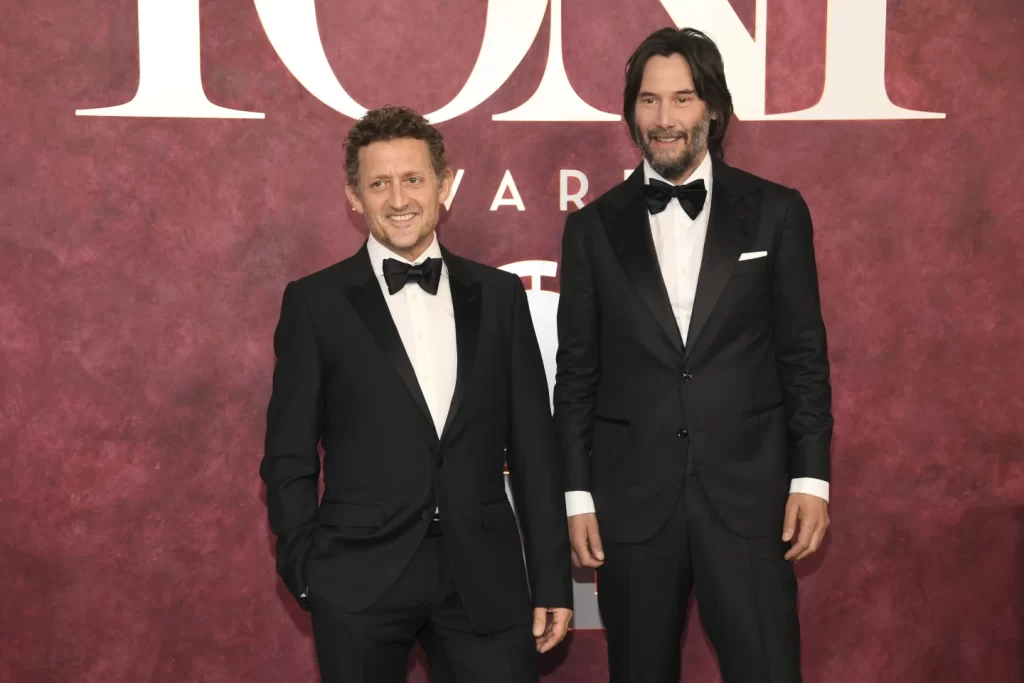
NEW YORK — Thirty-six years after he teamed up with Keanu Reeves to play a pair of well-intentioned dimwits on the big screen, Alex Winter finds himself beside the same guy on Broadway playing another set of sweet, low-bulbed guys.
The two actors have had different trajectories in the years since they kicked off the “Bill & Ted” movie franchise — including Winter becoming a skilled indie director — but have remained close and are reteaming for the existential stage masterpiece “Waiting for Godot.”
“That similarity is not lost on any of us,” says Winter. “We are inescapably Bill and Ted. So there’s going to be an aspect of that in there because it’s who we are.”
Playwright Samuel Beckett’s work is two acts of artful anticipation, a play filled with vaudevillian high jinks that mask increasingly agitated desperation. Two tramps, named Estragon and Vladimir, are awaiting the arrival of the mysterious title character. But will he ever show up?
Classic parts and pairs
Estragon is hysterically dense and bit more combative than Vladimir, who is more of a hand-wringer, contemplative, more sweet-tempered. They amuse each other. They debate whether or not to hang themselves. They eat turnips.
When Reeves came up with the idea of reuniting with Winter for the play, neither actor knew which part was right for them. They met in a hotel room for several days in New York, reading the play with director Jamie Lloyd.
One day, Reeves played Estragon; the next day they swapped. “By the third day, it was clear who was who. It just seemed clear to all of us, including Jamie,” says Winter, who landed on Vladimir. “I think it’s right temperamentally.”
Over the years, there have been many ways to capture the tone of “Waiting for Godot,” with a popular approach leaning into the vaudeville, making the two tramps into sort of Laurel and Hardy types.
Winter and Reeves weren’t attracted to that, instead inspired by Beckett’s real life. “Keanu and I were very interested in playing these characters in a grounded way, meaning not letting the absurdism overtake the humanity.”
Winter points out that Beckett worked for the French Resistance during World War II, and he and his soon-to-be-wife had to flee for their lives into rural France when the Nazis discovered their cell.
“Vladimir and Estragon are basically Samuel Beckett and his wife on the run,” he says. “They spent a year in the French countryside living in ditches and eating root vegetables and dreaming of sleeping in a loft in a barn with hay.”
Director of ‘Adulthood’
Winter just coincidentally has a new movie this fall at the same time he returns to Broadway, “Adulthood,” a dark comedy he directed starring Josh Gad and Kaya Scodelario.
It’s about a pair of siblings who discover a body bricked up in their mother’s home and must scramble to not let this revelation destroy their family. Underneath the comedy, it explores generational sins and modern family stress.
Winter was inspired by Alfred Hitchcock’s “Shadow of a Doubt” and Luis Buñuel’s “Los Olvidados.” “It has kind of a very serious subtext with a much lighter, more farcical surface,” he says. That sort of perfectly describes “Waiting for Godot” and the “Bill and Ted” movies, too.
Winter and Reeves first met as 20-somethings in the late ’80s doing “Bill & Ted’s Excellent Adventure.” Reeves became the blockbuster action star of franchises like “The Matrix” and “John Wick,” while Winter became an actor, director and documentarian of such movies as “Zappa.”
Winter and Reeves became close friends during the audition process for “Bill & Ted’s Excellent Adventure” because they had similar tastes in literature and theater. They both grew up on the East coast with artistic, cultured parents and they shared a love of playing bass, motorcycles, Schopenhauer and Kierkegaard.