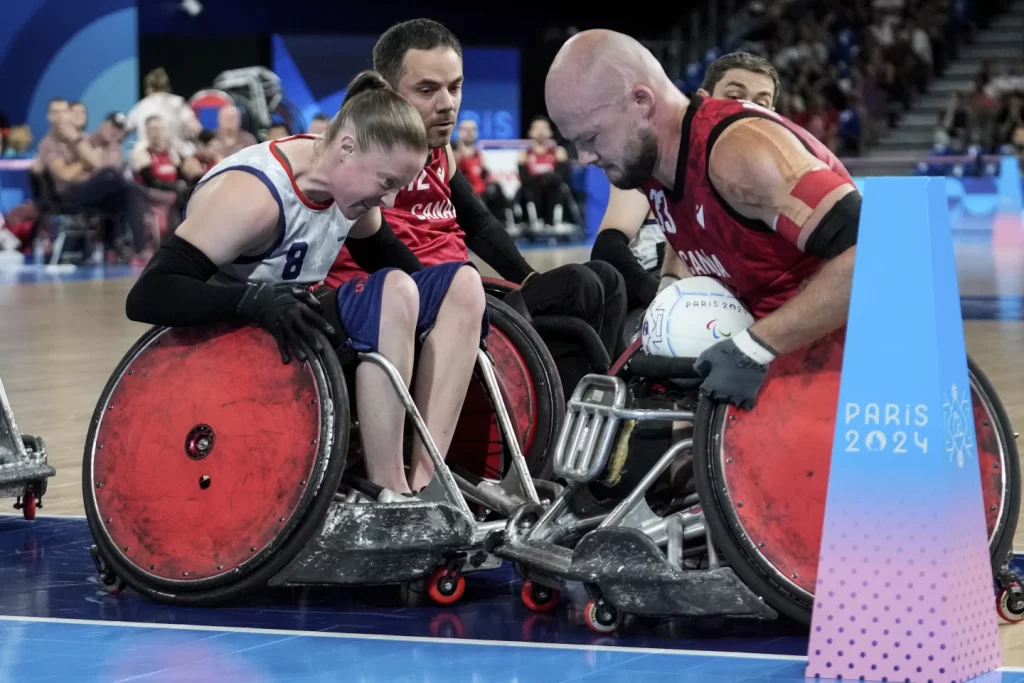
PARIS — When told by the stadium announcer that they were witnessing history, the Paris spectators roared and applauded. Not that the woman making history actually noticed: Sarah Adam was far too occupied — merrily slamming her wheelchair into other players, all of them men, and zipping across the court to score try after try.
Adam is blazing trails in France’s capital as the first American woman to compete in the most rough-and-tumble of the 22 sports at the Paralympics — wheelchair rugby.
She was in the starting lineup when Team USA kicked off its campaign on Thursday — against familiar foe Canada. Her six tries in 16 busy-as-a-bee minutes on court didn’t just contribute to a 51-48 victory in the group-stage game. Her belief and hope is that she’s also opening minds by showing that women can thrive in the mixed-gender but male-dominated sport.
“There’s a place for us on that court,” she said. “We need to have more females out there, and being seen, so that people know that this is an option for them.”
Other women in wheelchair rugby are barrier-busting, too. Australia has an unprecedented three women on its 12-player team in Paris. Denmark, Germany and Japan also have female players, leaving host nation France, defending champion Britain and Canada as the only teams that don’t.
The total of eight women is double the number that made wheelchair rugby teams at the Tokyo Paralympics in 2021. But the 88 men in Paris still outnumber the women 11-to-1, so there’s plenty of room and appetite for more progress.
“It’s going too slowly,” said Ella Sabljak, who scored one try in her 6 1/2 minutes on court in Australia’s opening game against Britain, which pulled away in the fourth quarter to win 58-55.
“We’re definitely paving the way in Australia,” she said. “Other teams definitely need to catch up, understand and recognize that women add value to the game. You know, we’re not burdens. We’re not different. We’re not difficult. We are, like, elite athletes amongst other elite athletes. And so I think people need to change their perspective on what women bring to the table.”
Adam was more upbeat.
“We’re getting more visibility,” she said. “The first step, that’s what matters.”
At the Paralympics, the sport classes athletes according to their physical abilities, with a score of 0.5 for the least able players, increasing by half-point increments to 3.5 for the most able. Together, the four players that teams field at any one time cannot have a combined total score above 8 — meaning that the most able players must team up with others less able.
But the sport rewards teams that field women — allowing them an extra half point for each woman they have on court. Against Canada, that rule allowed the U.S. team to start with Adam and Josh Wheeler, both classed at 2.5, and defender Jeff Butler, who added 0.5, but still leaving room for captain Chuck Aoki, classed at 3.0. He went on to become the team’s top scorer, contributing 21 tries.
“It levels the playing field,” Adam said of the rule.
Sabljak, the Australian, said: “It increases our chances of participating because it’s always been really male dominated.”
“It makes me feel like I am valued,” she added.
Andrea Bundon, who studies female participation in Paralympic sports, says wheelchair rugby is using the rule to encourage teams to look for and develop female players, who can then give them an extra edge on court.
“There is value in having the women and men compete together — they can appreciate each other’s athleticism and see that women are capable of competing at that level,” Bundon said in written comments to The Associated Press. She works at the University of British Columbia in Canada, specializing in the mechanics and anatomy of human movement.
“The position women occupy in this sport is still very precarious,” Bundon cautioned. But with Paralympic sports getting increasing attention, “the fact that these women are going to have the opportunity to showcase their athleticism and talent is good news and should be celebrated — even as we demand better!”