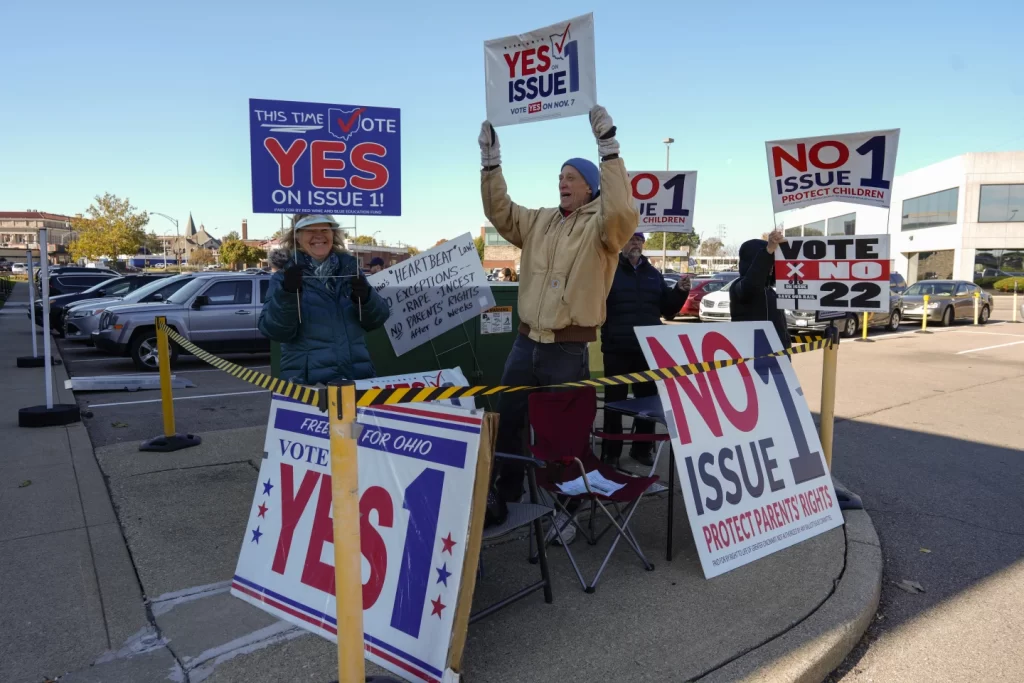
COLUMBUS, Ohio — It’s been nearly four decades since liberal-leaning justices held a majority on Ohio’s supreme court.
Democrats hope this is the year that changes, in a campaign that will begin to take shape with Tuesday’s primary. They’ll be choosing a candidate to compete for an open seat on a court that will be at the center of fights over redistricting, public education, health care, environmental issues and criminal justice.
But it’s abortion that Democrats hope will be a game-changer in a state that has swung from centrist to reliably Republican over the past decade. The Ohio Supreme Court is expected to shape how a voter-approved constitutional amendment that enshrined reproductive rights in the state constitution will be implemented.
“I don’t think it’s an overstatement to say reproductive freedom and abortion access is at stake in this state supreme court race,” said Kellie Copeland, executive director of Pro-Choice Ohio.
It will be a consequential year for state supreme court seats around the country, with 80 of them on the ballot in 33 states. Ohio is among only a few states where it’s possible for voters to flip partisan control of their supreme court, and already activists and the major parties are bracing for an intense and expensive campaign.
Democrats will be defending two seats on the Ohio court this year, while a third is open. Only the open seat, where two Democrats are campaigning for the right to face a Republican judge in November, has a competitive primary.
They would have to win all three races in the fall to flip the court’s 4-3 majority. That’s a tall task in a state where Republicans hold every statewide office, supermajorities in the Legislature and twice voted convincingly for Donald Trump for president.
But Ohio Democrats see a possible path to cracking the Republican Party’s longstanding lock on all three branches of state government. In November, the amendment enshrining an individual’s right to make reproductive health-care decisions — including on abortion, miscarriage care, contraception and IVF — won with 57% support.
“Voters may not realize that even if they pass this amendment for abortion rights, these fights over existing abortion laws are all still ongoing in the court system, and the Ohio Supreme Court holds power in interpreting the amendment how they see fit,” said Jessie Hill, a law professor at Case Western Reserve University School of Law in Cleveland who consulted for advocates of the amendment, known as Issue 1. “That is a huge amount of power.”
Aaron Baer, president of the Center for Christian Virtue in Ohio, said the partisan makeup of the court will largely determine how the amendment gets implemented.
“We just passed an amendment that says we’re not going to be able to have abortion restrictions prior to viability,” said Baer, who served on the board for Protect Women Ohio, the Issue 1 opposition campaign. “But are you going to see judges take this amendment and try to jam a California agenda onto Ohioans?”
State supreme court races across the country have become increasingly costly in recent years. During a Wisconsin Supreme Court race last year, spending topped $42 million, nearly triple the previous record for any state supreme court contest. A Democratic-backed Milwaukee judge won that race, giving liberals control of the court with the fate of the state’s abortion ban on the line.
Former Ohio Democratic Party Chair David Pepper said the party’s success in Wisconsin is bolstering its hopes in court races across the nation — particularly in Ohio, where party control is in play.
“I used to have to beg people nationally to understand why these supreme court races mattered,” he said. “After Wisconsin, these are no longer some hidden, low-interest campaigns.”
He said the races began to gain greater attention after the 2022 U.S. Supreme Court decision that ended the constitutional right to abortion, turning the issue back to the states.
In Michigan, where Democrats hold a 4-3 court majority, one Democrat and one Republican incumbent are up for election this year, though without party labels. The minimum wage and clean energy goals are among the central issues there.
In Ohio, Republicans have controlled a majority on the state Supreme Court since 1986. The court has served as final arbiter on disputed laws passed by GOP supermajorities in the Legislature and signed by Republican governors, as well as on decisions of the Republican-controlled redistricting commission.
The commission’s votes led to a protracted legal dispute in which the court repeatedly declared its maps unconstitutionally gerrymandered. After that fight, a bipartisan coalition is gathering signatures for a constitutional amendment in November that would remove politicians from Ohio’s map-making process. Their campaign could elevate redistricting as another major issue in the supreme court contests this fall.
The one contested primary in Tuesday’s election features two Democrats, 8th District Court of Appeals Judge Lisa Forbes and Judge Terri Jamison, a 10th District Court of Appeals judge who ran and lost two years ago. The winner will face Republican Dan Hawkins, a judge on the Franklin County Court of Common Pleas, for the one open seat.
During a recent candidate forum, both Democrats hinted at how important it could be to have a Democratic majority on the court to interpret laws coming from a legislature that is gerrymandered to give Republicans a supermajority.
Forbes, who has been endorsed by the state Democratic Party, said she was motivated to run to assure the court serves as an effective firewall.
“One of the things that I am concerned about is, you hear legislators talking openly about trying to avoid implementing, or working around, enacted laws — the constitutional amendment that the citizens of Ohio overwhelmingly enacted — and that gives me concern for our democracy,” she said. “When people speak, it is the legislators’ job to do their will.”
During the same event, Jamison said Ohio’s judiciary is an independent branch of government that should never defer to the Legislature.
“We have no secondary position to them,” she said.
Forbes, Jamison and Hawkins are seeking the seat currently held by Republican Justice Joseph Deters, after Deters chose instead to challenge Democratic Justice Melody Stewart for her seat this fall. The decision allows Deters to seek a spot on the court that runs until 2030, four years longer than his current term.
In the third contest, incumbent Justice Michael Donnelly, a Democrat, will face a challenge from Republican Megan Shanahan, a Hamilton County Common Pleas Court judge, in November.
Deters’ move could increase Democrats’ vulnerability and even allow Republicans to gain more seats on the high court than they already have. The former state treasurer and county prosecutor shares Stewart’s incumbency advantage but stands to benefit from Ohio’s conservative political leanings: Republicans represent roughly 54% of the electorate compared with Democrats’ 46%.
Party affiliation matters now in Ohio’s court races, thanks to a 2021 Republican-backed law that requires judicial candidates to run with party labels.
Ryan Stubenrauch, a Republican consultant to Shanahan’s campaign, said Ohio’s conservative-leaning politics will make it difficult for Democrats to win any court race that includes party labels. He also said abortion appears to have already faded as a top campaign issue.
“It would be the hope and prayer of Democrats to turn the supreme court race and every other race in Ohio into an abortion-centered race,” he said. “To me, that seems extremely unlikely to work because voters feel like abortion was addressed with Issue 1 and enough time will have passed that the concern will have been forgotten.”