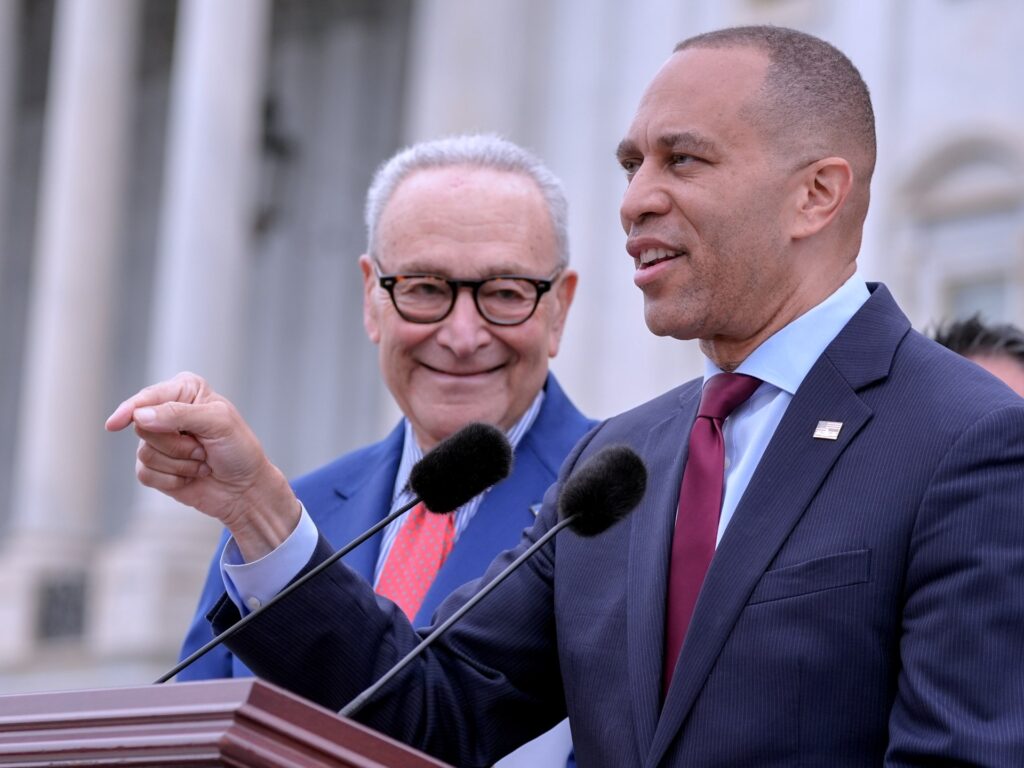
As the United States gears up for the next Congressional session, the Democratic Party is widely expected to maintain the current leadership with Senate Majority Leader Chuck Schumer and House Majority Leader Hakeem Jeffries continuing in their prominent roles. This anticipated continuity reflects strategic decisions within the party aimed at consolidating power and navigating an increasingly complex political landscape.
Chuck Schumer has been an influential figure in the Senate, known for his adeptness at legislative maneuvering and coalition-building. His leadership has been pivotal during significant legislative milestones, and many Democrats see his continued role as essential for maintaining momentum on key policy initiatives. Schumer’s experience and established relationships in the Senate provide stability at a time when the chamber remains closely divided.
Similarly, Hakeem Jeffries has emerged as a dynamic force within the House of Representatives. As the first Black leader of the House Democratic Caucus, Jeffries represents both symbolic and practical leadership for a party aiming to reflect the nation’s diversity. His ability to unify various Democratic factions has been critical in promoting the party’s agenda. Keeping Jeffries in power signals a commitment to inclusive leadership and progressive policy priorities.
Despite the expected leadership continuity, this prospect is not without internal challenges. The party has been experiencing long-running tensions between its progressive wing and more moderate members. These divides often manifest in policy disagreements and competition for committee assignments, but they also influence leadership dynamics. Some party members advocate for new faces or changes in the leadership approach to better address emerging priorities and voter expectations.
Even so, the value placed on experience and proven political acumen tends to outweigh these calls for change. The Democratic leadership believes that maintaining Schumer and Jeffries will help the party present a united front despite internal disagreements. This unity is seen as critical in countering strong Republican opposition and advancing the Democratic legislative agenda.
Moreover, retaining these leaders reflects a strategic calculation about the upcoming elections and policy battles. Schumer and Jeffries have demonstrated skillful navigation through the legislative process and have forged important alliances that are likely to prove beneficial in the event of a closely divided Congress. Their leadership is also expected to provide continuity in efforts such as climate policy, healthcare reform, and voting rights protections.
The Democratic Party’s leadership contest and the broader intra-party dynamics highlight the challenges of balancing diverse viewpoints while striving for electoral and legislative success. The upcoming decision to keep Schumer and Jeffries in power exemplifies this balancing act, underscoring the party’s preference for experience and cohesion in the face of political turbulence.
In conclusion, while underlying tensions persist within the Democratic Party, the consensus leans towards preserving the existing leadership structure in the Senate and House. This choice reflects a strategic commitment to experienced leadership to guide the party through the coming challenges and to maximize opportunities in Congress amid an increasingly polarized political environment.