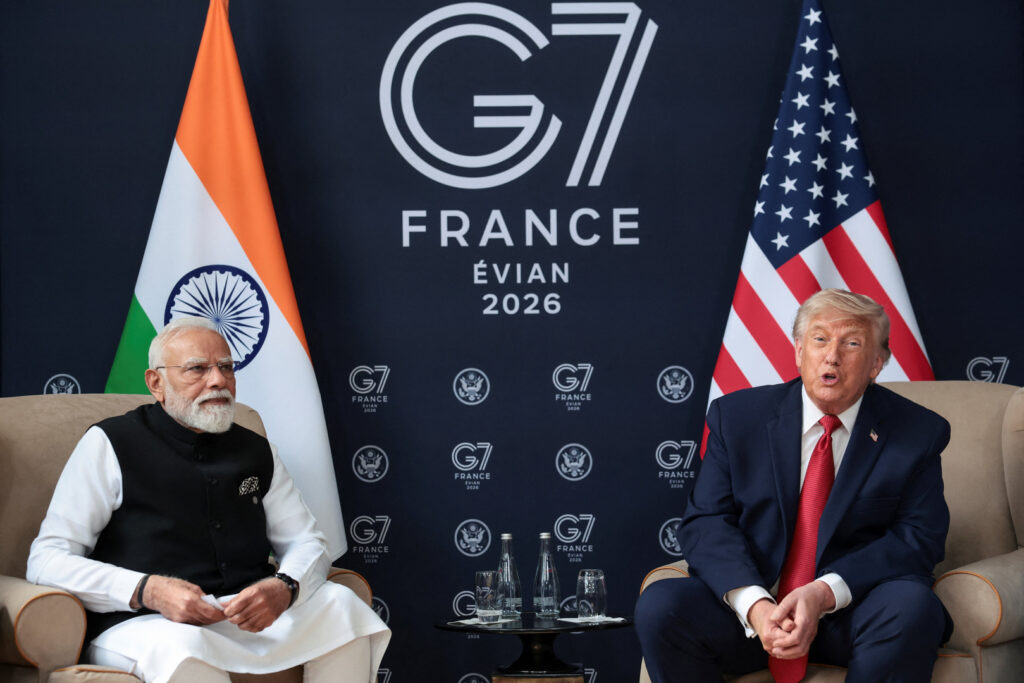
U.S. President Donald Trump attends a bilateral meeting with Indian Prime Minister Narendra Modi during the G7 Summit in Evian-les-Bains, France, June 17, 2026. REUTERS/Evelyn Hockstein
During the recent G7 summit held in France, President Donald Trump made headlines with his unexpected remarks about Indian Prime Minister Narendra Modi. In a surprising turn of phrase, Trump praised Modi using two starkly contrasting terms, referring to him both as a “killer” and an “angel.” This ambiguous compliment caught the attention of global media and sparked widespread discussion about the meaning and implications behind Trump’s words.
The G7 summit, a gathering of some of the world’s most powerful leaders, often serves as a platform for addressing major international issues as well as fostering diplomatic relationships. Trump’s comments about Modi came amidst conversations concerning geopolitical alliances, economic cooperation, and regional security.
The term “killer,” as used by Trump, was interpreted by many analysts as a reference to Modi’s strong and sometimes controversial political style. Modi, known for his decisive leadership and tough stance on policy enforcement, has been both praised for his effectiveness and criticized for his aggressive political maneuvers. Trump’s characterization could be seen as acknowledging Modi’s formidable approach to governance.
Conversely, calling Modi an “angel” suggested a recognition of his positive influence and leadership qualities. Modi has been credited with implementing transformative economic reforms in India, promoting digital innovation, and striving for development initiatives aimed at improving the lives of millions of citizens.
This dual expression by Trump reflects the complex and multifaceted nature of Modi’s leadership, which elicits varied perceptions both within India and internationally. The paradoxical labels have sparked debates about diplomatic language and the nuances of political dialogue in high-profile summits.
Critics argue that such polarizing descriptors oversimplify the challenges and achievements of a national leader, potentially misleading public opinion. Supporters, however, view Trump’s remarks as an acknowledgment of Modi’s dynamic and impactful role on the world stage.
The incident also highlights the unique communication style of Donald Trump, known for his unconventional and sometimes provocative statements. His approach often breaks diplomatic norms, aiming to capture media attention and emphasize certain viewpoints.
Following the summit, both Indian and international commentators weighed in on the remarks. Indian officials opted for a cautious response, emphasizing the continued strong ties between the United States and India. Experts suggest that despite the rhetoric, the underlying strategic partnership remains robust.
In summary, President Trump’s description of Prime Minister Narendra Modi as both a “killer” and an “angel” at the G7 summit encapsulates the complexities of international diplomacy and leadership perception. It prompts reflection on how leaders are portrayed and the impact of political rhetoric in shaping global narratives.
As relations between the two nations continue to develop, such statements underscore the need for clear and respectful communication. The world watches closely as leaders navigate the delicate balance of power, influence, and image in an increasingly interconnected political landscape.