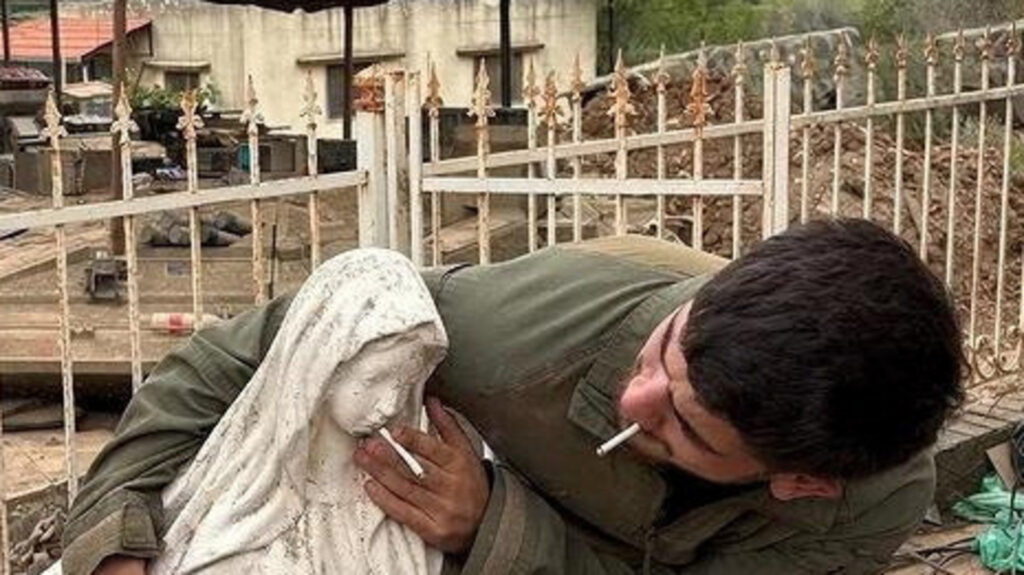
A soldier smokes and pushes another cigarette onto the mouth of a statue of the Virgin Mary in Debel, Lebanon, in this picture released May 6, 2026 obtained from social media. Social Media/via REUTERS THIS IMAGE HAS BEEN SUPPLIED BY A THIRD PARTY. NO RESALES. NO ARCHIVES. NEWS USE ONLY. VERIFICATION: Buildings' structure, statue and hills in background match satellite and archive imagery from Debel Coordinates: 33.12006, 35.36156 Date shot not confirmed but first posts found online May 5 Israeli media reported the incident Reuters was not able to verify the soldier's identity. TPX IMAGES OF THE DAY
A highly sensitive incident has emerged involving an Israeli soldier and a statue of the Virgin Mary in southern Lebanon. A photograph that has recently surfaced shows the soldier placing a cigarette into the mouth of the Virgin Mary statue, an act viewed as deeply offensive and provocative, especially in the context of the region’s religious and cultural tensions.
The image has sparked outrage among local communities and religious groups, who see the act as a blatant disrespect to one of Christianity’s most revered figures. The Virgin Mary holds significant religious importance for Christians worldwide and particularly in Lebanon, where diverse religious communities coexist.
Following the publication of the photo, the Israeli military has responded promptly by launching an official investigation into the matter. Military officials acknowledged the seriousness of the situation and emphasized their commitment to upholding ethical standards and discipline among soldiers.
According to sources, the probe will seek to identify the soldier involved, understand the circumstances surrounding the incident, and determine appropriate disciplinary actions. There have been no official statements regarding the motivations behind the soldier’s actions as the investigation is ongoing.
This incident has the potential to escalate tensions in the already sensitive Lebanese-Israeli border region. Historically, Lebanon and Israel have experienced strained relations, with occasional conflicts and uneasy ceasefires that have affected regional stability.
Religious symbols such as the Virgin Mary statue play a profound role in community identity and solidarity in Lebanon. Any perceived attack or desecration of these symbols often triggers strong reactions, including public protests and condemnation by religious leaders.
The Israeli military’s move to investigate the case swiftly highlights their awareness of the delicate nature of such incidents and the impact they could have on Israel’s image and diplomatic relations.
Local authorities in southern Lebanon have condemned the act, calling it an insult to the Lebanese people and their heritage. They have urged the international community to recognize the significance of the incident and ensure accountability.
Religious leaders from various faiths in Lebanon have also expressed concern, emphasizing the need for respect and coexistence among different religious and ethnic groups in the region.
Observers note that incidents like this can be exploited by extremist elements to fuel hatred and escalate conflicts. Thus, addressing such situations with transparency and responsibility is crucial for maintaining peace and civility.
This episode underscores the broader challenges facing soldiers in conflict zones where cultural and religious sensitivities are deeply intertwined with political struggles.
The military investigation’s outcome will be closely watched by international human rights organizations and governments concerned about the treatment of cultural and religious heritage in conflict areas.
In addition to internal disciplinary measures, this incident may prompt renewed discussions on the training and conduct standards for soldiers deployed in areas with diverse religious communities.
The Israeli Defense Forces (IDF) have historically emphasized the importance of discipline and respect for local customs; however, isolated incidents such as this test the effectiveness of such policies.
The incident occurred amidst ongoing tensions between Israel and groups in southern Lebanon, including Hezbollah, further complicating the regional security landscape.
Leaders within the Lebanese government have called for calm and restraint, warning against allowing such incidents to ignite broader hostilities.
International diplomats stationed in the region have also urged both sides to exercise caution and engage in dialogue to prevent escalation.
The role of religious symbols in conflict zones is often underestimated but remains a powerful factor in community cohesion and conflict dynamics.
This situation serves as a reminder of the importance of religious tolerance and the need to protect cultural heritage from acts that might inflame sectarian divisions.
As investigation efforts continue, the focus remains on accountability, the prevention of similar incidents, and fostering mutual respect between divided communities.
The Israeli military’s investigation process will include interviews, evidence collection, and consultations with cultural advisors to assess the full scope of the incident.
Depending on the findings, the soldier involved could face sanctions ranging from reprimands to court-martial, reflecting the seriousness of the offense.
This development has triggered widespread media coverage, stirring debates on military conduct and the responsibilities of soldiers in occupied or conflict-prone regions.
Community leaders in southern Lebanon have organized interfaith dialogues to reinforce messages of peace and tolerance.
The global Christian community has also taken note, with several churches expressing solidarity with Lebanese Christians and condemning the desecration.
The incident is a stark illustration of how individual actions can have far-reaching consequences in geopolitically sensitive environments.
Efforts to heal the resulting wounds involve collaboration between religious institutions, governmental bodies, and international organizations.
The event may influence future negotiations focused on cultural and religious protections amid the geopolitical complexities of the Israeli-Lebanese border.
As the probe unfolds, it remains a critical test for efforts aimed at maintaining discipline within military ranks and respecting the cultural fabric of conflict-affected areas.
The public and international community await transparency and justice to ensure such incidents do not undermine peace efforts.
Ultimately, this incident highlights the delicate balance required to navigate the intersecting paths of military operations, religious respect, and intercultural understanding in volatile regions.