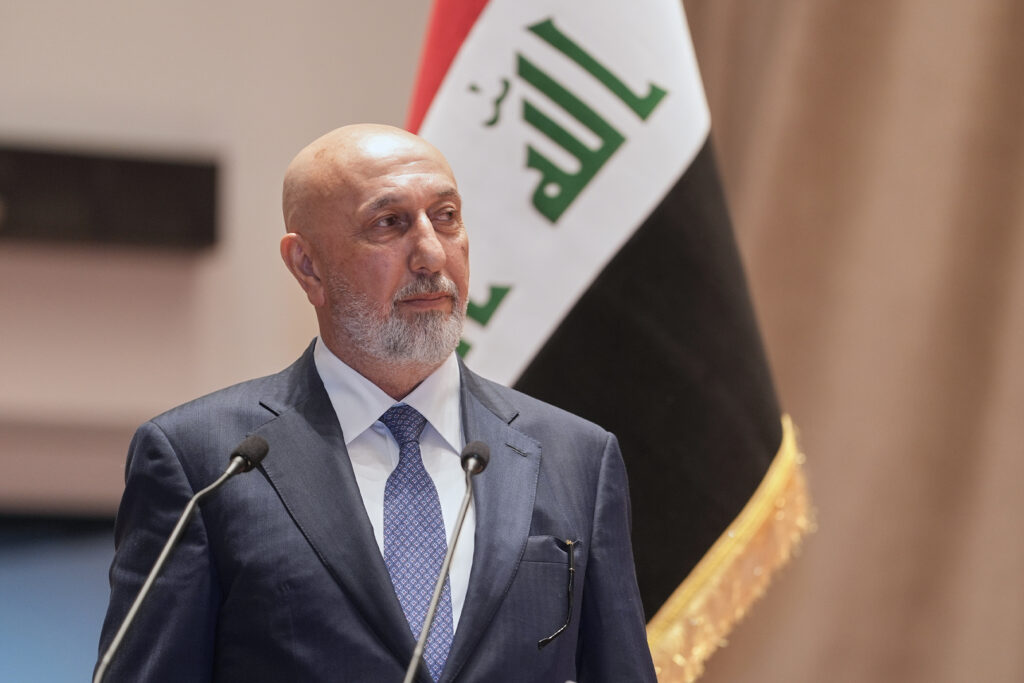
In this photo provided by the Iraqi Parliament Media Office, newly elected president of the Republic of Iraq, Nizar Amidi, speaks inside the Parliament after his election in Baghdad, Iraq, Saturday, April 11, 2026. (Iraqi Parliament Media Office via AP)
As Iraq approaches a crucial deadline, the Shia-led Coordination Framework faces mounting pressure to nominate the country’s next prime minister by Sunday, in accordance with constitutional mandates. This nomination is not just a procedural step but a pivotal moment that could determine Iraq’s political trajectory amid ongoing challenges.
The Coordination Framework, an alliance of Shia political parties, holds significant sway in Iraq’s parliamentary landscape. Their decision-making process, however, is fraught with complexities stemming from internal divisions, external pressures, and the broader geopolitical environment that shapes Iraq’s governance.
One of the primary obstacles confronting the Shia bloc is reconciling divergent interests and ambitions within the alliance. Various factions within the Coordination Framework advocate for different candidates, each embodying distinct political visions and alliances. This internal competition has delayed consensus, raising concerns about whether a nominee can be agreed upon in time.
Moreover, Iraq’s recent history of political instability and public dissatisfaction with government performance adds urgency to the nomination process. The prime ministerial candidate chosen must not only satisfy the Shia bloc’s internal dynamics but also command broader national support to effectively govern in a fragmented political landscape.
The constitution’s requirement to nominate a prime minister by Sunday sets a hard deadline, emphasizing the legal and political imperatives that the Coordination Framework must respect. Failure to meet this deadline could trigger constitutional crises or further political deadlock, exacerbating Iraq’s governance challenges.
Externally, Iraq’s Shia factions are influenced by regional powers and allies whose interests often differ or conflict. These external influences complicate the process, as candidates may be viewed through the lens of foreign alignments, affecting their legitimacy and acceptance domestically.
Despite these hurdles, the Coordination Framework’s determination to fulfill its constitutional role indicates a potential for overcoming current obstacles. The looming deadline may act as a catalyst for compromise and pragmatic decision-making, encouraging factions to prioritize national interest and political stability.
Political analysts suggest that the next prime minister’s ability to navigate Iraq’s intricate power dynamics, address security concerns, and promote economic recovery will be critical. The nominated leader will need to build coalitions across Iraq’s diverse ethnic and sectarian communities and work toward inclusive governance.
The international community watches closely, as Iraq’s stability significantly impacts regional security and global energy markets. Effective leadership emerging from the Shia bloc’s nomination could enhance Iraq’s prospects for reform and development.
In summary, while the Shia-led Coordination Framework confronts significant barriers in nominating Iraq’s next prime minister, the constitutional deadline and national imperatives provide strong incentives to resolve differences. Whether the bloc can unite behind a candidate who embodies both internal consensus and broader national acceptance remains a key question for Iraq’s political future.